
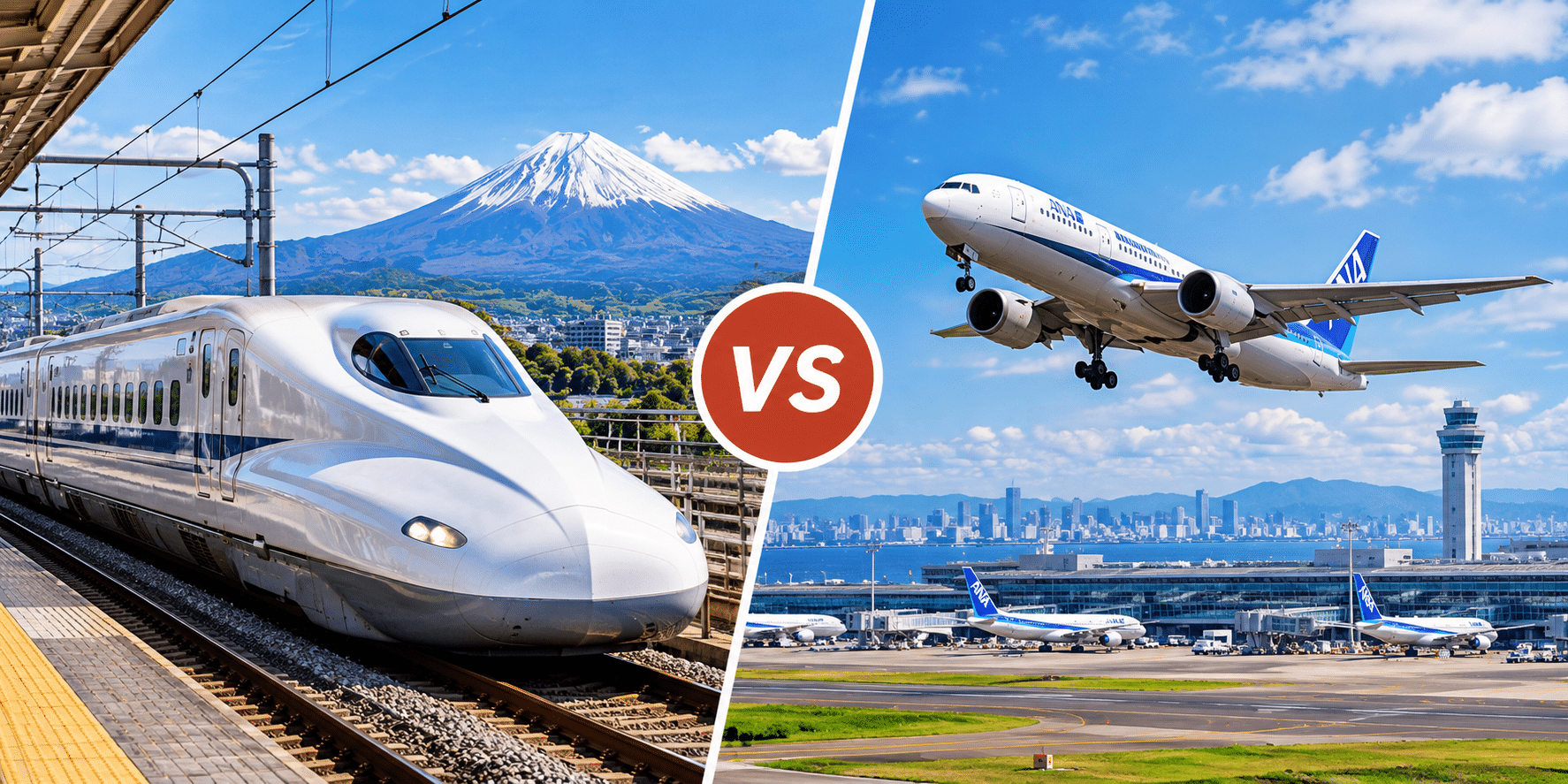
Japan is famous for its trains, and for good reason. The Shinkansen is fast, comfortable, frequent, and connects many of the country’s most popular destinations. For a first-time trip between cities such as Tokyo, Kyoto, and Osaka, taking the train often feels like the obvious choice.
But Japan is also much larger than many travelers realize. Once your itinerary stretches to Hiroshima, Fukuoka, Hokkaido, or Okinawa, domestic flights can become faster — and sometimes surprisingly affordable. On certain routes, flying can save several valuable hours. On others, a short flight looks faster on paper but loses its advantage once airport transfers, security, boarding, and baggage collection are included.
That is why comparing only the advertised train time and flight time can be misleading. The more useful question is:
Which option gets you from where you actually are to where you actually want to be with the least time, cost, and hassle?
In this guide, we’ll compare trains and domestic flights by door-to-door travel time, price, convenience, luggage, comfort, and reliability. We’ll also look at key routes such as Tokyo–Kyoto, Tokyo–Osaka, Tokyo–Hiroshima, Tokyo–Fukuoka, and Tokyo–Sapporo so you can decide when to take the Shinkansen, when to fly, and when the smartest Japan itinerary uses both.
Train vs Flying in Japan: Which Is Better?
For most journeys between Tokyo, Nagoya, Kyoto, and Osaka, the Shinkansen is usually the better choice. It takes you directly from one major station to another and avoids airport transfers, security, boarding time, and baggage collection.
Flying becomes much more attractive over longer distances. For routes such as Tokyo–Fukuoka, compare both options carefully, while for Tokyo–Sapporo and Tokyo–Okinawa, flying is usually the practical choice for most travelers. The key is to compare door-to-door travel time rather than flight time against train time.
Travel Owl Rule: If the Shinkansen takes around three hours or less, start with the train. At roughly three to four hours, compare both options. For substantially longer rail journeys, domestic flights become increasingly worth considering.
Table of Contents
The Most Important Rule: Compare Door-to-Door Travel Time
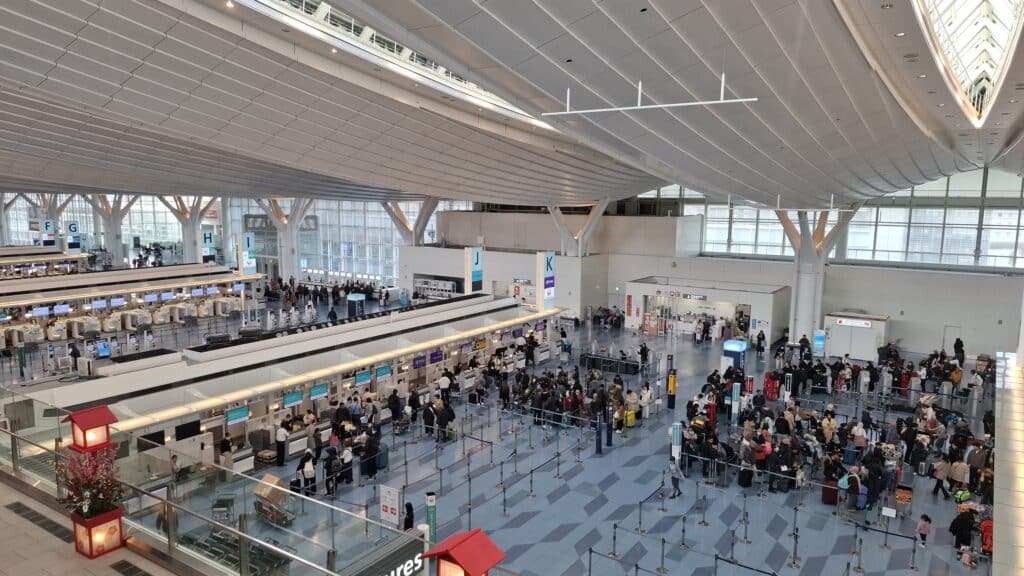
A common mistake when comparing trains and domestic flights in Japan is looking only at the scheduled journey time. A flight may take 1 hour 30 minutes while the Shinkansen takes around 3 hours — but that does not necessarily mean flying saves 90 minutes.
What matters is how long it takes to get from your accommodation in one city to your accommodation in the next. Once airport transfers, check-in, security, boarding, and baggage collection are included, the difference can become much smaller.
Hotel → Station → Train → Hotel
1. Travel from your hotel to the station
2. Find your platform and board
3. Take the Shinkansen
4. Continue from the arrival station to your hotel
Hotel → Airport → Flight → Hotel
1. Travel from your hotel to the airport
2. Check in and drop off baggage if required
3. Pass through security
4. Wait for boarding
5. Take the flight
6. Collect checked baggage
7. Travel from the airport into the destination city
Japan’s major Shinkansen stations are often located in or close to the center of the city. Airports are usually farther away. That gives the train a significant advantage before the journey has even started — particularly on routes such as Tokyo–Kyoto and Tokyo–Osaka.
The opposite can also be true. Fukuoka Airport is exceptionally close to central Fukuoka, for example, which makes flying to Fukuoka much more competitive than flying to destinations with airports located far outside the city.
Your exact itinerary matters too. Staying near Tokyo Station makes the Shinkansen especially convenient, while staying near Haneda Airport can shift the calculation toward flying. The same applies at your destination.
Travel Owl Tip: Never compare a 1½-hour flight with a 3-hour train journey and automatically assume the flight saves 90 minutes. Compare the complete journey from hotel door to hotel door. That is the time that actually matters on your Japan trip.
Train vs Domestic Flights in Japan at a Glance
Neither trains nor domestic flights are always better in Japan. The Shinkansen has a major advantage for shorter and medium-distance city-to-city journeys, while flying becomes increasingly useful when you need to cover very long distances. Here’s how the two options compare.
Shorter City-to-City Trips
The Shinkansen is particularly difficult to beat when both cities are directly connected and the rail journey is only a few hours.
The Middle Ground
On longer routes such as Tokyo–Hiroshima or Tokyo–Fukuoka, your hotel location, airfare, luggage, and airport access can change the answer.
Long-Distance Jumps
Flying makes much more sense when crossing large parts of Japan or adding destinations such as Hokkaido or Okinawa to your itinerary.
Bottom Line: Don’t decide that your Japan trip will be a “train trip” or a “flying trip” before you build the route. For many itineraries, the smartest solution is a combination of Shinkansen journeys for shorter connections and domestic flights for the longest jumps.
Which Is Faster: Shinkansen or Flying?
For shorter journeys between major Japanese cities, the Shinkansen is often faster in practice even when the flight itself takes less time. The reason is simple: trains require far less time before and after the actual journey.
On longer routes, however, the calculation gradually shifts toward flying. Once a train journey takes four, five, or more hours, the shorter time in the air can outweigh the extra time required to reach and navigate the airports.
Less Time Around the Journey
Major stations are often centrally located, departures are frequent, and you normally do not need the same check-in, security, boarding, and baggage-collection time required for a flight.
Less Time Covering Long Distances
The longer the distance, the more valuable the speed of flying becomes. This is especially important when connecting regions that are many hours apart by rail.
A Simple Starting Point for Choosing Train or Plane
Airport procedures and transfers often eliminate the flight’s shorter travel time.
Airport location, hotel location, fares, luggage, and departure times can decide the winner.
Flying becomes increasingly attractive, especially when the destination airport has good city access.
Important: This is a practical rule of thumb, not a fixed cutoff. Always compare the complete door-to-door journey for your specific route.
What Does This Look Like in Practice?
Tokyo to Kyoto is an easy example. The fastest Shinkansen services cover the journey in a little over two hours, and Kyoto Station puts you directly inside the city. Flying requires traveling to a Tokyo airport, taking the flight to an Osaka-area airport, and then continuing overland to Kyoto. For most travelers, the train is the clear winner.
Tokyo to Hiroshima sits closer to the middle ground. The Shinkansen journey is much longer than Tokyo–Kyoto, so flying starts to look competitive. But Hiroshima Airport is well outside central Hiroshima, which reduces much of the apparent time advantage.
Tokyo to Fukuoka shifts the balance further toward flying. The rail journey is considerably longer, while Fukuoka Airport has exceptionally convenient access to the city. This is exactly the type of route where comparing only the transport mode — rather than the complete journey — can lead to the wrong decision.
Travel Owl Tip: Think about usable vacation time, not just transport time. Saving three hours on a long-distance transfer can be extremely valuable on a 10-day Japan trip. Saving 20 minutes may not be worth an extra airport transfer, stricter departure time, and additional hassle.
Which Is Cheaper: Shinkansen or Domestic Flights?
There is no simple rule that trains are cheaper than flying in Japan — or vice versa. On some routes, a regular Shinkansen ticket can cost more than a discounted domestic flight. On others, the train becomes better value once you include airport transfers, baggage fees, and other extras.
The biggest difference is that train fares are generally more predictable, while airfares can vary significantly depending on the airline, route, travel date, departure time, and how far in advance you book.
Costs to Consider
Ticket: Base fare + Shinkansen supplement
Seat: Price depends on seat and service type
Station access: Often inexpensive because major stations are centrally located
Luggage: Usually no separate fee for ordinary luggage
Discounts: Advance-purchase fares and rail passes may reduce the cost on suitable itineraries
Costs to Consider
Airfare: Can vary substantially by airline and booking date
Airport access: Add transport to and from both airports
Checked baggage: May be included or cost extra depending on the fare
Seat selection: Some fares may charge extra
Discounts: Advance fares and low-cost carriers can make flying surprisingly inexpensive
Don’t Compare Ticket Prices Alone
Train Cost = Shinkansen ticket + station transfers + any seat or booking upgrades
Flight Cost = Airfare + airport transfers + baggage fees + seat fees + other optional extras
Don’t Ignore Japan’s Low-Cost Airlines
Japan has a substantial domestic aviation network, including low-cost carriers. On longer routes, promotional or advance airfares can sometimes make flying considerably cheaper than travelers expect.
However, the lowest advertised fare is not necessarily the amount you will actually pay. Baggage allowances, seat selection, ticket flexibility, and airport transportation can all affect the final cost. This is particularly important if you are traveling with a large suitcase.
The rail journey is relatively short, airport transfers are expensive or inconvenient, you have luggage, or a rail pass or discounted train fare already covers the route.
You’re covering a long distance, book a competitive fare in advance, travel light, or use airports with inexpensive and convenient connections to the city.
What If You Have a Japan Rail Pass?
A rail pass can change the calculation, but don’t take a long train journey simply because it feels “free.” You have already paid for the pass, and your vacation time still has value. If flying saves several hours on a long route, it may still be the smarter choice. Likewise, don’t buy a nationwide JR Pass just to make train travel appear cheaper — calculate whether the pass actually pays off for your itinerary first.
Travel Owl Tip: If a flight appears cheaper than the Shinkansen, add every extra cost before booking. If the final difference is small, convenience and door-to-door travel time are often more important than saving a few thousand yen.
Which Is More Convenient: Train or Plane?
For most journeys between major cities on Japan’s Shinkansen network, the train is usually the more convenient option. The advantage is not just speed. It is the simplicity of the entire journey.
Major railway stations are often located in or near city centers, departures on busy Shinkansen routes are frequent, and the process from arriving at the station to sitting on the train is relatively straightforward. Flying adds more steps — and therefore more opportunities for waiting, delays, and logistical friction.
Why the Train Feels Easier
Central stations: Often convenient for hotels and sightseeing areas
Frequent departures: Many trains operate throughout the day on major routes
Simple boarding: No airport-style security and boarding process
No baggage claim: Your luggage normally stays with you
More flexibility: Multiple departures can make itinerary changes easier
Where Flying Adds Extra Steps
Airport transfer: You first need to reach the departure airport
Earlier arrival: You need additional time before departure
Security: Passengers and hand luggage must be screened
Baggage: Checked luggage adds drop-off and collection time
Arrival transfer: You still need to get from the airport to your final destination
Departure Frequency Is an Underrated Advantage
One of the biggest advantages of the Shinkansen is easy to overlook: you often have many departure options on major routes. If you want to spend another hour in Tokyo before leaving for Kyoto, there may be another suitable train soon afterward.
Flights operate on fixed schedules too, of course, but missing a flight or changing to a later departure can be much more disruptive. This difference makes trains particularly attractive on sightseeing days when you do not want your entire schedule built around reaching an airport at a specific time.
Fewer Travel Steps Mean Less Friction
On a first trip to Japan, every additional transfer requires a little attention: finding the correct train, navigating a new station, locating the airport terminal, checking baggage, or working out how to reach your next hotel. A direct Shinkansen journey removes several of those steps. That can make the travel day feel considerably easier even when the theoretical time difference is small.
But Flying Can Be More Convenient on the Right Route
Convenience changes once distances become large. Spending most of a day on trains is not necessarily easier simply because there is no airport involved. A direct flight from Tokyo to Sapporo, for example, is usually far more practical for a typical visitor than making the entire journey by rail.
Airport location matters as well. Some Japanese airports have exceptionally good connections to their cities. Fukuoka Airport is the standout example, with very quick subway access to central Fukuoka. On routes like this, one of the train’s usual advantages — arriving close to the city center — becomes much less important.
Travel Owl Verdict: For short and medium-distance journeys between major cities, the Shinkansen usually wins on convenience. For very long distances, the hours saved by flying can outweigh the extra airport procedures. The best option is the one that removes the most friction from your complete travel day.
What About Luggage: Train or Plane?
Luggage is one of the most practical differences between taking the Shinkansen and flying in Japan. If you’re traveling with a small suitcase or backpack, either option can be straightforward. With large suitcases, however, the comparison becomes more important.
On trains, you normally keep your luggage with you and do not have to wait at a baggage carousel after arrival. On flights, checked baggage can be easier to handle during the actual journey, but baggage allowances, possible fees, drop-off, and collection all need to be considered.
Luggage Stays With You
Normal luggage: Usually carried onboard without a separate baggage fee
No baggage drop: Take your luggage directly onto the train
No baggage claim: Leave the station with your luggage immediately
Large luggage: Special rules can apply on certain Shinkansen routes
Main drawback: You have to move the luggage through stations and transfers yourself
Check It and Travel Lighter
Checked luggage: You don’t need to handle large bags during the flight
Allowances: Depend on the airline and fare type
Low-cost fares: Checked baggage may cost extra
Extra time: Baggage drop and collection add to the journey
Main advantage: Once checked in, you don’t need to carry the suitcase through the journey
Large Suitcases on the Shinkansen
Large luggage does not automatically mean you should fly. However, travelers using the Tokaido, Sanyo, Kyushu, and Nishi Kyushu Shinkansen should be aware of the rules for oversized baggage.
If the combined height, width, and depth of your baggage is more than 160 cm and up to 250 cm, you generally need to reserve a seat with an oversized baggage area or an oversized baggage compartment on applicable trains. Very large items exceeding the permitted limits cannot be brought onboard under the normal rules.
Luggage Forwarding Can Change the Calculation
Japan’s luggage-forwarding services — commonly known as Takkyubin or takuhaibin — allow you to send suitcases ahead instead of carrying them between cities yourself.
For example, you could send your large suitcase from a Tokyo hotel to your Kyoto hotel and travel on the Shinkansen with only a small overnight bag. This removes one of the biggest disadvantages of rail travel for visitors carrying heavy luggage.
It can be particularly useful on multi-city itineraries with several train journeys, crowded stations, or intermediate stops where you don’t need your full luggage.
Which Is Easier for Your Luggage?
Train is usually extremely easy. Carry it onboard and leave the station immediately after arrival.
Either can work. Check Shinkansen oversized-baggage requirements and your airline’s baggage allowance.
Flying may simplify the journey once bags are checked, but baggage fees and airport transfers matter.
Consider forwarding the large suitcase and traveling between cities with a smaller bag.
Travel Owl Tip: Don’t choose a flight solely because you don’t want to carry a large suitcase on the train. Luggage forwarding can remove the problem entirely. Send the large bag ahead and keep only what you need for the journey.
Which Is More Comfortable: Shinkansen or Flying?
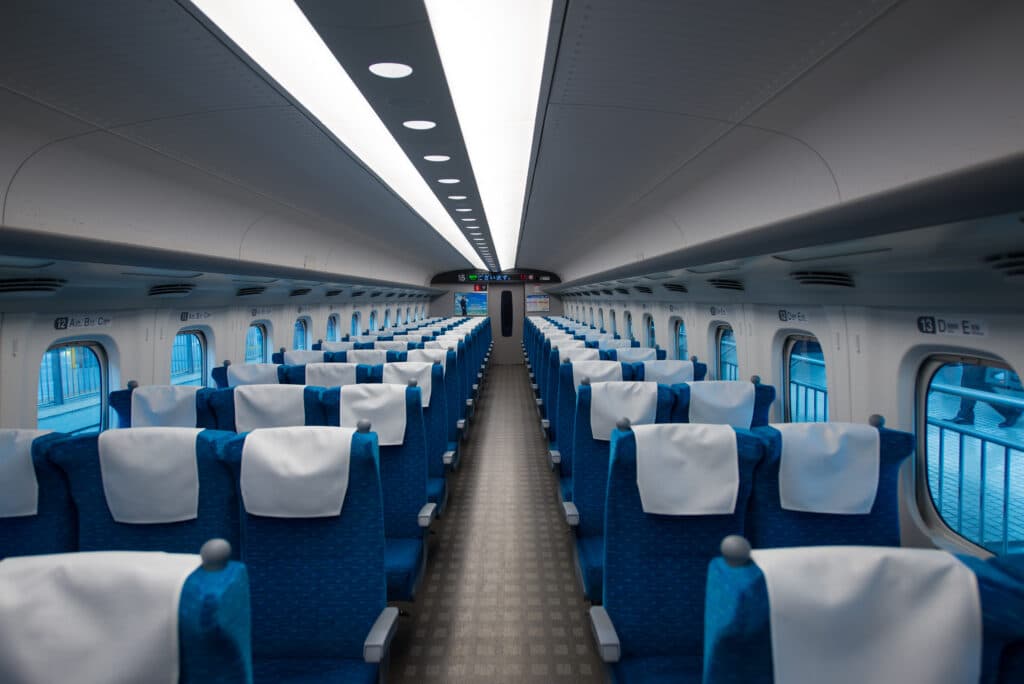
If you compare only the time spent onboard, the Shinkansen is usually the more comfortable way to travel. Seats are generally spacious, you can move around during the journey, and there is no need to remain seated for most of the trip as you would on a short domestic flight.
The difference becomes particularly noticeable on journeys of two or three hours. Instead of treating the transfer as lost travel time, you can use it to relax, eat, work, read, or simply watch Japan pass outside the window.
Better for Using the Journey
Seat space: Generally comfortable even in ordinary cars
Freedom to move: You can get up and walk during the journey
Food & drinks: Easy to bring your own meal or snacks onboard
Productive time: Easier to read, work, or simply relax
Scenery: The changing landscape becomes part of the journey
Better for Shortening Long Journeys
Seat space: Depends considerably on airline and aircraft
Movement: More restricted during a short flight
Food & drinks: Service varies by airline and fare
Productive time: Short flight and boarding procedures interrupt the journey
Main advantage: Several hours of rail travel can be replaced by a much shorter flight
The Shinkansen Can Be Part of the Japan Experience
For many first-time visitors, taking the Shinkansen is not simply transportation. Buying an ekiben at the station, watching cities and countryside pass outside the window, and experiencing Japan’s high-speed rail system can be an enjoyable part of the trip itself.
On the Tokaido Shinkansen between Tokyo and Kyoto or Osaka, you may even get a view of Mount Fuji when the weather cooperates. That doesn’t make the train objectively better, but it does mean that two and a half hours on the Shinkansen may feel very different from two and a half hours spent reaching, navigating, and waiting at airports.
Not All Travel Hours Are Equal
A three-hour journey where you sit comfortably, eat lunch, read, and watch the scenery can feel less disruptive than a shorter journey divided between an airport train, check-in, security, boarding, a flight, baggage claim, and another transfer. When the total travel times are reasonably close, how you spend those hours matters too.
When a Flight Is Still the More Comfortable Choice
Comfort has limits. A pleasant train journey can become tiring when it lasts most of the day or requires multiple connections. If a direct domestic flight saves several hours, arriving earlier and having more time at your destination may be more valuable than having a more comfortable seat along the way. This is especially relevant for long-distance journeys to places such as Hokkaido or Kyushu.
Travel Owl Verdict: The Shinkansen usually wins for onboard comfort, particularly on journeys of a few hours. But if flying saves a substantial part of your travel day, the most comfortable choice may simply be the one that gets you to your destination sooner.
Which Is More Reliable: Shinkansen or Domestic Flights?
Japan’s Shinkansen is famous for punctuality, and under normal operating conditions it is an exceptionally reliable way to travel. Domestic flights are also generally efficient, but aviation is more exposed to airport operations and weather conditions at both ends of the journey.
That does not mean trains never experience disruption. Typhoons, heavy rain, strong winds, earthquakes, and heavy snow can delay or suspend rail services as well as flights. The practical difference is often what happens to your itinerary when something goes wrong.
Strong Everyday Reliability
Punctuality: Extremely reliable under normal conditions
Frequency: Major routes have many departures throughout the day
Recovery options: Frequent services can sometimes make a later train practical
Weather: Severe rain, wind, snow, or typhoons can still disrupt service
Earthquakes: Safety systems can stop trains when significant seismic activity is detected
Reliable, but More Weather-Dependent
Normal operations: Domestic flights are generally efficient and frequent on major routes
Weather: Strong winds, typhoons, snow, and poor conditions can affect operations
Multiple locations: Conditions at either airport can affect the journey
Rebooking: Alternatives depend on airline schedules and available seats
Knock-on effect: A cancellation can consume a larger part of the travel day
What Happens During Typhoons and Severe Weather?
Severe weather is the main situation where travelers should avoid assuming that either option will operate normally. During a strong typhoon, airlines may cancel flights and railway operators may reduce, suspend, or pre-emptively cancel services.
If severe weather is forecast during your trip, check the official airline or railway operator rather than relying only on your original booking information. In some situations, operators announce expected disruption in advance, giving you time to adjust your plans.
What About Winter Travel?
Heavy snow can affect both trains and flights, particularly when traveling in northern Japan or regions facing the Sea of Japan. This matters if your itinerary includes destinations such as Hokkaido during winter.
Avoid building an itinerary that depends on a perfectly timed long-distance transfer immediately before an international flight. A transport system can be highly reliable overall and still be vulnerable to exceptional weather on the day you travel.
Reliability Matters Most When You Have No Margin for Error
A one-hour delay on an ordinary sightseeing day may be inconvenient but manageable. The same delay can become much more serious if you have an international flight, cruise departure, limited-entry reservation, or another important connection later that day.
When the consequences of a delay are high, build some buffer into your itinerary rather than relying on either trains or flights operating perfectly.
Travel Owl Verdict: For ordinary city-to-city journeys, the Shinkansen has the edge in reliability and flexibility. But neither trains nor flights are immune to severe weather or other disruption. If an important connection depends on arriving at a precise time, the smartest solution is not simply choosing the “more reliable” transport — it is leaving enough buffer when the consequences of a delay are high.
Tokyo to Kyoto: Train or Fly?
For almost every first-time visitor, the Shinkansen is the better way to travel from Tokyo to Kyoto. The route is fast, direct, frequent, and takes you from central Tokyo straight to Kyoto Station. Flying may look competitive if you compare only time in the air, but Kyoto does not have its own major commercial airport.
Tokyo → Kyoto: Take the Train
Unless you have an unusual itinerary involving an airport connection, there is little reason to fly between Tokyo and Kyoto. The Shinkansen is one of the clearest examples of why city-to-city rail works so well in Japan.
Tokyo → Kyoto
Journey: Direct
Fastest services: Around 2 hours 10 minutes
Departure: Tokyo or Shinagawa Station
Arrival: Kyoto Station
Main advantage: Fast, simple city-to-city journey
Tokyo → Osaka Airport → Kyoto
Journey: Flight + ground transfer
Departure: Usually a Tokyo airport
Arrival: Osaka-area airport
Then: Continue overland to Kyoto
Main drawback: Kyoto has no major commercial airport
Why the Shinkansen Wins
The biggest advantage is not simply the speed of the train. It is the lack of unnecessary transfers. From Tokyo or Shinagawa Station, you board the Tokaido Shinkansen and get off at Kyoto Station. There is no airport security, no flight boarding process, and no airport-to-Kyoto transfer after landing.
Kyoto Station is also a useful arrival point for continuing your journey. It connects directly with local trains, subway services, buses, taxis, and other rail routes, making it relatively easy to continue toward your accommodation or sightseeing area.
Is There Any Reason to Fly?
There are exceptions, but they are unusual for a typical tourist. Flying might make sense if you are already at a Tokyo airport and can connect conveniently to an Osaka-area flight, or if Kyoto is only one part of a more complicated air itinerary. But if you’re staying in Tokyo and your next hotel is in Kyoto, taking the Shinkansen is usually the obvious choice.
Travel Owl Tip: If you’re traveling from Tokyo to Kyoto during the middle of your trip, don’t spend too much time comparing flights. Take the Shinkansen and focus your planning effort elsewhere. This is one of the easiest transport decisions on a classic Japan itinerary.
Tokyo to Osaka: Train or Fly?
For most travelers, the Shinkansen is the better way to travel from Tokyo to Osaka. Flying can sometimes be cheaper and the time in the air is much shorter, but the train’s city-to-city convenience makes it difficult to beat once you compare the complete journey.
Tokyo → Osaka: Usually Take the Train
If you’re traveling from a hotel in Tokyo to a hotel in Osaka, the Shinkansen is usually faster overall, simpler, and more flexible. Consider flying mainly when you find a particularly attractive fare or your itinerary already puts you close to an airport.
Tokyo → Shin-Osaka
Journey: Direct
Fastest services: Around 2½ hours
Departure: Tokyo or Shinagawa Station
Arrival: Shin-Osaka Station
Main advantage: Simple city-to-city connection with frequent departures
Tokyo → Osaka
Journey: Airport transfer + flight + city transfer
Flight time: Roughly 1–1½ hours
Departure: Usually Haneda or Narita
Arrival: Usually Itami or Kansai International
Main drawback: Airport time reduces much of the apparent speed advantage
Why the Shinkansen Usually Wins
The flight itself is considerably shorter than the train journey, but that is only part of the trip. When flying, you need to reach a Tokyo airport, arrive early enough for the flight, pass through security, board, fly to Osaka, and then travel from the arrival airport into the city.
With the Shinkansen, you can board at Tokyo or Shinagawa and arrive at Shin-Osaka. From there, local trains and the Osaka Metro connect you with major areas such as Umeda, Namba, Shinsaibashi, and other parts of the city. The result is a journey with fewer steps and less waiting.
Itami or Kansai Airport Makes a Difference
Not all flights to Osaka are equally convenient. Osaka Itami Airport (ITM) is much closer to central Osaka than Kansai International Airport (KIX), making a Haneda–Itami flight considerably more competitive for city-to-city travel.
Kansai International Airport is farther from central Osaka. If a low-cost fare requires traveling from Narita to Kansai, the inexpensive airfare can look attractive while adding substantial ground travel at both ends. Always check the actual airports before comparing prices.
Don’t Rule Out the Plane Completely
Flying becomes more attractive if:
• You find an airfare substantially cheaper than the Shinkansen
• You’re staying close to Haneda Airport
• Your flight uses convenient Haneda–Itami airports
• You’re connecting directly from another flight
• Your Osaka destination is particularly convenient from the arrival airport
What About a Tokyo–Kyoto–Osaka Itinerary?
If Osaka is part of a classic Tokyo–Kyoto–Osaka route, there is even less reason to fly. Take the Shinkansen from Tokyo to Kyoto, explore Kyoto, and then continue to Osaka by local or regional train. Flying between Tokyo and Osaka only to backtrack to Kyoto usually adds unnecessary complexity.
Travel Owl Verdict: For a normal Tokyo hotel → Osaka hotel journey, take the Shinkansen. If you find a very cheap flight, compare the specific airports, airport-transfer costs, baggage fees, and complete door-to-door time before deciding.
Tokyo to Hiroshima: Train or Fly?
Tokyo to Hiroshima is where the train-vs-flight decision becomes much more interesting. The Shinkansen journey is considerably longer than Tokyo–Kyoto or Tokyo–Osaka, so flying starts to look attractive. But Hiroshima Airport is located well outside central Hiroshima, which reduces much of the plane’s apparent time advantage.
Tokyo → Hiroshima: Usually Train, but Compare Both
For most tourists traveling from central Tokyo to central Hiroshima, the Shinkansen is usually the simpler choice. Flying can compete on total travel time and sometimes on price, but the airport transfers at both ends make this a much closer decision than the flight time suggests.
Tokyo → Hiroshima
Journey: Direct on suitable Nozomi services
Travel time: Roughly 4 hours on the fastest direct services
Departure: Tokyo or Shinagawa Station
Arrival: Hiroshima Station
Main advantage: Direct city-to-city journey with no airport transfer
Tokyo → Hiroshima
Journey: Airport transfer + flight + airport transfer
Flight time: Roughly 1½ hours
Departure: Typically Haneda Airport
Arrival: Hiroshima Airport
Main drawback: Significant ground transfer into Hiroshima
Hiroshima Airport Changes the Calculation
If Hiroshima Airport were located next to the city center, flying would be a much stronger winner. But it isn’t. After landing, you still need to travel into Hiroshima, with airport limousine buses commonly used for the connection to Hiroshima Station and other central areas.
By contrast, the Shinkansen arrives directly at Hiroshima Station. This is why a flight that spends far less time in motion does not necessarily save nearly as much time when measured from hotel door to hotel door.
• You’re traveling from central Tokyo
• Your Hiroshima hotel is near the station or city center
• You value simplicity and flexibility
• Hiroshima follows Kyoto or Osaka in your itinerary
• You’re already staying near Haneda Airport
• You find a significantly cheaper airfare
• Your schedule matches a convenient flight
• Hiroshima is a standalone long-distance jump from Tokyo
Don’t Compare Tokyo–Hiroshima in Isolation
Many first-time visitors do not actually travel directly from Tokyo to Hiroshima. A more common itinerary is:
Tokyo → Kyoto → Osaka → Hiroshima
In that case, flying makes very little sense. Hiroshima fits naturally into a westbound rail itinerary, and the journey from Kyoto or Osaka is much shorter than traveling all the way from Tokyo.
Travel Owl Verdict: If you’re traveling directly from central Tokyo to central Hiroshima, start by checking the Shinkansen. Flying is worth comparing, especially for price, but Hiroshima Airport’s location removes much of its theoretical speed advantage. If Hiroshima comes after Kyoto or Osaka, the train is the clear choice.
Tokyo to Fukuoka: Train or Fly?
Tokyo to Fukuoka is one of the clearest examples of a route where flying deserves serious consideration. The Shinkansen provides a direct rail connection between Tokyo and Hakata, but the journey takes around five hours. A domestic flight is much shorter, and Fukuoka Airport has one major advantage: it is exceptionally close to central Fukuoka.
Tokyo → Fukuoka: Fly for Speed, Train for Simplicity
If Fukuoka is your next destination and saving time is the priority, flying is usually the stronger choice. Take the Shinkansen if you prefer a simple city-to-city journey, want to avoid airports, or Fukuoka is part of a longer westbound rail itinerary.
Tokyo → Hakata
Journey: Direct on suitable Nozomi services
Travel time: Around 5 hours
Departure: Tokyo or Shinagawa Station
Arrival: Hakata Station
Main advantage: Direct city-to-city travel with no airport procedures
Tokyo → Fukuoka
Journey: Airport transfer + flight + short city transfer
Flight time: Roughly 2 hours
Departure: Haneda or Narita, depending on airline
Arrival: Fukuoka Airport
Main advantage: Major time saving with unusually convenient airport access
Fukuoka Airport Is What Makes Flying So Competitive
Airport location often weakens the case for flying in Japan. Fukuoka is the major exception. Fukuoka Airport’s domestic terminal is connected to the city’s subway network, and the ride to Hakata Station takes only a few minutes.
That means the usual post-flight penalty — a long journey from an outlying airport into the city — is largely absent. This makes Tokyo–Fukuoka very different from Tokyo–Hiroshima, where the arrival airport is much farther from the destination city.
• You’re traveling directly from Tokyo to Fukuoka
• Your Japan trip is relatively short
• Saving several hours matters
• You find a competitive airfare
• Your accommodation is convenient from Fukuoka Airport
• You strongly prefer rail travel over airports
• You want maximum schedule flexibility
• You’re stopping in Kyoto, Osaka, or Hiroshima first
• Relevant rail-pass coverage changes the cost calculation
• You enjoy long train journeys and want the journey itself to be part of the trip
Are You Really Traveling Tokyo → Fukuoka?
If your itinerary is:
Tokyo → Fukuoka
flying is often the smarter choice.
But if your itinerary is:
Tokyo → Kyoto → Hiroshima → Fukuoka
the answer changes completely. Each individual rail leg is manageable, and flying between these intermediate destinations would usually add unnecessary airport transfers and complexity.
One of the Smartest Options: Train South, Fly Back
For a longer Japan itinerary, you do not necessarily need to choose between trains and flights at all. One efficient strategy is to travel gradually west by rail — for example from Tokyo to Kyoto, Hiroshima, and Fukuoka — and then fly directly from Fukuoka back to Tokyo.
This avoids spending another five hours retracing the same route by Shinkansen and demonstrates why combining transport modes can be more efficient than committing to rail for every journey.
Travel Owl Verdict: For a direct Tokyo → Fukuoka journey, flying usually wins when saving time matters. If Fukuoka is the final stop on a westbound itinerary through Kyoto, Osaka, or Hiroshima, continue by train — and consider flying back to Tokyo instead of retracing the entire route by rail.
Tokyo to Sapporo: Train or Fly?
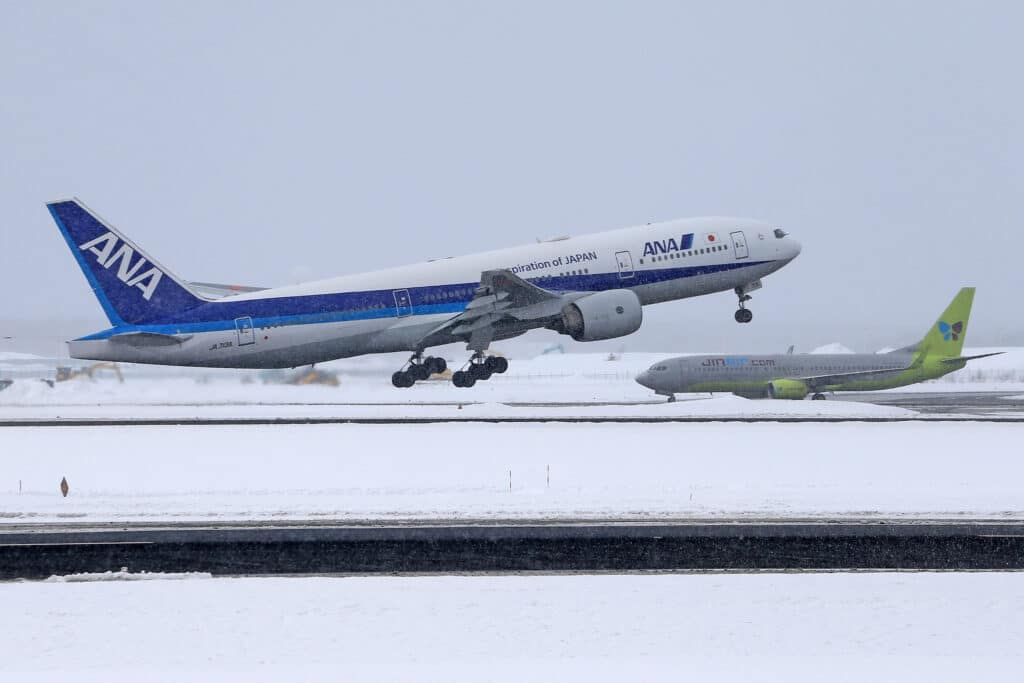
For most travelers, flying is by far the better way to travel from Tokyo to Sapporo. Unlike Kyoto, Osaka, Hiroshima, and Fukuoka, Sapporo is not yet connected directly to Tokyo by Shinkansen. Reaching Sapporo by rail requires a long journey through northern Honshu and Hokkaido, followed by an additional train connection.
Tokyo → Sapporo: Fly
Unless you specifically want the long-distance rail journey itself, take a domestic flight from Tokyo to Hokkaido. The time saving is substantial and there are frequent flights between the Tokyo area and New Chitose Airport.
Tokyo → Sapporo
Journey: Shinkansen + connecting train
Travel time: Roughly 8 hours or more
Shinkansen: Tokyo → Shin-Hakodate-Hokuto
Then: Limited express connection toward Sapporo
Main drawback: Very long journey with a required transfer
Tokyo → New Chitose
Journey: Flight + airport transfer to Sapporo
Flight time: Roughly 1½ hours
Departure: Haneda or Narita, depending on airline
Arrival: New Chitose Airport
Main advantage: Saves several hours compared with traveling entirely by rail
The Shinkansen Does Not Yet Reach Sapporo
This is the key fact many first-time visitors miss. The Hokkaido Shinkansen currently terminates at Shin-Hakodate-Hokuto in southern Hokkaido. From there, you still need to continue by conventional limited express train to reach Sapporo.
That makes Tokyo–Sapporo fundamentally different from Tokyo–Kyoto or Tokyo–Fukuoka. You cannot simply board a Shinkansen in Tokyo and remain on the same train until Sapporo.
Why Flying Makes So Much More Sense
Tokyo–Sapporo is a major domestic air route, giving travelers multiple airline and schedule options. Once you arrive at New Chitose Airport, frequent rail services connect the airport with central Sapporo.
Even after including the journey to the airport, check-in, security, the flight, and the transfer from New Chitose into Sapporo, flying normally saves several hours of valuable vacation time compared with traveling all the way from Tokyo by train.
When Would You Take the Train?
Traveling from Tokyo to Sapporo by rail can still make sense if the journey itself is part of your trip. For example, you might deliberately break the route into several destinations rather than traveling straight through.
Consider the train if:
• You are a rail enthusiast
• You want to stop in northern Japan along the way
• Hakodate is already part of your itinerary
• You deliberately want a long-distance Japanese rail experience
A Better Way to Add Hokkaido to a Japan Trip
If you have a two-week Japan itinerary and want to combine the classic cities with Hokkaido, flying is often the most efficient way to prevent transport from consuming too much of your trip.
Instead of:
Tokyo → long rail journey → Sapporo
consider:
Tokyo → fly to Sapporo → explore Hokkaido
The Hokkaido Shinkansen is planned to eventually extend to Sapporo. Until that extension opens, however, do not plan a Tokyo–Sapporo journey as though a direct Shinkansen connection already exists.
Travel Owl Verdict: For a direct Tokyo → Sapporo journey, fly. The train is an interesting experience rather than the efficient choice. Choose rail mainly if Hakodate or northern Japan is part of the journey itself; otherwise, use the time you save by flying to enjoy more of Hokkaido.
Tokyo to Okinawa: Train or Fly?
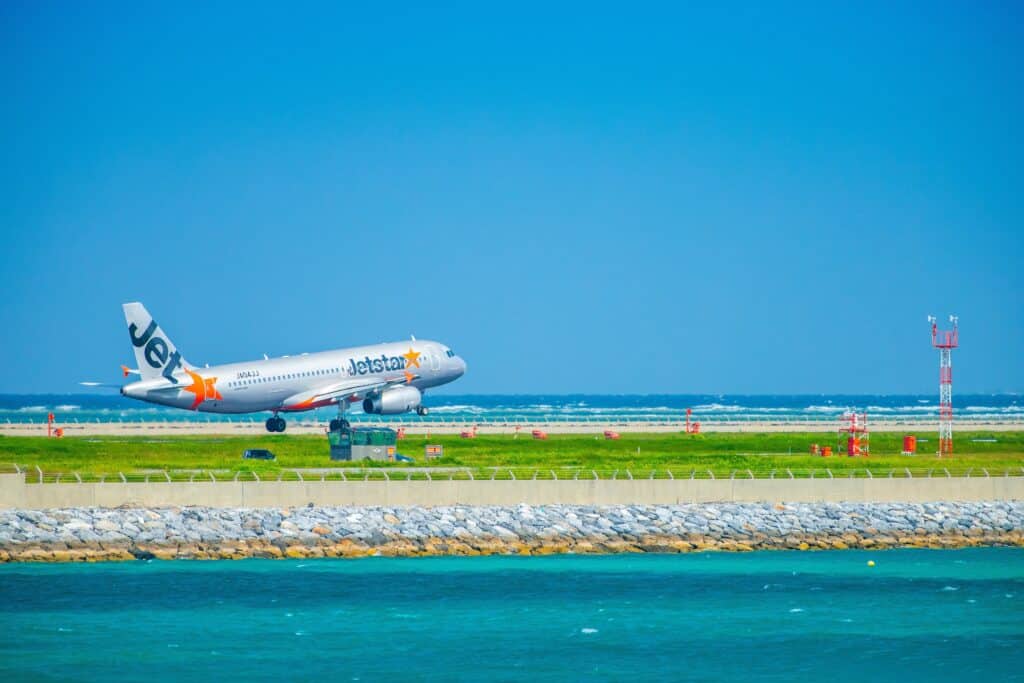
For Tokyo to Okinawa, the decision is simple: fly. Okinawa is separated from Japan’s main islands by hundreds of kilometers of sea and has no rail connection to the mainland. Unlike Hokkaido, which can at least be reached partly by Shinkansen, Okinawa cannot be added to a rail itinerary without switching to another form of transport.
Tokyo → Okinawa: Fly
For almost every visitor, a domestic flight is the practical way to travel from Tokyo to Okinawa. There is no Shinkansen or conventional rail route connecting mainland Japan with Okinawa.
Tokyo → Okinawa
Direct rail connection: None
Shinkansen: Does not reach Okinawa
Mainland connection: Requires air or sea travel
Verdict: Not a practical train journey
Tokyo → Naha
Journey: Direct flight available
Flight time: Roughly 3 hours
Departure: Haneda or Narita, depending on airline
Arrival: Naha Airport
Main advantage: By far the most practical connection
Why Okinawa Is Different from the Rest of This Comparison
Most train-vs-flight decisions in Japan involve a trade-off. The train may be slower but more convenient, while the flight may save time but add airport transfers. Okinawa is different because there is no continuous rail alternative.
Ferries connect parts of Okinawa with other Japanese islands, but they are much slower and generally make sense because you specifically want the sea journey — not because they are an efficient alternative to flying from Tokyo.
Treat Okinawa as a Separate Flight Segment
If you want to combine Okinawa with a classic mainland Japan itinerary, it usually makes more sense to think of it as a separate section of the trip rather than trying to integrate it into your rail route.
For example:
Tokyo → Kyoto → Osaka → fly to Okinawa
This allows you to use the Shinkansen where it performs best and switch to flying once the geography makes air travel clearly more efficient.
Remember: Okinawa Is More Than Naha
Flying into Naha gets you to Okinawa’s main island, but your transport planning may not end there. If your destination is another island in the Okinawa archipelago, such as Ishigaki or Miyakojima, you may need another flight or ferry depending on your itinerary.
This is another reason to plan Okinawa separately from the rail-heavy part of a Japan trip: once you reach the islands, the transport logic changes considerably.
Travel Owl Verdict: For Tokyo → Okinawa, fly. There is no practical rail alternative. The smarter planning decision is not whether to take the train or plane, but where Okinawa should fit into your itinerary so that you avoid unnecessary backtracking and use domestic flights efficiently.
When You Should Take the Train in Japan
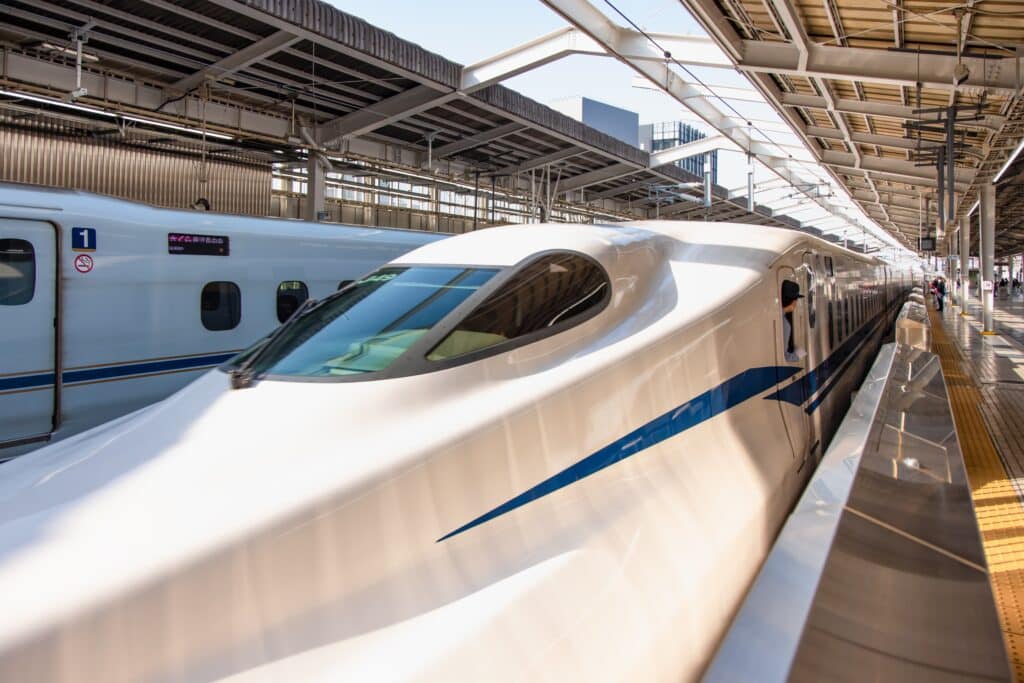
The Shinkansen is not automatically the best choice for every journey in Japan, but it is extremely difficult to beat on the routes where it works best. Choose the train when the rail journey is reasonably short, the stations are convenient, and flying would add more steps than it saves.
Take the Train When It Keeps the Journey Simple
If you can travel from a convenient station near your current accommodation to a convenient station near your next destination in roughly three hours or less, start with the train. Once the rail journey becomes substantially longer, compare flights before booking.
The Shinkansen Takes Around 3 Hours or Less
This is the strongest territory for high-speed rail. Once airport transfers, security, boarding, and arrival procedures are included, flying often provides little or no meaningful time advantage.
Both Stations Are Convenient
Rail becomes especially attractive when you can leave from a central station and arrive close to your next hotel. Tokyo–Kyoto is a perfect example.
You Want Schedule Flexibility
Major Shinkansen corridors have frequent departures. That gives you more freedom to choose when to leave instead of structuring part of your day around a specific flight.
You’re Traveling Through Several Cities
Trains are ideal for progressive itineraries such as Tokyo → Kyoto → Osaka → Hiroshima. Each city becomes the next logical step instead of requiring repeated journeys to and from airports.
You Want a Simpler Travel Day
Fewer stages usually mean less friction: reach the station, board the train, and continue from the arrival station. For first-time visitors, that simplicity can be worth more than a small theoretical time saving.
You Value Comfortable Travel Time
A few hours on the Shinkansen can be useful downtime. You can eat, read, work, relax, or watch Japan pass outside the window instead of dividing the journey between transfers, security, boarding, and baggage collection.
Routes Where the Train Is Usually the Easy Choice
For a typical first-time Japan itinerary, these are exactly the kinds of journeys where rail works particularly well:
Don’t Confuse “Train Is Easy” with “Use Trains for Everything”
Japan’s rail system is so good that it is tempting to build an entire trip around trains. But excellent rail infrastructure does not make every long-distance rail journey efficient. The goal is not to maximize train travel — it is to use trains where they save time and reduce hassle.
Travel Owl Rule: Choose the train when it gives you a direct, reasonably short, city-to-city journey with fewer travel steps. For Tokyo–Kyoto, Tokyo–Osaka, and shorter legs along the main Shinkansen corridor, rail is usually the smartest default. Once the train journey becomes long enough to consume a large part of your day, start comparing flights.
When You Should Fly in Japan
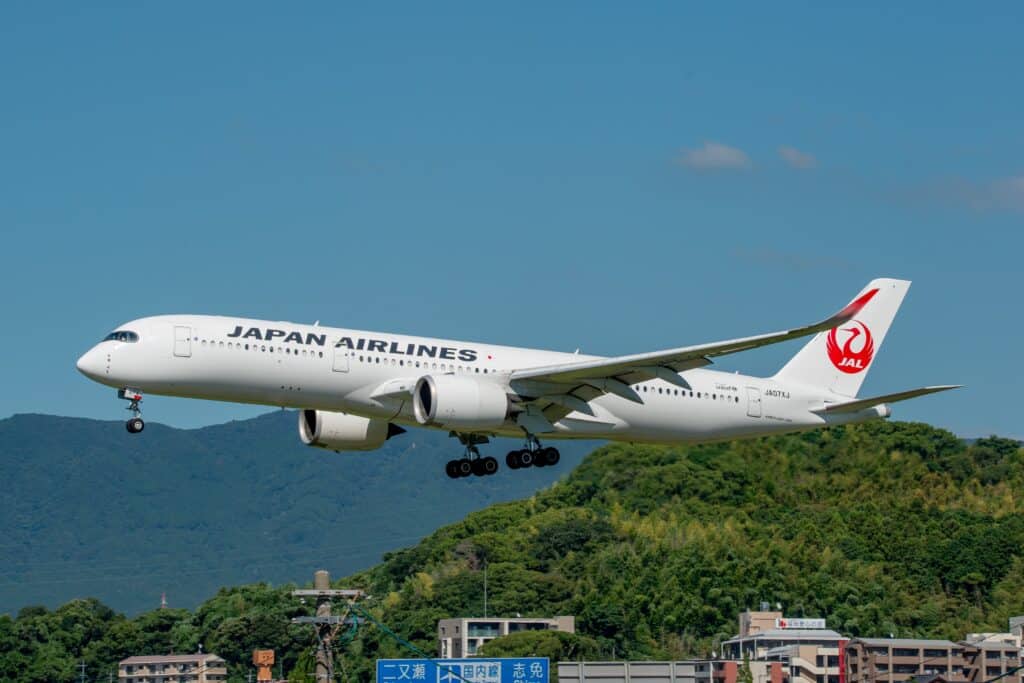
Japan’s trains are excellent, but there is a point where staying on the rails stops being the smartest use of your time. Flying becomes more attractive when the distance is long, the rail journey consumes a large part of the day, or your destination is poorly connected — or not connected at all — by high-speed rail.
Fly When the Distance Starts Costing You Vacation Time
Once a direct train journey approaches four to five hours or more, check domestic flights before booking. The plane will not always win, but the potential time saving becomes large enough that it deserves a proper door-to-door comparison.
The Train Journey Is Very Long
A two- or three-hour Shinkansen ride is easy to justify. Five, eight, or more hours is different. On long routes, a flight can return a meaningful part of the day to your itinerary.
Your Destination Is Far from the Shinkansen Network
High-speed rail does not connect every destination in Japan. Sapporo still requires a substantial onward rail journey from the current Hokkaido Shinkansen terminus, while Okinawa has no rail connection to mainland Japan at all.
The Airport Is Conveniently Located
Airport location can completely change the calculation. Fukuoka is the standout example: its airport is exceptionally close to the city center, making flying much more competitive than on routes with distant arrival airports.
You’re Making One Long Jump
Flying works particularly well when you want to skip a large section of the country rather than stop along the way — for example, traveling directly from Tokyo to Sapporo or Fukuoka.
You’re Already at an Airport
A domestic flight becomes much more attractive when it connects naturally with another flight. If you are already at Haneda, Narita, Kansai, or another airport, you remove one of aviation’s biggest disadvantages: the extra journey from the city to the airport.
A Good Airfare Makes the Choice Easy
Domestic airline discounts and low-cost carriers can make some long-distance flights very competitive. Just compare the final price after baggage, seat selection, and airport-transfer costs rather than looking only at the advertised fare.
Routes Where Flying Deserves Serious Consideration
These are the kinds of journeys where you should at least check domestic flights before committing to rail:
Your Vacation Time Has a Value
A traveler spending three weeks in Japan may happily devote five hours to a scenic train journey. Someone visiting for seven or ten days may value those hours very differently.
If flying saves several hours and gives you an extra afternoon or evening at your destination, paying slightly more can sometimes be the better-value decision.
The Best Japan Itinerary Often Uses Both
One of the biggest planning mistakes is assuming that you need to choose between a “train trip” and a “flight trip.” You don’t. Japan’s transport network works particularly well when you combine trains for shorter city-to-city journeys with flights for the longest jumps.
For example:
Tokyo → Kyoto by Shinkansen → Hiroshima by Shinkansen → Fukuoka by Shinkansen → Tokyo by plane
This lets you move progressively through western Japan without repeatedly using airports, while avoiding a long rail journey back to Tokyo at the end.
Travel Owl Rule: Start comparing flights once the train journey becomes long enough to consume a significant part of your day. For destinations such as Fukuoka, Sapporo, and Okinawa, flying can save valuable time. The smartest Japan itinerary often uses trains for the corridor and flights for the jumps.
When the Cheapest Option Isn’t the Smartest
Finding the lowest fare is useful, but the cheapest ticket is not always the cheapest journey. A low-cost flight may require expensive airport transfers and baggage fees. A train may cost more but deliver you directly into the city and save enough time to make the difference worthwhile.
Instead of asking only “Which ticket costs less?”, compare what each option costs you in money, time, convenience, and lost vacation hours.
Compare the Whole Journey, Not Just the Ticket
Real Travel Cost = Ticket + Transfers + Baggage + Extras + Time Lost
You do not need to assign an exact monetary value to every hour. The point is simply to recognize that saving ¥2,000 is not necessarily a good deal if it costs you several additional hours and makes the travel day significantly more complicated.
Start with the Fare
Compare the actual train fare with the flight available on your travel date. Domestic airfares can vary substantially, so generic price comparisons are less useful than checking your specific journey.
Add the Hidden Costs
Include airport transfers, checked baggage, seat selection, and other relevant extras. A cheap advertised airfare can become much less impressive after the complete journey is priced.
Count Door-to-Door Hours
Compare the time from your current accommodation to your next one. Include airport access, waiting, security, baggage collection, transfers, and the journey from the arrival airport.
Count the Travel Steps
A journey with several transfers, baggage handling, and strict departure times may be technically cheaper while being much less convenient than a simple direct train.
Example: Would You Spend ¥3,000 to Save Three Hours?
Imagine one option costs ¥12,000 and takes six hours door to door, while another costs ¥15,000 and takes three hours. The second option costs ¥3,000 more, but gives you three additional hours at your destination.
On a long, relaxed trip, you may happily save the money. On a seven- or ten-day Japan itinerary, spending the extra ¥3,000 could effectively buy you another afternoon of sightseeing. Neither choice is automatically correct — but ticket price alone cannot tell you which is better.
What Is One Hour of Your Japan Trip Worth to You?
You do not need to calculate an exact hourly value. Simply think about the trade-off.
Would you pay ¥1,000 more to save 20 minutes? Probably not in many situations.
Would you pay ¥3,000 more to save three hours? That may be very different.
Would you pay ¥5,000 more to avoid losing almost an entire sightseeing day? On a short trip, the answer may easily be yes.
A Cheap Flight Can Also Be a False Economy
Suppose a low-cost flight between Tokyo and Osaka appears significantly cheaper than the Shinkansen. Before booking, check which airports it uses. A Narita-to-Kansai itinerary can require substantial ground travel on both sides, while the Shinkansen connects Tokyo or Shinagawa directly with Shin-Osaka.
Once airport transfers, baggage charges, and additional travel time are included, the lowest airfare may no longer represent the best value.
The Same Rule Applies If You Have a JR Pass
A rail journey can feel “free” once you have already paid for a rail pass, but your time is still being spent. Taking an eight-hour train simply because it is covered by your pass may be poor itinerary planning if a reasonably priced flight would save several hours.
Rail-pass coverage should influence the cost comparison, but it should not automatically decide the transport mode.
Ask These Five Questions
1. What is the final price after transfers, baggage, and extras?
2. How long will the journey take from hotel door to hotel door?
3. How many transfers and travel steps are involved?
4. What could I do with the time the faster option saves?
5. Is the saving large enough to justify choosing the less convenient option?
Travel Owl Rule: Don’t optimize your Japan trip for the lowest transport price. Optimize it for the best combination of cost, time, convenience, and itinerary value. Saving a little money is rarely a win if it costs you several valuable hours or turns a simple journey into a complicated one.
Travel Owl Train vs Flight Decision Rule
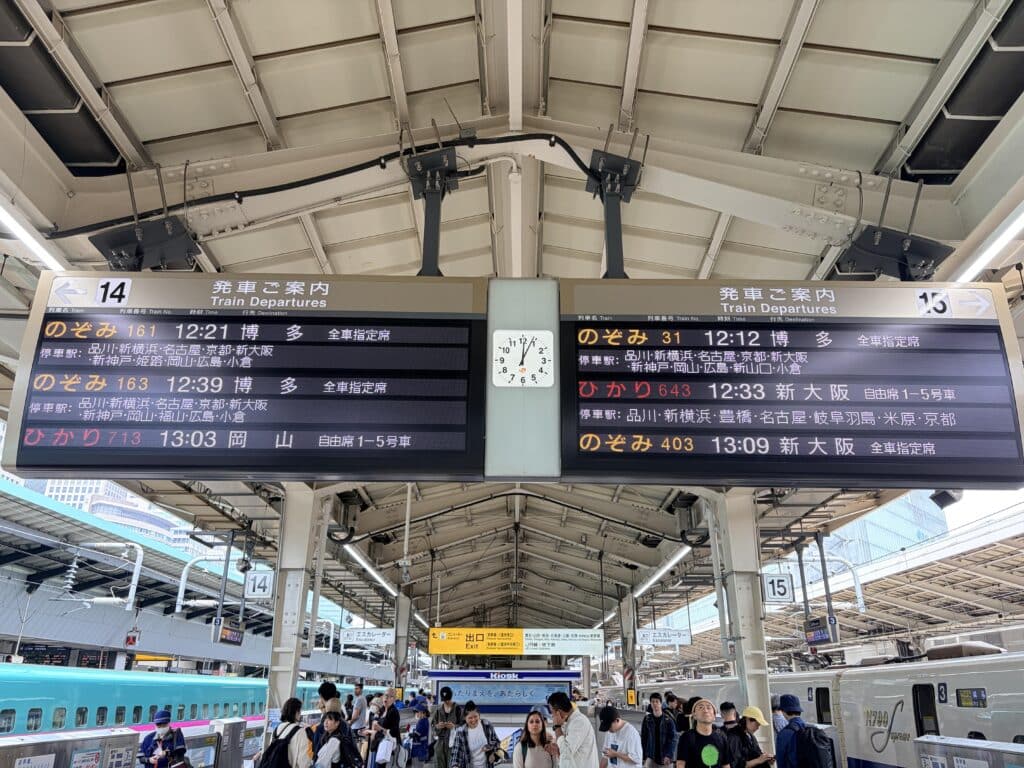
Still not sure whether to take the Shinkansen or fly? You do not need to compare every detail from scratch. Use this simple decision rule to narrow the choice to Train, Compare Both, or Fly.
Should You Take the Train or Fly?
Is there a practical direct or near-direct rail connection?
No → Start with flying.
Yes → Go to Step 2.
Is the train journey around 3 hours or less?
Yes → Take the train in most cases.
No → Go to Step 3.
Is the train journey roughly 3–4 hours?
Yes → Compare both door to door.
No, it is substantially longer → Go to Step 4.
Would flying save several hours door to door?
Yes → Flying is probably the smarter choice.
No → The train may still be worth taking.
Is there an itinerary reason to choose the other option?
Check your hotel locations, airport access, luggage, price, rail-pass coverage, connections, and previous or next destination. These factors can override the general rule.
Your Result
Short + Direct + Central
Choose the train when the journey is reasonably short and both stations work well with your itinerary. This is the typical answer for Tokyo–Kyoto and Tokyo–Osaka.
The Middle Ground
When rail takes several hours but still offers a convenient city-to-city journey, compare the complete trip. Tokyo–Hiroshima is a good example.
Long-Distance Jump
Flying becomes the default when rail would consume a large part of the day or cannot complete the journey efficiently. Think Tokyo–Sapporo or Tokyo–Okinawa.
Train vs Flight Cheat Sheet
| Route | Start With | Why |
|---|---|---|
| Tokyo → Kyoto | Train | Fast, direct, city-to-city |
| Tokyo → Osaka | Usually Train | Airport process removes much of the flight advantage |
| Tokyo → Hiroshima | Usually Train | Direct rail journey; airport is outside central Hiroshima |
| Tokyo → Fukuoka | Compare Both | Long rail journey; exceptionally convenient arrival airport |
| Tokyo → Sapporo | Fly | No direct Shinkansen to Sapporo and major time saving by air |
| Tokyo → Okinawa | Fly | No rail connection to mainland Japan |
Travel Owl Decision Rule: Under roughly 3 hours by train → start with rail. Around 3–4 hours → compare both. Beyond that → increasingly consider flying. Then adjust the answer for airport location, total price, luggage, your previous and next destinations, and the amount of vacation time each option consumes.
Sample Japan Itineraries: Train or Fly?
The smartest transport choice becomes clearer when you look at your entire itinerary rather than one journey at a time. A route that seems long from Tokyo may make perfect sense by train once Kyoto, Osaka, or Hiroshima is placed between the two destinations.
These examples show how trains and domestic flights can work together on realistic Japan trips.
Tokyo + Kyoto + Osaka
For a short first trip focused on Japan’s classic cities, there is usually no reason to take a domestic flight between destinations.
Tokyo → Kyoto
Take the Shinkansen
Fast, direct, and much simpler than flying to an Osaka-area airport and backtracking to Kyoto.
Kyoto → Osaka
Take the Train
These cities are close together and connected by frequent rail services.
Best strategy: Keep the entire trip on rail. Adding airports between these cities would make this itinerary more complicated without providing a meaningful advantage.
✈️ Departure Planning: This itinerary works particularly well if you arrive in Tokyo and fly home from Osaka’s Kansai International Airport (KIX). If your return flight departs from Tokyo, allow additional time and budget for the journey back. The Shinkansen is usually the simplest option.
Tokyo + Kyoto + Hiroshima + Fukuoka
This itinerary shows why you should not automatically fly from Tokyo to Fukuoka simply because the direct rail journey is long. Once you break the route into logical stops, trains become much more attractive.
Tokyo → Kyoto
Train
An ideal Shinkansen journey and a natural first move west.
Kyoto → Hiroshima
Train
Rail keeps the itinerary moving west without unnecessary airport transfers.
Hiroshima → Fukuoka
Train
A relatively short Shinkansen journey directly to Hakata.
Fukuoka → Tokyo
Fly
Avoid retracing the entire route by rail and save several hours.
Best strategy: Travel progressively west by train, then fly back to Tokyo. This is a good example of why combining transport modes can outperform an all-rail itinerary.
Tokyo + Kyoto + Osaka + Sapporo
Adding Hokkaido changes the transport logic completely. Use trains for the classic Tokyo–Kyoto–Osaka corridor, then switch to a domestic flight for the long jump north.
Tokyo → Kyoto
Train
The Shinkansen is the obvious choice for this core route.
Kyoto → Osaka
Train
Short, easy, and frequent rail connections make flying irrelevant.
Osaka → Sapporo
Fly
Flying avoids an extremely long multi-stage rail journey and preserves valuable sightseeing time.
Best strategy: Use trains within Japan’s main city corridor and fly when moving between distant regions.
✈️ Departure Planning: This itinerary ends in Sapporo, so plan your international departure accordingly. Depending on available connections, you may be able to depart from New Chitose Airport via an international hub. Otherwise, book a domestic flight back to Tokyo or another suitable gateway. Allow a generous connection buffer, particularly if your flights are on separate tickets.
Connect Nearby Destinations — Fly Between Distant Regions
Instead of deciding that your entire Japan trip will be either “by train” or “by plane,” divide it into geographic clusters.
Rail works extremely well.
Rail works naturally as you move west.
A domestic flight often makes sense.
Flying is the practical connection.
Don’t Add Flights Just Because Your Trip Is Long
A longer Japan itinerary does not automatically need more flights. If your destinations form a logical geographic progression, trains may remain the easiest option even over two or three weeks.
Flights become most useful when they remove a long backtrack, connect distant regions, or replace a rail journey that would consume too much of the day. Add them strategically rather than simply because they are available.
Travel Owl Rule: Build your route first and choose transport second. Use trains to connect destinations that form a natural corridor, then use flights to bridge large geographic gaps or eliminate unnecessary backtracking. That is usually more efficient than trying to force an entire Japan itinerary onto one transport mode.
Common Train vs Flight Mistakes in Japan

Even with Japan’s excellent transport network, a few planning mistakes can waste time and money. Here are eight to avoid when choosing between trains and domestic flights.
Comparing Flight Time with Train Time
A 90-minute flight is not necessarily faster than a three-hour train. Include airport transfers, security, boarding, and baggage collection.
Looking Only at the Advertised Fare
Cheap flights can become expensive once airport transfers, checked baggage, and optional extras are added. Compare the total cost.
Ignoring Which Airport You Are Using
Haneda and Itami may be convenient, while Narita and Kansai can add substantial transfer time. Airport location matters as much as flight duration.
Choosing Each Journey in Isolation
Tokyo–Fukuoka may favor flying, but Tokyo → Kyoto → Hiroshima → Fukuoka is a different calculation. Consider the entire route.
Using Trains Everywhere
Japan’s rail network is excellent, but lengthy journeys to distant regions such as Hokkaido can consume valuable sightseeing time.
Flying Everywhere Because It Looks Faster
On routes such as Tokyo–Kyoto, airport procedures and transfers often eliminate the advantage of a short flight.
Letting a JR Pass Decide Every Journey
A train journey covered by your pass still costs time. Sometimes paying for a flight is worth the hours saved.
Letting Luggage Complicate the Journey
Check airline baggage allowances and Shinkansen oversized-luggage rules. Luggage forwarding can make train travel easier.
Optimizing Transport Instead of Optimizing the Trip
The cheapest ticket or fastest individual connection does not always create the best itinerary. A smarter transport plan reduces backtracking, protects sightseeing time, and connects your destinations in a logical order.
Travel Owl Tip: Don’t try to prove that trains or flights are always better in Japan. Choose the transport that makes your overall itinerary work best.
Final Verdict: Train or Fly in Japan?
For most first-time visitors, trains should be the default for short and medium-distance journeys between Japan’s major cities, while domestic flights are better for the longest jumps between regions.
The mistake is thinking you need to choose one transport mode for your entire trip. Japan works best when you use each where it has the strongest advantage.
Shorter City-to-City Journeys
Start with rail when the journey is around three hours or less, the stations are convenient, and the Shinkansen gives you a simple city-to-city connection.
The Middle Ground
When the train takes roughly three to four hours or somewhat longer, compare door-to-door time, total cost, airport location, luggage, and how the journey fits your itinerary.
Long-Distance Jumps
Start with flying when rail would consume a large part of the day, particularly for journeys to Hokkaido or Okinawa and other long regional jumps.
For Most First-Time Japan Trips
Tokyo → Kyoto: Train
Tokyo → Osaka: Usually train
Tokyo → Hiroshima: Usually train, but compare both
Tokyo → Fukuoka: Compare both; flying often wins for a direct trip
Tokyo → Sapporo: Fly
Tokyo → Okinawa: Fly
Don’t plan a train trip. Don’t plan a flight trip. Plan the best Japan trip. Use the Shinkansen where it gives you fast, comfortable city-to-city travel. Use domestic flights when they save several valuable hours or connect distant regions. And whenever the answer is unclear, compare hotel door to hotel door — not train time against flight time.
Japan Train vs Domestic Flights FAQ
Still deciding between the Shinkansen and a domestic flight? These quick answers cover the most common questions travelers have when planning longer journeys around Japan.
Is it better to travel around Japan by train or plane?
For most first-time visitors, trains are better for short and medium-distance journeys between major cities, while domestic flights become more useful for long-distance travel between regions. The smartest itinerary often combines both rather than relying exclusively on trains or planes.
Is the Shinkansen faster than flying in Japan?
On many shorter routes, the Shinkansen can be faster door to door even when the flight itself is shorter. Trains usually require less pre-departure time and often connect convenient city stations, while flying adds airport transfers, security, boarding, and potentially baggage collection.
At what distance should I consider flying instead of taking the Shinkansen?
There is no fixed distance, but a useful rule of thumb is to start with the train when the rail journey takes around three hours or less. At roughly three to four hours, compare both. For substantially longer journeys, domestic flights deserve serious consideration. Always compare door-to-door time rather than scheduled travel time alone.
Is it cheaper to fly or take the Shinkansen in Japan?
It depends on the route, travel date, airline, and how early you book. Discounted domestic flights can sometimes cost less than the Shinkansen, but remember to include airport transfers, baggage fees, seat fees, and other extras. Train fares are generally more predictable, while airfares can vary considerably.
Should I take the train or fly from Tokyo to Kyoto?
Take the Shinkansen in almost every normal sightseeing itinerary. Tokyo and Kyoto are connected directly by high-speed rail, while Kyoto does not have a major commercial airport. Flying means using an airport in the Osaka region and then continuing overland to Kyoto, which usually makes the journey less convenient.
Should I take the train or fly from Tokyo to Fukuoka?
Compare both. For a direct Tokyo-to-Fukuoka journey, flying is often faster because the rail trip is long and Fukuoka Airport is unusually close to the city center. However, if you are traveling through Kyoto, Osaka, or Hiroshima first, continuing west by train can make much more sense.
Should I fly from Tokyo to Sapporo?
For most travelers, yes. The Hokkaido Shinkansen does not currently reach Sapporo, so traveling entirely by rail requires a transfer and takes much longer than flying. Rail can still be worthwhile if Hakodate or the train journey itself is part of your itinerary.
Can I take a train from Tokyo to Okinawa?
No. Okinawa is not connected to mainland Japan by rail. For normal tourist itineraries, flying to Naha or another Okinawan airport is the practical option.
Is it worth flying within Japan if I already have a JR Pass?
Sometimes. A JR Pass can make an eligible train journey cheaper from your perspective, but it does not make your travel time free. If a domestic flight saves several hours on a long route, it can still be the smarter choice. Compare the time saving and additional flight costs before deciding.