
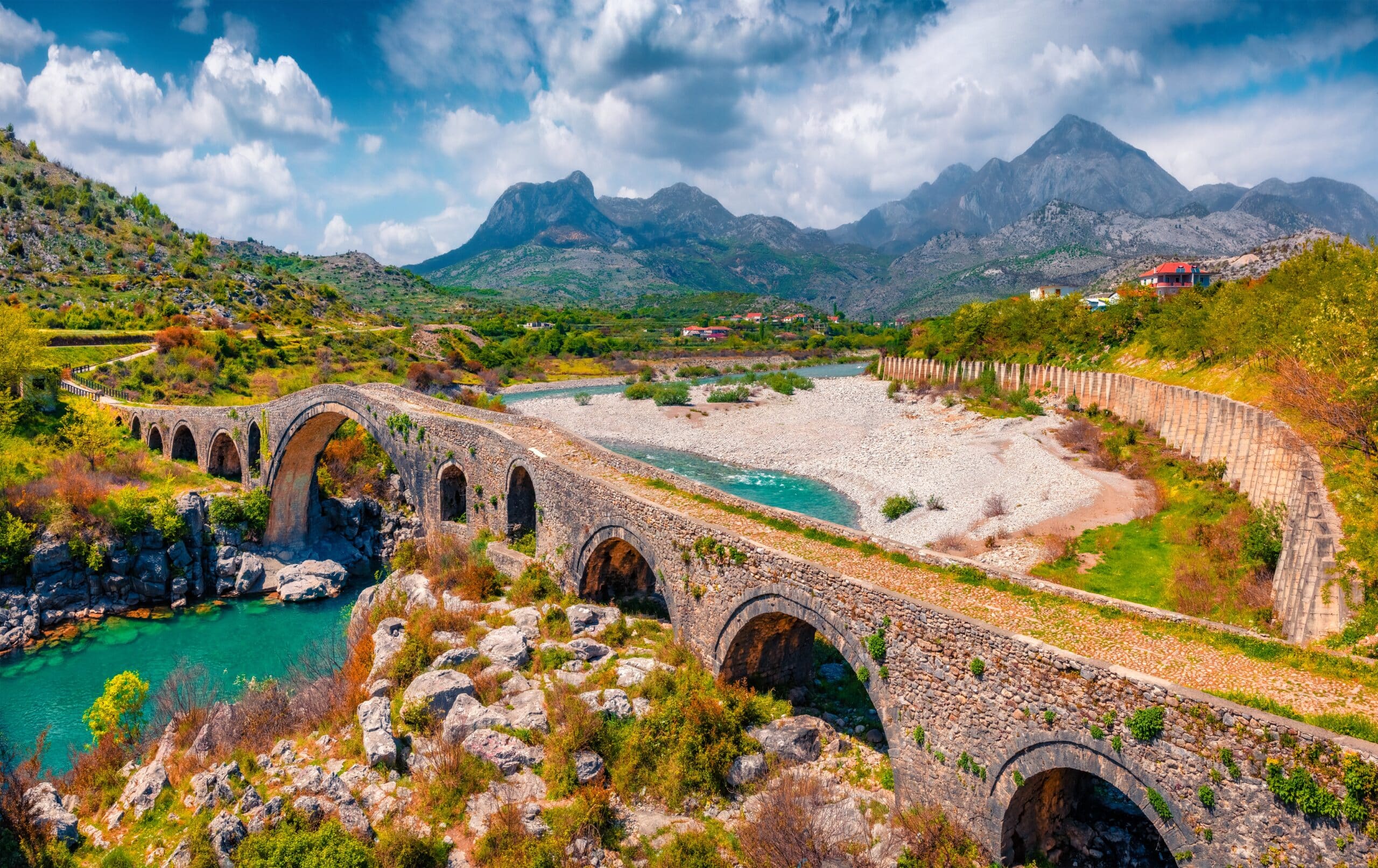
Tucked between the turquoise waters of the Adriatic and Ionian seas and the dramatic peaks of the Balkan mountains, Albania remains one of Europe’s most intriguing and least explored destinations. For centuries the country stood isolated from much of the outside world, preserving landscapes, traditions, and historic towns that feel remarkably authentic today.
Traveling through Albania is like stepping into a mosaic of cultures shaped by ancient civilizations and powerful empires. Illyrian tribes first inhabited these lands long before the arrival of the Roman Empire, whose roads and amphitheaters still dot the countryside. Later came the Byzantine Empire, the Ottoman Empire, and eventually the struggles for national independence that forged modern Albania.
Yet history is only one part of the country’s charm.
The landscapes here feel wonderfully untamed. Jagged mountains rise abruptly from fertile valleys, crystal rivers wind through deep gorges, and long beaches stretch along a coast that rivals the Mediterranean’s most famous shores. The rugged beauty of the Albanian Alps contrasts with the sun-soaked villages of the Albanian Riviera, where olive groves tumble down toward brilliant blue water.
Equally memorable is Albania’s warm and generous hospitality. Visitors are often welcomed with strong coffee, homemade raki, and plates of traditional dishes such as byrek, grilled lamb, and fresh seafood caught along the coast.
Despite its growing popularity among adventurous travelers, Albania still feels refreshingly undiscovered. Quiet mountain villages preserve centuries-old traditions, Ottoman-era towns remain beautifully intact, and archaeological sites reveal stories that stretch back thousands of years.
From vibrant cities and UNESCO-protected historic towns to remote alpine valleys and hidden beaches, Albania offers a travel experience filled with authenticity and discovery.
For those willing to venture beyond Europe’s well-worn routes, Albania reveals itself as a land of extraordinary beauty, fascinating history, and unforgettable journeys.
24. Tirana
The energetic heart of Albania beats in Tirana, a capital city that has transformed dramatically in the decades since the fall of communism.
Once dominated by gray concrete buildings and strict authoritarian rule under Enver Hoxha, Tirana has reinvented itself as a colorful and vibrant urban center. Brightly painted facades, lively cafés, and public art now fill the streets, creating a city that feels young, creative, and constantly evolving.
At the center of it all lies Skanderbeg Square, a vast plaza named after Albania’s national hero Gjergj Kastrioti Skanderbeg, who led resistance against the Ottomans in the 15th century. The square is surrounded by some of the capital’s most important landmarks, including the Et’hem Bey Mosque, one of the few religious buildings to survive the country’s communist era.
Nearby, visitors can explore Bunk’Art 2, a museum built inside a Cold War bunker that tells the story of Albania’s decades of isolation. The city is also known for its lively café culture, where locals gather for long conversations over espresso.
For a break from the busy streets, the nearby Mount Dajti offers sweeping views over the city and surrounding countryside.
Tirana’s energy, creativity, and complex history make it one of the most fascinating capitals in the Balkans.
23. Berat
On the banks of the Osum River, the historic town of Berat rises in terraces of white Ottoman houses climbing the hillside.
Often called the “City of a Thousand Windows,” Berat is one of Albania’s most beautiful and historic destinations. Its remarkable architecture and cultural heritage have earned it recognition as a UNESCO World Heritage Site.
The town’s story stretches back more than 2,400 years. Illyrians first built a fortress here, later expanded by the Roman Empire and the Byzantine Empire.
At the summit of the hill stands the impressive Berat Castle, one of the largest inhabited fortresses in the Balkans. Unlike many castles that exist only as ruins, this ancient citadel still contains homes, churches, and quiet streets where families have lived for generations.
Inside the castle walls visitors can discover the Onufri Museum, which houses remarkable religious icons created by the famous Albanian painter Onufri.
Across the river lies the historic Gorica Quarter, connected to the main town by the elegant Gorica Bridge.
At sunset, the white houses glow golden against the surrounding mountains, creating one of Albania’s most unforgettable scenes.
22. Gjirokastër
High above the Drino River, the remarkable town of Gjirokastër stands as one of the best-preserved Ottoman towns in the Balkans.
Often called the “Stone City,” Gjirokastër is known for its steep cobbled streets and distinctive houses built with gray stone roofs that cascade down the hillside. The town is protected as a UNESCO World Heritage Site due to its exceptional architectural heritage.
Dominating the skyline is the massive Gjirokastër Fortress, one of the largest castles in the Balkans. Its walls offer sweeping views over the valley and surrounding mountains.
Inside the fortress grounds lies an unusual sight — a Cold War-era American aircraft captured by Albania during the communist period, now displayed as part of the castle museum.
Gjirokastër is also famous as the birthplace of two influential figures: Albania’s former dictator Enver Hoxha and internationally renowned writer Ismail Kadare.
Exploring the old town reveals traditional Ottoman mansions such as Zekate House, where visitors can see how wealthy families once lived.
With its dramatic architecture, layered history, and mountain scenery, Gjirokastër feels like a place suspended between past and present.
21. Sarandë
Facing the turquoise waters of the Ionian Sea, the lively coastal city of Sarandë serves as one of the main gateways to the breathtaking Albanian Riviera. Located in southern Albania, just across the strait from Corfu, the city has become a favorite destination for travelers seeking sun, sea, and a relaxed Mediterranean atmosphere.
Sarandë stretches along a curved bay framed by hills covered in olive trees. Its waterfront promenade is lined with palm trees, cafés, and seafood restaurants where visitors linger over long lunches while watching ferries arrive from Greece.
Although modern hotels now dominate much of the shoreline, the area has a long history that stretches back to ancient times. Nearby ruins and archaeological sites reveal the layers of civilizations that once passed through this strategic coastal region.
During the evening, Sarandë comes alive. Locals and visitors stroll along the seaside promenade, stopping for gelato or coffee as the sun sets over the Ionian Sea. Restaurants serve freshly caught fish, grilled octopus, and traditional Albanian dishes accompanied by local wine or homemade raki.
The city also makes an excellent base for exploring the surrounding region. Some of Albania’s most famous natural and historical attractions lie just a short drive away, including the ancient ruins of Butrint and the crystal-clear beaches of Ksamil.
With its lively waterfront, beautiful sea views, and easy access to some of the country’s most spectacular sights, Sarandë captures the relaxed coastal spirit of southern Albania.
20. Butrint
Hidden among forests and lagoons near the southern coast of Albania, the remarkable ruins of Butrint reveal more than two thousand years of Mediterranean history.
Designated a World Heritage Site by UNESCO, Butrint is the most important archaeological site in Albania and one of the most fascinating ancient cities in the Balkans.
According to legend, the city was founded by refugees fleeing the fall of Troy, linking its story to the epic world of Greek mythology. Archaeological evidence shows that the site later flourished under the Greek civilization before becoming an important Roman colony.
Today, visitors can wander through an extraordinary collection of ruins scattered across a lush peninsula. Among the most impressive structures is the well-preserved Butrint Theatre, originally built during the Hellenistic period and later expanded by the Romans.
Nearby stand the remains of Roman baths, a basilica, defensive walls, and the elegant Lion Gate, which once guarded the city’s entrance.
What makes Butrint especially unique is its setting. The ruins lie within the protected wetlands of Butrint National Park, surrounded by forests, lagoons, and quiet waterways where birds and wildlife thrive.
Walking along shaded paths between ancient stone walls, visitors experience both the grandeur of classical history and the peaceful beauty of Albania’s natural landscape.
Butrint offers a journey through centuries of civilization, where Greek, Roman, Byzantine, and Venetian influences remain etched into the stones of this extraordinary ancient city.
19. Ksamil
Along the sparkling Ionian coast of southern Albania, the small seaside village of Ksamil has become famous for some of the most stunning beaches in the country.
Located just south of Sarandë and close to the ruins of Butrint, Ksamil feels like a slice of the Mediterranean paradise. White sand beaches meet shallow turquoise water, while small forested islands dot the bay just offshore.
These tiny islets are one of Ksamil’s most distinctive features. Visitors often rent small boats or kayaks to paddle out and explore them, swimming in the calm, clear water along the way.
The beaches themselves vary from lively resort areas with restaurants and beach bars to quieter coves where travelers can relax beneath umbrellas and listen to the gentle waves of the Ionian Sea.
Seafood is the highlight of the local cuisine. Restaurants serve freshly grilled fish, mussels harvested from nearby lagoons, and traditional Albanian dishes made with olive oil and herbs grown in the surrounding hills.
Because of its beauty, Ksamil has become increasingly popular in recent years, especially during summer. Yet early mornings and evenings still offer moments of quiet when the sea turns glassy and the islands glow in soft golden light.
With its brilliant water, island-dotted bay, and relaxed coastal atmosphere, Ksamil represents the most tropical side of Albania’s Riviera — a place where the colors of the sea rival those of the Caribbean.
18. Theth
Hidden deep within the dramatic peaks of the Albanian Alps, the remote mountain village of Theth is one of the most breathtaking destinations in Albania.
Often called part of the “Accursed Mountains,” this rugged region feels worlds away from the busy coastal towns. Jagged limestone peaks rise sharply above green valleys, while crystal-clear rivers carve their way through forests and alpine meadows.
Theth sits at the heart of Theth National Park, a protected landscape known for its dramatic scenery and traditional mountain culture. For centuries the village remained isolated, accessible only by difficult mountain paths. Today a winding road connects it with the northern city of Shkodër, though the journey still feels like an adventure.
One of the village’s most iconic landmarks is the charming Church of Theth, a small white stone church standing alone in a wide meadow surrounded by towering mountains.
Nearby stands the historic Lock-in Tower, a fortified refuge once used during blood feuds under the traditional Albanian code of honor known as the Kanun.
Visitors often hike through the valley to discover the natural beauty surrounding the village. Trails lead to waterfalls, hidden springs, and the famous Blue Eye of Theth, a stunning natural pool fed by icy mountain water.
In the evenings, guesthouses serve hearty traditional meals — lamb, fresh cheese, homemade bread, and mountain tea.
With its dramatic landscapes and preserved traditions, Theth offers a glimpse into Albania’s wild and timeless alpine world.
17. Valbona Valley
Across the rugged peaks of the Albanian Alps, another extraordinary mountain landscape unfolds within Valbona Valley National Park.
This spectacular valley is often described as the crown jewel of northern Albania. Towering limestone mountains rise dramatically above the wide valley floor, where the crystal-clear Valbona River flows through forests and open meadows.
The valley’s beauty lies in its scale and serenity. Unlike many alpine regions in Europe, Valbona remains relatively untouched by mass tourism. Small guesthouses and family farms dot the landscape, preserving a traditional way of life that has existed for generations.
Hiking is the main attraction here. Trails wind through forests of beech and pine, climb high mountain passes, and lead to panoramic viewpoints overlooking the valley.
One of the most famous routes connects Valbona with the remote village of Theth. This challenging but rewarding trek crosses a high mountain pass, offering some of the most spectacular views in the Balkans.
Wildlife is abundant in the surrounding mountains. Brown bears, wolves, and lynx inhabit the forests, though they are rarely seen by visitors.
During summer, the valley fills with wildflowers and the sound of rushing water from melting snow high in the peaks.
Evenings are peaceful and quiet. Travelers gather in wooden guesthouses to share stories over traditional meals prepared with local ingredients.
For those seeking pristine nature and true mountain adventure, Valbona Valley represents one of the most unforgettable landscapes in Albania.
16. Shkodër
Located between rivers, mountains, and lakes, the historic city of Shkodër is widely regarded as the cultural heart of northern Albania.
With a history stretching back more than two millennia, Shkodër is one of the oldest cities in the Balkans. It has long been a crossroads of civilizations, shaped by Illyrians, Romans, Venetians, and Ottomans.
The city’s most impressive landmark is the legendary Rozafa Castle, which stands on a hill overlooking the meeting point of the Drin River, Buna River, and Kir River.
According to local legend, the castle’s walls were strengthened through a tragic sacrifice. A young woman named Rozafa was immured within the structure so that it would stand forever — a story still remembered throughout the region.
The city itself has a lively and artistic atmosphere. Pedestrian streets in the historic center are lined with colorful buildings, cafés, and galleries where locals gather to socialize late into the evening.
Nearby lies the vast Lake Shkodër, the largest lake in the Balkans, shared between Albania and Montenegro. Its wetlands are home to hundreds of bird species, making it an important destination for nature lovers.
Shkodër also serves as the main gateway to the dramatic mountains of the Albanian Alps, including the villages of Theth and Valbona.
With its deep history, vibrant culture, and beautiful natural surroundings, Shkodër remains one of Albania’s most fascinating and welcoming cities.
15. Krujë
Perched on a mountainside north of Tirana, the historic town of Krujë stands as one of the most important symbols of national identity in Albania.
For Albanians, Krujë is inseparable from the story of the national hero Gjergj Kastrioti Skanderbeg, who led a long and determined resistance against the Ottoman Empire in the 15th century. From the fortress here, Skanderbeg successfully defended the region through a series of sieges that became legendary throughout Europe.
Dominating the town is the imposing Krujë Castle, whose stone walls still overlook the surrounding plains. Inside the fortress stands the Skanderbeg Museum, dedicated to the life and legacy of Albania’s greatest historical figure. The museum displays weapons, artifacts, and historical exhibits that recount the dramatic battles fought for independence.
Just below the castle lies one of the most charming spots in the town — the traditional Old Bazaar of Krujë. This narrow cobbled street is lined with small wooden shops selling handcrafted goods, from woven carpets and copperware to traditional clothing and souvenirs.
Walking through the bazaar feels like stepping back in time. The scent of mountain herbs and leather fills the air while artisans demonstrate centuries-old crafts.
From Krujë’s terraces and viewpoints, visitors enjoy sweeping panoramas across the plains toward the Adriatic Sea.
With its powerful historical legacy and traditional atmosphere, Krujë remains one of Albania’s most meaningful and evocative destinations.
14. Durrës
Stretching along the Adriatic coast west of Tirana, the bustling city of Durrës is both Albania’s largest port and one of its oldest continuously inhabited settlements.
Founded in the 7th century BCE by Greek colonists, the city quickly became an important trading center. Later it flourished under the Roman Empire, when it served as the starting point of the famous Via Egnatia, the ancient road connecting the Adriatic with Constantinople.
The most impressive reminder of this Roman past is the enormous Durrës Amphitheatre, the largest Roman amphitheater in the Balkans. Built in the 2nd century, the arena once held around 20,000 spectators who gathered to watch gladiator battles and public spectacles.
Over the centuries, Durrës passed through many hands, including the Byzantine Empire, the Republic of Venice, and the Ottoman Empire. Each left traces in the city’s architecture and fortifications.
Today Durrës combines historical sites with lively seaside tourism. Long sandy beaches stretch south of the city, attracting both locals and visitors during the summer months.
Along the waterfront promenade, cafés and seafood restaurants offer views of the Adriatic while serving freshly grilled fish and traditional Albanian dishes.
With its mix of ancient history and modern seaside life, Durrës offers a fascinating glimpse into Albania’s long connection with the Mediterranean world.
13. Llogara Pass
High above the sparkling Ionian Sea, the dramatic curves of Llogara Pass create one of the most breathtaking drives in Albania.
The road winds through the rugged mountains of Llogara National Park, climbing more than 1,000 meters above the coastline before descending toward the famous villages of the Albanian Riviera.
As the road rises, the scenery transforms dramatically. Mediterranean vegetation gives way to dense forests of pine and fir, while panoramic viewpoints reveal the brilliant blue waters of the Ionian far below.
Travelers often stop at roadside terraces where local restaurants serve grilled lamb, mountain cheese, and honey harvested from alpine flowers.
One of the most famous viewpoints is known as Caesar’s Pass. According to legend, the Roman leader Julius Caesar once crossed this mountain route while pursuing his rival Pompey during the Roman civil war.
Today the pass is popular not only with road travelers but also with hikers and paragliders who launch from the cliffs overlooking the sea.
From the highest points, the view stretches across the Ionian coast toward distant islands of Greece.
Driving through Llogara Pass offers one of the most unforgettable travel experiences in Albania — a journey where mountains, forests, and sea come together in spectacular harmony.
12. Himarë
Along the dazzling coastline of the Albanian Riviera, the relaxed seaside town of Himarë offers a perfect blend of beach life, history, and Mediterranean charm in southern Albania.
Unlike some of the region’s busier resorts, Himarë retains a laid-back atmosphere where life moves at a slower pace. The town stretches along a curved bay with clear turquoise waters and a lively waterfront promenade lined with small cafés and family-run restaurants.
Fresh seafood is a highlight here. Local taverns serve grilled fish, shrimp, and traditional Albanian dishes accompanied by olive oil produced in nearby groves. As the evening approaches, the promenade fills with locals and travelers enjoying the cool sea breeze and the glow of the sunset over the Ionian Sea.
Above the modern town rises the historic Himarë Castle, an ancient hilltop settlement with sweeping views of the coast. Inside its weathered stone walls stand the remains of old churches, houses, and narrow alleyways that reveal the town’s long and complex history.
The region surrounding Himarë is dotted with beautiful beaches and small villages. Quiet coves with crystal-clear water lie hidden between rocky cliffs, while olive trees and citrus groves cover the hillsides.
Himarë has long been influenced by both Albanian and Greek cultures, which can be seen in the language, architecture, and cuisine of the area.
With its relaxed coastal atmosphere and stunning natural surroundings, Himarë captures the easygoing spirit of the Albanian Riviera.
11. Dhërmi
Clinging to the slopes of the Ceraunian Mountains, the picturesque village of Dhërmi overlooks one of the most spectacular stretches of coastline in Albania.
The village itself sits high above the sea, where narrow cobbled streets wind between whitewashed houses, old churches, and shaded courtyards filled with flowers. From almost every corner, sweeping views open across the deep blue waters of the Ionian Sea.
Below the village lies Dhërmi Beach, widely considered one of the most beautiful beaches along the Albanian Riviera. Its long stretch of pale pebbles and crystal-clear water attracts visitors looking for both relaxation and adventure.
In recent years, Dhërmi has also become known for its lively summer scene. Beach clubs and music festivals draw younger travelers, while quieter areas remain perfect for swimming and enjoying the peaceful coastal scenery.
Despite its growing popularity, the village has preserved much of its traditional character. Stone houses, small Orthodox churches, and ancient olive groves reflect centuries of life along this rugged coast.
Hiking trails from the village lead through mountain landscapes filled with wild herbs and Mediterranean vegetation.
Whether exploring its historic streets or relaxing by the sea, Dhërmi offers a beautiful balance of culture, nature, and seaside charm.
10. Apollonia
Among rolling hills near the Adriatic coast lies one of the most important archaeological sites in Albania: the ancient city of Apollonia.
Founded in the 6th century BCE by Greek colonists from Corfu and Corinth, Apollonia quickly became a thriving center of trade and culture. At its height, the city was home to tens of thousands of people and served as an important stop along the Via Egnatia, the famous Roman road linking the Adriatic with the eastern Mediterranean.
During the time of the Roman Empire, Apollonia flourished as a prosperous and influential city. The young Augustus, who later became the first Roman emperor, even studied philosophy here.
Today visitors can wander among the atmospheric ruins scattered across a wide hillside. Remains of temples, public buildings, and ancient streets offer glimpses into the city’s former grandeur.
One of the most striking structures is the Monastery of St. Mary, a beautiful medieval monastery built within the ancient city’s walls. The monastery now houses a museum displaying sculptures, mosaics, and artifacts discovered at the site.
Surrounded by olive groves and quiet countryside, Apollonia has a peaceful and almost timeless atmosphere.
Walking among its columns and stone paths, visitors encounter the echoes of ancient civilizations that once shaped the Mediterranean world.
9. Korçë
In the fertile plains of southeastern Albania, near the border with Greece, lies the elegant cultural city of Korçë. Often considered one of the most refined cities in the country, Korçë is known for its intellectual traditions, historic architecture, and vibrant artistic life.
Unlike many other Albanian towns shaped primarily by Ottoman influence, Korçë developed a more European character during the 19th and early 20th centuries. Tree-lined boulevards, French-style villas, and lively public squares give the city a unique atmosphere.
At the center of Korçë stands the impressive Korçë Cathedral, one of the largest Orthodox churches in Albania. Nearby, museums and galleries celebrate the city’s contributions to education, literature, and music.
Korçë is particularly famous for its traditional serenades — romantic songs performed by small groups of musicians during evening gatherings. These melodies, often accompanied by guitars and mandolins, have become a cherished part of the city’s cultural identity.
The city is also home to Birra Korça, Albania’s oldest brewery, founded in 1928. Visitors can sample the locally brewed beer in restaurants and taverns throughout the city.
Just outside Korçë lies the charming mountain village of Dardhë, known for its alpine scenery and traditional stone houses.
With its artistic spirit, historic charm, and relaxed atmosphere, Korçë offers travelers a different perspective on Albania — one rooted in culture, creativity, and tradition.
8. Pogradec
On the shores of one of Europe’s oldest and deepest lakes lies the peaceful town of Pogradec, a charming destination in eastern Albania.
The town sits along the western edge of Lake Ohrid, a vast and ancient body of water shared between Albania and North Macedonia. Estimated to be more than three million years old, the lake is recognized as a UNESCO World Heritage Site because of its extraordinary biodiversity and cultural significance.
Pogradec itself has a calm and welcoming atmosphere. A scenic lakeside promenade stretches along the shore, where locals stroll in the evenings and fishermen cast their lines into the clear blue water.
The lake is famous for its unique species, particularly the rare Ohrid trout, a delicacy often served in local restaurants grilled or baked with herbs.
Not far from the town lies Drilon Park, a peaceful natural area filled with springs, canals, and swans gliding across tranquil waters.
Pogradec is also closely connected to Albanian literature. The beloved poet Lasgush Poradeci was born here, and his works often celebrate the beauty of Lake Ohrid and the surrounding landscapes.
With its serene scenery, rich cultural connections, and refreshing lakeside air, Pogradec offers a quiet retreat far from the busy coastal resorts.
7. Prespa Lakes
Far from the busy cities and coastal resorts, the remote region of the Prespa Lakes offers one of the most tranquil landscapes in Albania.
Located at the meeting point of Albania, North Macedonia, and Greece, this unique ecosystem consists of two interconnected lakes: Great Prespa Lake and Small Prespa Lake.
Surrounded by mountains and remote villages, the Prespa region feels wonderfully untouched by modern tourism. Quiet rural communities preserve traditional ways of life, where agriculture and fishing remain central to daily living.
The lakes themselves are renowned for their ecological importance. The surrounding wetlands provide habitat for many rare bird species, including the impressive Dalmatian pelican, one of the largest flying birds in the world.
In Albania, the lakes are protected as part of Prespa National Park, a cross-border conservation area created to safeguard the region’s unique wildlife and natural beauty.
Small villages such as Liqenas sit quietly along the lakeshore, where visitors can enjoy peaceful views of the water and surrounding mountains.
Fishing boats glide across the calm surface while shepherds graze livestock in nearby meadows. The rhythm of life here remains slow and deeply connected to nature.
For travelers willing to venture off the main tourist routes, the Prespa Lakes reveal a hidden side of Albania — one defined by silence, wild landscapes, and timeless rural traditions.
6. Vlorë
Along the meeting point of the Adriatic and Ionian seas stands the historic coastal city of Vlorë, one of the most significant places in the story of Albania.
For centuries, Vlorë served as an important port connecting the Balkans with the wider Mediterranean world. Yet the city’s most defining moment came in 1912, when Albania declared independence from the Ottoman Empire here under the leadership of Ismail Qemali.
Today this historic event is commemorated at the Independence Monument and the nearby Museum of Independence, where visitors can learn about the country’s struggle for sovereignty.
Beyond its historical significance, Vlorë has become an increasingly popular seaside destination. A long coastal promenade lined with palm trees stretches along the waterfront, filled with restaurants, cafés, and lively evening gatherings.
The surrounding coastline offers beautiful beaches and scenic views across the bay. From the city, travelers can see the rugged outline of the Karaburun Peninsula and the mysterious Sazan Island rising from the sea.
Local cuisine highlights the rich marine life of the Adriatic. Fresh fish, grilled squid, and seafood risotto are staples of many restaurants along the shore.
As the sun sets over the bay, the city glows with warm Mediterranean light, and the promenade fills with locals enjoying the evening breeze.
With its blend of national history, seaside beauty, and vibrant culture, Vlorë remains one of Albania’s most meaningful coastal cities.
5. Karaburun Peninsula
Stretching between the Adriatic and Ionian seas, the rugged Karaburun Peninsula forms one of the wildest and least developed coastlines in Albania.
Protected as part of Karaburun-Sazan Marine Park, this remote peninsula is a paradise of dramatic cliffs, hidden coves, and crystal-clear water. Much of the coastline is inaccessible by road, giving it an unspoiled character rarely found along the Mediterranean.
The peninsula rises steeply from the sea, covered with Mediterranean shrubs and forests of pine and oak. Hiking trails wind across the hills, offering panoramic views of the sparkling coastline below.
One of the most remarkable features of Karaburun is its network of sea caves carved into the limestone cliffs. Among them is the impressive Haxhi Ali Cave, a massive cavern associated with legends of pirates and sailors who once used it as a hidden refuge.
Boat trips departing from Vlorë often explore these caves and secluded beaches, where swimmers can dive into incredibly clear water.
The peninsula is also important for marine biodiversity. Dolphins, sea turtles, and numerous fish species inhabit the protected waters of the surrounding marine park.
Because of its remote location and protected status, Karaburun remains one of the most pristine coastal landscapes in the Balkans.
For travelers seeking wild nature and untouched scenery, this dramatic peninsula offers a rare glimpse of the Adriatic as it once was.
4. Sazan Island
Just off the coast near Vlorë, the rugged silhouette of Sazan Island rises from the waters where the Adriatic Sea meets the Ionian.
For decades, this isolated island was one of the most secretive places in Albania. During the communist era under Enver Hoxha, Sazan served as a heavily fortified military base, filled with bunkers, tunnels, and artillery positions designed to defend the country from potential invasion.
Because of its strategic location at the entrance to the Bay of Vlorë, the island was strictly closed to civilians for much of the 20th century.
Today, however, parts of Sazan are slowly opening to visitors. Boat excursions now allow travelers to explore sections of the island and learn about its unusual history.
Walking along its abandoned military roads, visitors encounter rows of concrete bunkers, crumbling barracks, and hidden tunnels carved into the hillsides — relics of Albania’s Cold War isolation.
Yet nature has begun reclaiming the island. Mediterranean vegetation spreads across the hills, and seabirds nest along the rocky cliffs.
The surrounding waters, protected within Karaburun-Sazan Marine Park, are remarkably clear and rich in marine life.
Because it remained closed for so long, the island has developed a rare combination of historical intrigue and untouched natural beauty.
Sazan Island stands today as one of Albania’s most unusual destinations — a place where Cold War history meets the quiet rhythms of the Adriatic Sea.
3. Syri i Kaltër
Hidden in the lush countryside of southern Albania, the natural spring known as Syri i Kaltër appears almost unreal. Its name translates to “Blue Eye,” and once visitors see it, the reason becomes immediately clear.
The spring forms a perfectly round pool of deep sapphire water surrounded by dense forest. At its center lies a dark, seemingly bottomless hole from which icy water surges upward with tremendous force. The vivid color gradients — deep indigo in the middle fading into turquoise and emerald — create the illusion of a giant eye gazing upward from the earth.
Scientists estimate the spring’s depth at over fifty meters, though its exact bottom remains unknown due to the powerful underwater currents. Millions of liters of crystal-clear water pour out every hour, eventually feeding the nearby Bistricë River.
The surrounding nature reserve is filled with oak and sycamore trees, creating a peaceful setting of shade, birdsong, and flowing water. Wooden walkways allow visitors to approach the spring while protecting the delicate environment.
Although the water remains extremely cold year-round, some adventurous travelers still take a quick plunge during the warm summer months.
Small cafés and local vendors nearby serve traditional dishes and refreshing drinks, allowing visitors to relax while enjoying the tranquil scenery.
The Blue Eye is one of Albania’s most enchanting natural wonders — a place where geology, myth, and beauty merge into a single unforgettable sight.
2. Osum Canyon
Cut deep into the limestone mountains of southern Albania, the dramatic Osum Canyon is often called the country’s own Grand Canyon.
Carved over millions of years by the flowing Osum River, the canyon stretches for more than 25 kilometers near the historic town of Çorovodë. Towering cliffs rise up to 100 meters high, their vertical walls revealing layers of rock shaped by ancient geological forces.
In spring, when snowmelt fills the river, the canyon becomes one of Albania’s top rafting destinations. Adventure seekers navigate the twisting river through narrow passages, hidden caves, and waterfalls cascading down the cliffs.
During summer and autumn, when water levels drop, the canyon transforms into a paradise for hiking and exploration. Travelers can walk along the riverbed, discovering natural pools, rock formations, and secluded sections of the gorge.
Several small waterfalls tumble down the canyon walls, creating refreshing swimming spots during warmer months.
The canyon’s cliffs are dotted with caves and unusual rock formations that locals have named after their shapes. One formation, for example, resembles a giant cathedral rising above the river.
Despite its dramatic beauty, Osum Canyon remains relatively unknown outside Albania, giving visitors the rare chance to explore a spectacular landscape without large crowds.
For those seeking both adventure and breathtaking scenery, Osum Canyon offers one of the country’s most thrilling natural experiences.
1. Mount Tomorr
Rising proudly above the landscapes of central Albania, the majestic Mount Tomorr has long been considered one of the country’s most sacred mountains.
Standing over 2,400 meters tall, Tomorr dominates the surrounding region with rugged peaks, alpine meadows, and sweeping panoramic views. Yet its importance extends far beyond its natural beauty.
For centuries, the mountain has been associated with spiritual traditions and ancient legends. It holds special significance for followers of the Bektashi Order, a mystical Islamic tradition with deep roots in Albanian culture.
Every August, thousands of pilgrims climb the mountain during a religious gathering held at the Abaz Ali Shrine, located high on Tomorr’s slopes. The event blends spiritual devotion with festive celebrations, music, and shared meals.
Even outside the pilgrimage season, Mount Tomorr attracts hikers and nature lovers. Trails lead through forests and rocky ridges toward the summit, where spectacular views stretch across the mountains and valleys of Albania.
Wildflowers bloom across the alpine meadows during summer, and shepherds still graze their flocks on the high pastures.
The mountain is protected within Tomorr National Park, preserving its diverse ecosystems and traditional landscapes.
Standing atop Tomorr at sunset, with the vast Albanian countryside unfolding below, travelers often feel a deep sense of connection to the land and its long history.
Mount Tomorr is more than just a mountain — it is a symbol of Albania’s spiritual heritage, natural beauty, and enduring traditions.