
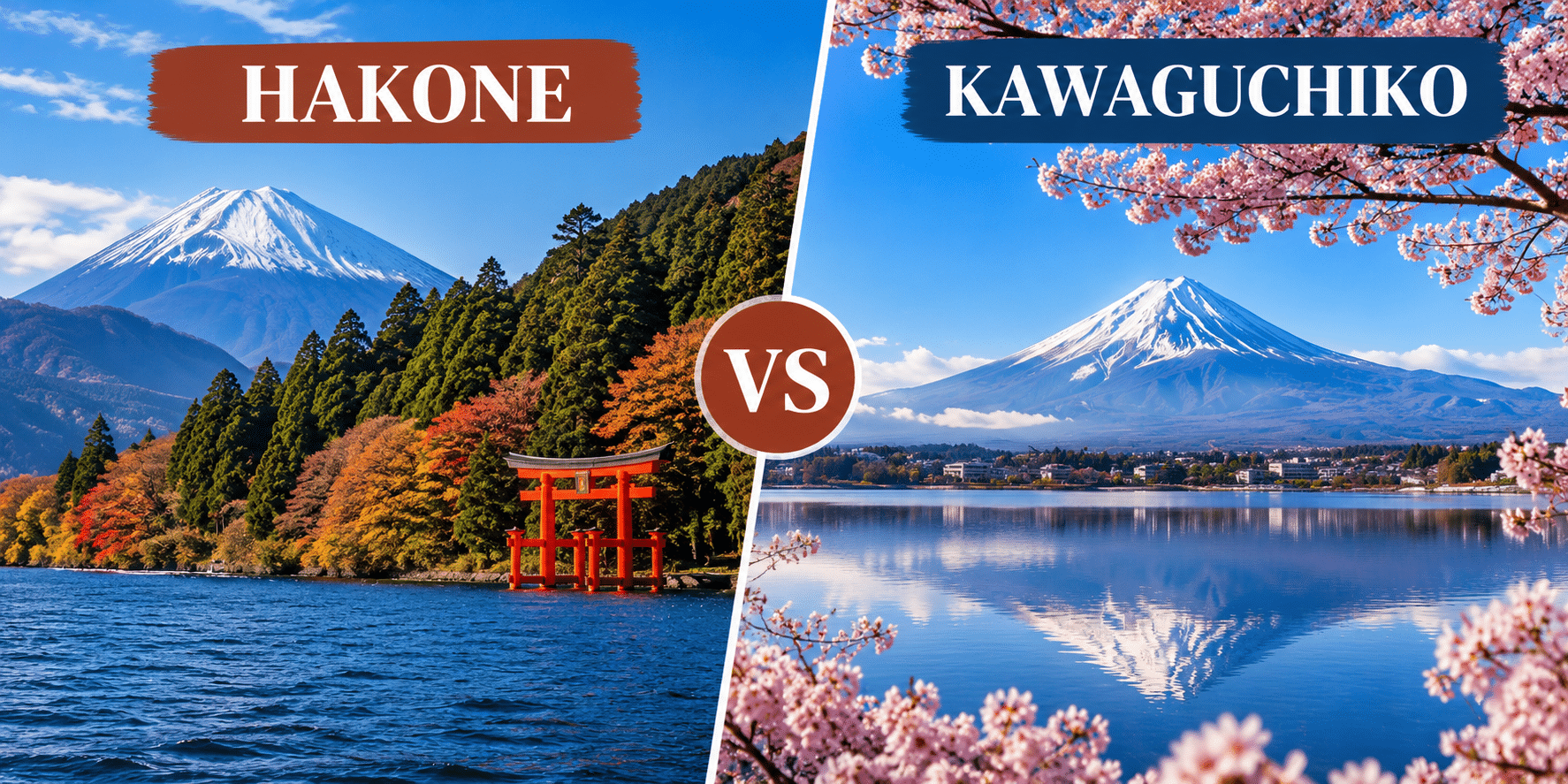
Hakone and Kawaguchiko are two of the most popular escapes from Tokyo for travelers hoping to experience Mt Fuji — but they offer very different kinds of trips.
Hakone is the more varied destination. It combines hot springs, traditional ryokan stays, mountain scenery, Lake Ashi, volcanic landscapes, museums, and a famous sightseeing loop — with Mt Fuji appearing as a spectacular bonus when the weather cooperates.
Kawaguchiko, on the other hand, puts Mt Fuji much more firmly at the center of the experience. The mountain dominates the landscape around Lake Kawaguchi, creating some of Japan’s most iconic views and making the area especially appealing for photography, seasonal scenery, cycling, and slower lakeside exploration.
That difference is the key to choosing between them.
🗻 If seeing Mt Fuji is the main reason for your trip, Kawaguchiko will usually be the better choice. If you want Fuji to be part of a broader experience with onsen, sightseeing, scenery, and a memorable ryokan stay, Hakone will usually suit you better.
Neither destination is automatically the better choice. Weather can completely change the experience, staying overnight can be far more rewarding than visiting for the day, and your ideal destination depends on whether you care most about Fuji views, photography, onsen, attractions, relaxation, or variety.
In this comparison, we’ll look at the differences that actually matter — from Mt Fuji views and scenery to things to do, onsen, ryokan stays, transport, day trips, overnight stays, seasons, and bad-weather options — so you can decide whether Hakone or Kawaguchiko deserves a place in your Japan itinerary.
Quick Answer: Hakone or Kawaguchiko?
Choose Kawaguchiko if seeing Mt Fuji is the main reason for your trip. The mountain feels much more dominant here, with classic lake-and-Fuji views, excellent photography opportunities, and beautiful seasonal scenery.
Choose Hakone if you want a more varied destination experience. You can combine possible Mt Fuji views with onsen, a traditional ryokan stay, Lake Ashi, volcanic scenery, museums, and the Hakone sightseeing loop.
- You want an onsen or ryokan experience
- You prefer more sightseeing variety
- Museums and attractions matter to you
- You want plenty to do even if Fuji is hidden
- Mt Fuji is a bonus rather than the entire purpose of the trip
- Seeing Mt Fuji is your top priority
- You want iconic Fuji photography
- You prefer lakeside scenery and slower exploration
- You want Fuji to dominate the landscape
- You are visiting for seasonal Fuji views
The simplest way to decide: Kawaguchiko is usually better when Mt Fuji itself is the destination. Hakone is usually better when you want Mt Fuji to be one part of a broader Japan experience.
Table of Contents
Hakone vs Kawaguchiko at a Glance
If you are choosing between Hakone and Kawaguchiko, the biggest difference is not simply which destination has more attractions. It is what you want the trip to be about. Here is the quick comparison before we look at each category in more detail.
Hakone wins on variety. It offers the stronger mix of onsen, ryokan, sightseeing, museums, transport experiences, and scenery. Kawaguchiko wins when Mt Fuji is the priority. Its greatest strength is giving you more opportunities to make the mountain the centerpiece of your trip.
The Biggest Difference: Hakone Is a Destination — Kawaguchiko Is About Fuji
Hakone and Kawaguchiko are often treated as interchangeable Mt Fuji destinations, but that is slightly misleading. The role Mt Fuji plays in each trip is very different.
In Hakone, Mt Fuji is one highlight among many. You might see the mountain from Lake Ashi, the ropeway area, or other viewpoints, but much of the Hakone experience has little to do with Fuji itself.
Think onsen, ryokan, Lake Ashi, volcanic landscapes, museums, mountain transport, and sightseeing — with Mt Fuji appearing as an impressive extra when conditions are clear.
Think Mt Fuji views, Lake Kawaguchi, photography, seasonal landscapes, cycling, viewpoints, and quiet lakeside time. Fuji is not a bonus here — it is the visual centerpiece.
That distinction becomes especially important when the weather changes.
If clouds completely hide Mt Fuji during a day in Hakone, you can still soak in an onsen, visit the Hakone Open-Air Museum, explore Owakudani, cruise across Lake Ashi, or simply enjoy your ryokan. The trip can still feel worthwhile without seeing Fuji at all.
In Kawaguchiko, cloudy weather has a bigger impact. There are still things to do around the lake, but many of the area’s most memorable experiences — viewpoints, photography spots, lakeside panoramas, and Fuji-view accommodation — become significantly less impressive when the mountain disappears.
Kawaguchiko is the stronger Mt Fuji destination. Hakone is the stronger all-round destination. If your trip would feel disappointing without a clear view of Fuji, Kawaguchiko gives you the experience you are probably imagining. If you want a destination that remains rewarding whether Fuji appears or not, Hakone has the advantage.
What Does a Trip to Hakone Feel Like?
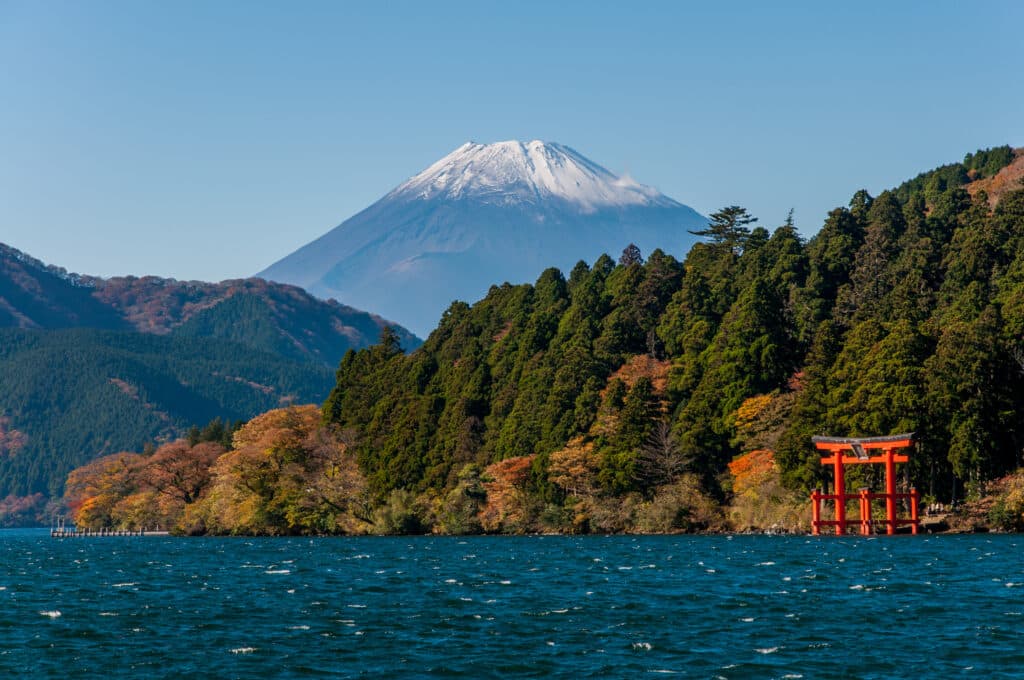
Hakone feels less like visiting one specific attraction and more like moving through a collection of different experiences. Mountains, forests, hot springs, volcanic landscapes, museums, Lake Ashi, and traditional inns are spread across the region, connected by trains, buses, cable cars, a ropeway, and sightseeing boats.
That variety is one of Hakone’s biggest strengths.
Hakone is one of the easiest places near Tokyo to build a trip around hot springs and a traditional ryokan stay.
Trains, cable cars, the ropeway, buses, and boats make getting around feel like part of the sightseeing rather than simply transportation.
Owakudani adds something Kawaguchiko cannot really replicate: an active volcanic landscape with steaming vents and dramatic mountain scenery.
Places such as the Hakone Open-Air Museum give you worthwhile alternatives when the weather is not cooperating.
A typical first visit often follows some version of the Hakone sightseeing loop: traveling through the mountains, crossing the volcanic area around Owakudani, descending toward Lake Ashi, and continuing by boat or bus through another part of the region.
On a clear day, Mt Fuji can suddenly appear during that journey — and that is part of Hakone’s appeal. You are not necessarily looking at Fuji all day. Instead, the mountain becomes one spectacular element within a much broader landscape.
This also makes Hakone particularly good for travelers who like active sightseeing during the day followed by a slower evening. You can spend several hours exploring, then check into a ryokan, soak in an onsen, have dinner, and let the pace of the trip change completely.
Hakone is best for travelers who want variety. Choose it if your ideal escape from Tokyo combines scenery, sightseeing, unusual transport, onsen, and a ryokan experience — with a clear view of Mt Fuji as a memorable bonus rather than the only reason for going.
What Does a Trip to Kawaguchiko Feel Like?
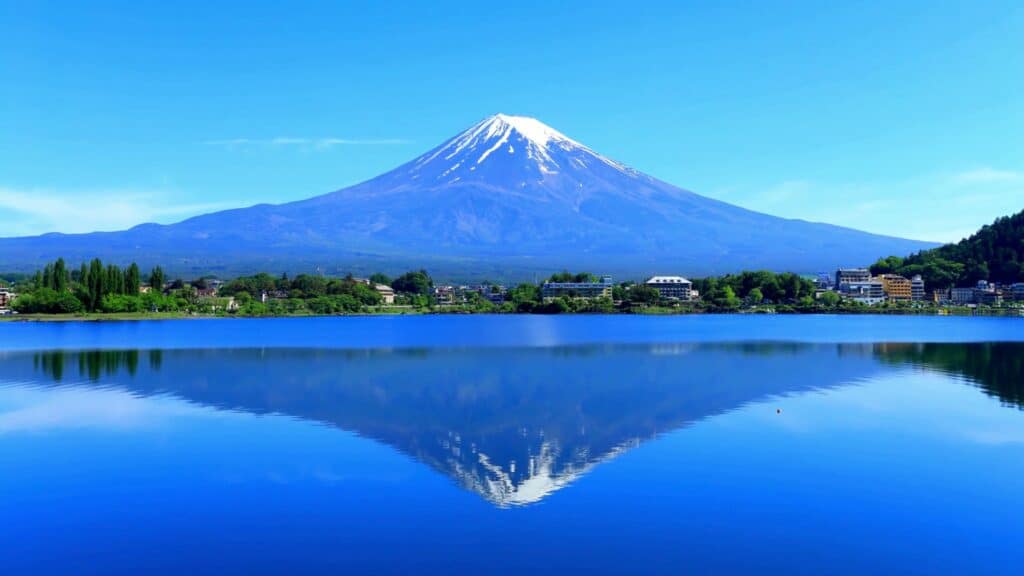
Kawaguchiko feels very different from Hakone. Instead of moving through a long sightseeing circuit, the experience is more about slowing down and enjoying Mt Fuji from different perspectives.
The mountain is the defining feature of the landscape. On a clear day, Fuji rises dramatically beyond Lake Kawaguchi and can appear almost everywhere — from lakeside paths and parks to cafés, hotel rooms, onsen, and quiet roads around the northern shore.
Kawaguchiko gives you some of the most impressive opportunities to see Mt Fuji as the dominant feature of the landscape.
Lake Kawaguchi creates the classic combination of water, mountains, and Fuji, particularly along the quieter northern shore.
Sunrise light, reflections, cherry blossoms, flowers, and autumn leaves make Kawaguchiko especially rewarding for Fuji photography.
Walking or cycling around parts of the lake encourages a slower style of travel, with viewpoints, parks, cafés, and small stops along the way.
There are attractions around Kawaguchiko, but trying to tick off as many of them as possible misses much of the destination’s appeal. A good day here can be surprisingly simple: see Fuji early in the morning, explore the lakeshore, stop at a viewpoint or café, and give yourself time to enjoy the landscape.
Nearby spots such as Oishi Park and the north shore of Lake Kawaguchi provide classic Fuji views, while the wider Fuji Five Lakes area gives travelers with more time opportunities to explore beyond the busiest parts of Kawaguchiko.
There is also the famous view of Mt Fuji from Chureito Pagoda in nearby Fujiyoshida. It is not directly beside Lake Kawaguchi, but it is close enough to be incorporated into many Kawaguchiko itineraries and has become one of the region’s signature viewpoints.
Kawaguchiko becomes particularly rewarding when you stay overnight. Day-trippers often arrive after the clearest part of the morning has passed, while overnight visitors can be outside early when Fuji visibility is often better and the lakeside atmosphere is quieter. A room or onsen with a direct Fuji view can also turn the accommodation itself into part of the experience.
Kawaguchiko is best for travelers who want Mt Fuji to be the experience. Choose it if your ideal trip revolves around spectacular Fuji views, photography, lakeside scenery, seasonal landscapes, and a slower pace rather than a long list of attractions.
Mt Fuji Views: Hakone or Kawaguchiko?
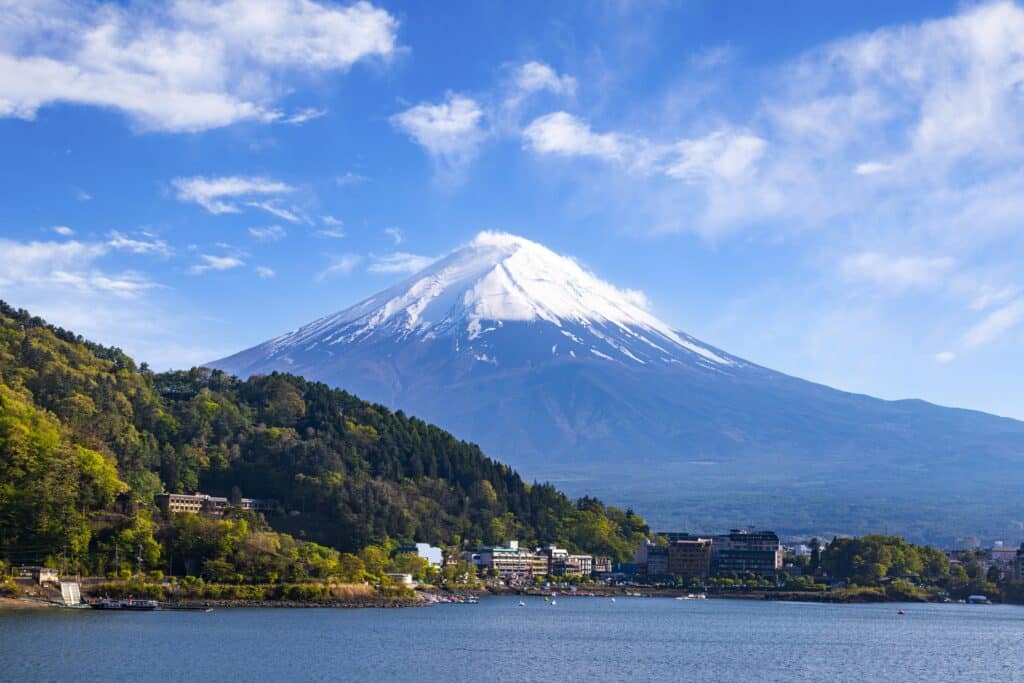
If seeing Mt Fuji is your main priority, this is the comparison that matters most — and there is a fairly clear winner.
Kawaguchiko generally offers the stronger Mt Fuji experience. Fuji feels closer, larger, and much more dominant in the landscape. Around Lake Kawaguchi, you can see the mountain from multiple viewpoints rather than relying on one particular sightseeing stop.
Hakone can deliver spectacular Fuji views, particularly around Lake Ashi and higher parts of the sightseeing route.
But Fuji is usually something you encounter at selected viewpoints rather than a constant presence throughout the day.
Kawaguchiko gives you far more opportunities to build your day around direct, expansive views of Mt Fuji.
The north shore of Lake Kawaguchi is particularly impressive because the lake creates a wide foreground beneath the mountain.
Where Kawaguchiko Has the Advantage
The biggest advantage is not simply that you can see Fuji. It is how much of the landscape the mountain occupies.
From the right side of Lake Kawaguchi, Mt Fuji rises almost directly beyond the water. Depending on the season and conditions, you can photograph Fuji with reflections, cherry blossoms, colorful flowers, autumn leaves, snow, or the lake itself in the foreground.
You also have several different Fuji-view experiences within the wider area, including Oishi Park, the northern lakeshore, elevated viewpoints, and nearby Fujiyoshida. That makes Kawaguchiko much better suited to travelers who want to spend several hours — or even an entire day — enjoying and photographing the mountain.
Hakone Can Still Deliver an Iconic Fuji View
Hakone should not be dismissed as a Fuji destination. On a clear day, the combination of Mt Fuji, Lake Ashi, forested mountains, and Hakone Shrine can be spectacular.
The difference is that Hakone’s Fuji views are part of a broader sightseeing experience. You may see the mountain beautifully for part of the day and then continue toward an onsen, museum, volcanic valley, or ryokan without seeing it again.
But Neither Destination Guarantees Mt Fuji
This is the most important reality to understand before planning either trip: Mt Fuji can disappear completely behind clouds.
Visibility can change rapidly, and a clear morning does not guarantee a clear afternoon. In general, early mornings tend to offer better chances of unobstructed views, which is one reason an overnight stay can be particularly valuable in Kawaguchiko.
If seeing Mt Fuji is one of the highlights of your Japan trip, avoid building an inflexible itinerary around a single afternoon viewpoint. Check the forecast, prioritize Fuji views early in the day, and — if possible — give yourself some flexibility to move the trip to a clearer day.
For Mt Fuji views alone, choose Kawaguchiko. Hakone can provide beautiful glimpses of Fuji, but Kawaguchiko gives the mountain a much bigger role in the landscape and offers more opportunities to experience it from different viewpoints.
Scenery: Which Is More Beautiful?
Both Hakone and Kawaguchiko are among the most scenic escapes from Tokyo, but they create very different visual experiences. Hakone offers more variety, while Kawaguchiko delivers the more dramatic Mt Fuji-centered landscape.
This is one category where choosing a winner makes little sense. The better destination depends on what kind of scenery you want to spend your time in.
Hakone changes constantly as you move through the region. One moment you are surrounded by forested mountains; later you may be crossing volcanic terrain, looking across Lake Ashi, or riding above the landscape on the ropeway.
The scenery feels layered and varied rather than dominated by one landmark.
Kawaguchiko has a simpler visual formula — lake, sky, seasonal landscapes, and Mt Fuji — but when conditions are right, that combination is difficult to beat.
Fuji feels much larger here and often becomes the dominant feature of the entire landscape.
Hakone Is Better for Changing Landscapes
A large part of Hakone’s appeal comes from moving through different environments. The mountain railway climbs through forested valleys, the ropeway opens up views across the surrounding mountains, Owakudani introduces a stark volcanic landscape, and Lake Ashi creates a completely different atmosphere again.
That makes Hakone particularly rewarding if you enjoy scenic variety throughout the day. You are not traveling to one famous panorama and then looking at variations of it — the landscape itself keeps changing.
Kawaguchiko Is Better for the Classic Japan Panorama
Kawaguchiko offers less variety, but its best scenery can be more immediately spectacular.
On a clear morning, seeing snow-capped Mt Fuji rising behind Lake Kawaguchi is one of those views that looks almost unreal in person. The wide lake creates space around the mountain, while different foregrounds allow the same basic panorama to change dramatically throughout the year.
Spring can bring cherry blossoms and other flowers, summer brings greener landscapes, autumn adds intense foliage, and winter often combines clearer skies with a snow-covered Fuji.
The Difference Becomes Bigger When Fuji Disappears
There is one important catch. Kawaguchiko’s scenic advantage depends heavily on Mt Fuji being visible.
If thick clouds hide the mountain, the lake and surrounding countryside are still pleasant, but the landscape loses its defining feature. Hakone is less dependent on a single view because forests, Lake Ashi, volcanic scenery, gardens, and mountain landscapes remain part of the experience regardless of Fuji visibility.
Choose Hakone for scenic variety; choose Kawaguchiko for the most dramatic Mt Fuji landscapes. Hakone gives you forests, mountains, volcanic terrain, and Lake Ashi in one trip. Kawaguchiko gives you fewer types of scenery, but on a clear day its combination of Mt Fuji and Lake Kawaguchi is hard to beat.
Things to Do: Which Has More Variety?

If you want a trip filled with different activities and sightseeing experiences, Hakone has the clear advantage. Kawaguchiko has plenty to keep you occupied, but many of its best experiences revolve around the same central theme: enjoying Mt Fuji and the surrounding landscape.
Hakone feels more like a traditional sightseeing destination, where the journey itself connects a series of very different attractions.
- Ride the Hakone Ropeway
- Explore the volcanic landscape of Owakudani
- Cross Lake Ashi by sightseeing boat
- Visit Hakone Shrine
- Explore the Hakone Open-Air Museum
- Soak in an onsen
- Stay in a traditional ryokan
- Travel the Hakone sightseeing loop
- Explore the shores of Lake Kawaguchi
- Photograph Mt Fuji from different viewpoints
- Visit Oishi Park
- Walk or cycle around parts of the lake
- Ride the Mt. Fuji Panoramic Ropeway
- Visit nearby Chureito Pagoda
- Enjoy seasonal flowers and autumn foliage
- Relax at a Fuji-view hotel or onsen
Hakone Is Better for Active Sightseeing
The biggest strength of Hakone is that each part of the day can feel different. You might begin on a mountain railway, continue by cable car and ropeway, walk through the volcanic landscape at Owakudani, cross Lake Ashi by boat, visit a shrine, and finish the day soaking in an onsen.
The famous Hakone sightseeing loop also gives first-time visitors a natural structure. Rather than constantly deciding what to do next, you can follow a route through many of the region’s major experiences.
Hakone’s museums add another layer. The Hakone Open-Air Museum is one of the standout attractions, while other art museums and gardens give you options that have little to do with Mt Fuji.
Kawaguchiko Is Better When You Do Less
Kawaguchiko works differently. There are attractions, but packing the day with sightseeing can actually make the experience worse.
Some of the best moments are remarkably simple: walking beside Lake Kawaguchi with Fuji in front of you, cycling between viewpoints, stopping for coffee with a mountain view, photographing reflections on the water, or spending longer than planned at a quiet spot along the northern shore.
That slower rhythm is not a disadvantage if it is what you want. In fact, travelers who find highly structured sightseeing days exhausting may prefer Kawaguchiko precisely because there is less pressure to keep moving from attraction to attraction.
What Happens If Mt Fuji Is Hidden?
This is where the difference becomes particularly important.
Hakone still has a strong sightseeing itinerary on a cloudy day. You can visit museums, explore the region, enjoy Lake Ashi, ride parts of the transport network, soak in an onsen, and spend time at your ryokan.
Kawaguchiko still has attractions and pleasant lakeside scenery, but if Fuji remains completely hidden, many of the experiences you probably traveled there for lose some of their impact.
Do not choose between these destinations by counting attractions. Choose Hakone if you enjoy having a full sightseeing itinerary. Choose Kawaguchiko if you are comfortable building the day around scenery rather than sights.
Hakone wins for sightseeing variety. There is simply a broader mix of experiences, from volcanic landscapes and museums to Lake Ashi, unusual transport, onsen, and ryokan stays. Kawaguchiko is better for travelers who prefer fewer attractions and more time enjoying Mt Fuji and the landscape.
Onsen & Ryokan: Hakone or Kawaguchiko?
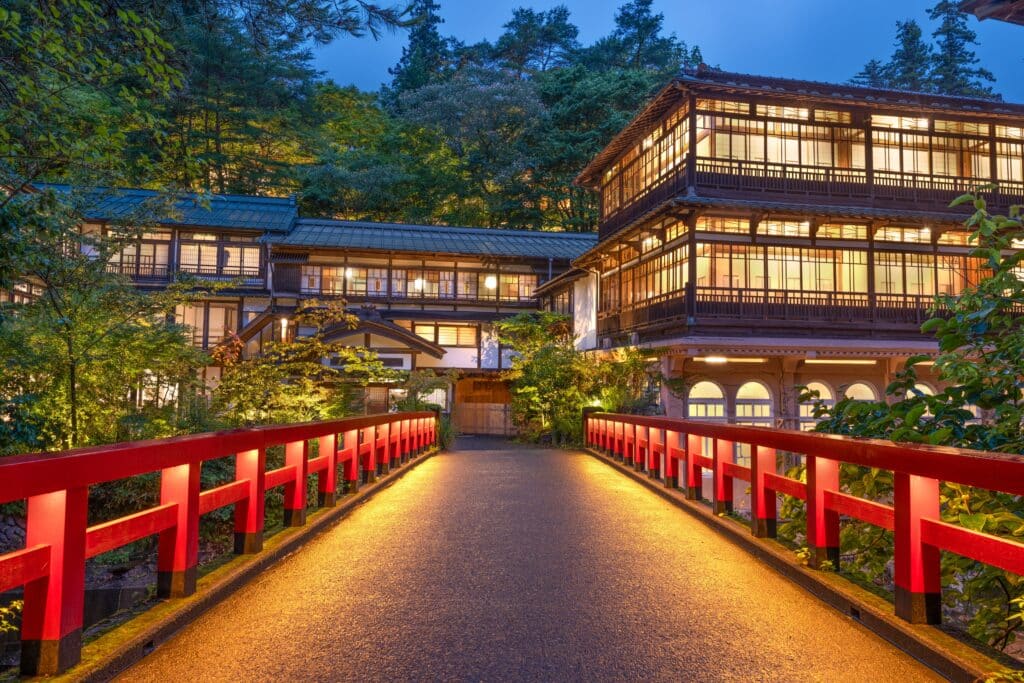
If staying in a traditional ryokan and soaking in an onsen is one of the experiences you want from Japan, both Hakone and Kawaguchiko can deliver an excellent overnight stay. But they have different strengths.
Hakone is the stronger all-round onsen and ryokan destination. Kawaguchiko’s special advantage is different: the possibility of soaking in a bath or waking up in your room with Mt Fuji directly in front of you.
- Long-established hot-spring destination
- Wide choice of traditional ryokan
- Many public and private onsen options
- Excellent for a first ryokan experience
- Easy to make the ryokan the centerpiece of your stay
- Excellent ryokan and resort options
- Some rooms offer direct Mt Fuji views
- Fuji-view baths can be spectacular
- Wonderful for romantic stays
- Especially rewarding on clear mornings
Why Hakone Is the Classic Onsen Choice
Hakone has been known as a hot-spring destination for centuries, and the onsen experience feels deeply integrated into a visit here. Rather than being an optional extra, staying at a ryokan and soaking in an onsen can become one of the main reasons to visit Hakone.
There is also much more choice. You can find everything from relatively simple traditional inns to luxurious ryokan with elaborate multi-course dinners, landscaped surroundings, and private open-air baths attached to the room.
For travelers trying a ryokan for the first time, Hakone is particularly easy to recommend because you can combine that traditional experience with a full day of sightseeing before slowing down completely in the evening.
Kawaguchiko Has One Extraordinary Advantage
Kawaguchiko cannot match Hakone’s depth as an onsen destination, but it can offer something Hakone cannot consistently replicate: a direct view of Mt Fuji from your room or bath.
At the right accommodation, you may wake up, open the curtains, and see Fuji filling the horizon. Some properties also have communal or private baths positioned specifically to take advantage of the mountain views.
When the weather cooperates, that can be one of the most memorable accommodation experiences of an entire Japan trip.
But there is an obvious catch: you are paying for a view that nature does not guarantee. A premium Fuji-view room can still face a wall of clouds on the day you stay.
Which Is Better for a First Ryokan Stay?
For most first-time visitors, I would choose Hakone. The ryokan experience fits naturally into the destination, and the stay remains worthwhile even if Mt Fuji never appears.
If you have already experienced a traditional ryokan elsewhere — or if waking up to Mt Fuji is specifically on your Japan wish list — Kawaguchiko becomes much more tempting.
If you book a Fuji-view room in Kawaguchiko, check exactly what “Fuji view” means before paying a large premium. Room orientation, floor level, surrounding buildings, and whether the view is available from the room, balcony, or only the bath can make a significant difference.
Choose Hakone for the stronger overall onsen and traditional ryokan experience. Choose Kawaguchiko if your dream is more specific: waking up to Mt Fuji or soaking in a bath while looking directly at the mountain.
Photography: Hakone or Kawaguchiko?
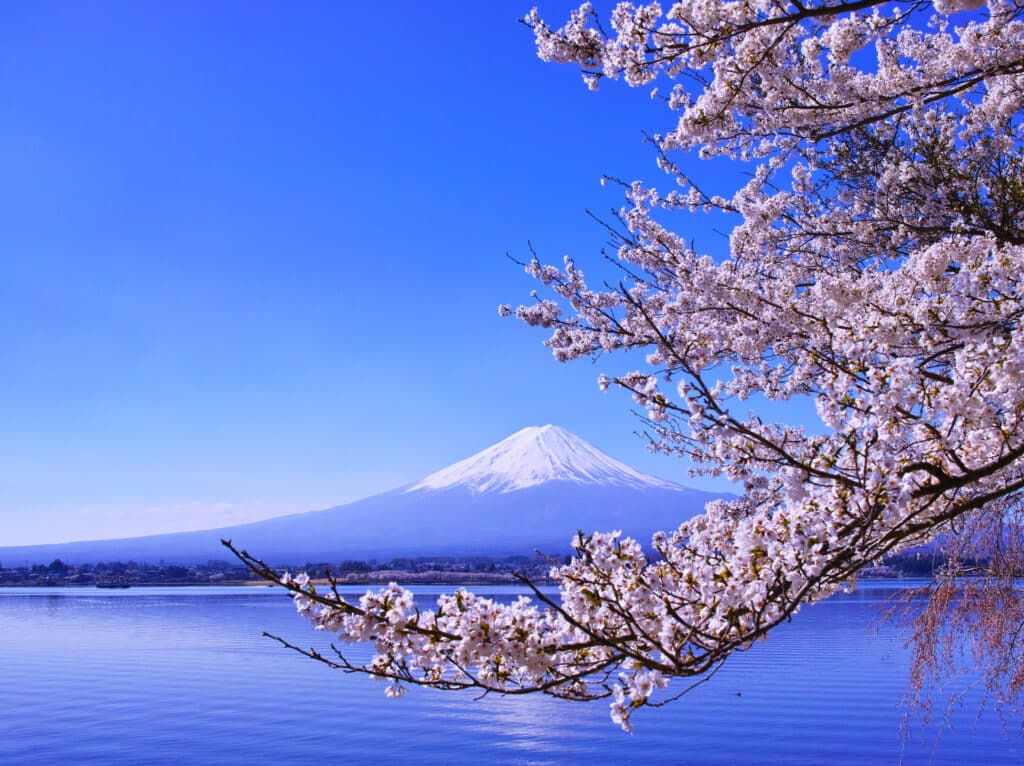
If photography is an important part of your trip, the choice depends on what you want to photograph. Hakone offers more variety, but Kawaguchiko is the stronger destination for iconic Mt Fuji photography.
In Hakone, your images might include forested mountains, Lake Ashi, Hakone Shrine, the ropeway, volcanic Owakudani, traditional ryokan, and occasional views of Fuji. In Kawaguchiko, the photographic possibilities are more concentrated around one extraordinary subject: Mt Fuji itself.
- Lake Ashi and mountain scenery
- Hakone Shrine and its lakeside torii gate
- Volcanic landscapes around Owakudani
- Forests and seasonal foliage
- Traditional ryokan atmosphere
- Mt Fuji from selected viewpoints
- Mt Fuji across Lake Kawaguchi
- Fuji reflections on calm water
- Cherry blossoms with Mt Fuji
- Autumn leaves with Mt Fuji
- Seasonal flowers at Oishi Park
- Chureito Pagoda and Fuji nearby
Why Kawaguchiko Is Better for Mt Fuji Photography
Kawaguchiko gives photographers something particularly valuable: multiple opportunities to photograph the same mountain with completely different foregrounds.
You can frame Fuji across the open water of Lake Kawaguchi, place seasonal flowers in the foreground, photograph the mountain behind autumn foliage, search for reflections on calm mornings, or travel to nearby Fujiyoshida for the famous Chureito Pagoda composition.
Instead of arriving at one viewpoint, taking a photograph, and moving on, you can spend hours exploring different angles around the area.
Hakone Offers More Diverse Images
Hakone is better if you want your photographs to tell the story of an entire destination rather than revolve primarily around Mt Fuji.
The red lakeside torii of Hakone Shrine, boats crossing Lake Ashi, steaming volcanic terrain at Owakudani, mountain transport, forests, museums, and ryokan interiors give you a much broader range of subjects.
And when Fuji does appear, it becomes an additional photographic highlight rather than the only shot you came to capture.
Timing Matters More in Kawaguchiko
Because so much of Kawaguchiko photography depends on Fuji visibility, when you photograph matters almost as much as where you photograph.
Early morning is often the most rewarding time to be outside. Conditions can be clearer, the lake may be calmer, popular viewpoints are quieter, and softer light can make the mountain considerably more photogenic.
This is another reason photographers should seriously consider staying overnight rather than arriving from Tokyo in the middle of the day.
If photography is one of your main reasons for visiting Kawaguchiko, plan your best Fuji viewpoints for early morning rather than treating them as stops later in the day. Use the middle of the day for cafés, museums, cycling, or other activities if clouds begin to build.
Choose Kawaguchiko for Mt Fuji photography. The combination of the mountain, Lake Kawaguchi, reflections, flowers, cherry blossoms, and autumn foliage gives you far more opportunities to create classic Fuji images. Choose Hakone if you prefer a wider variety of subjects and want Fuji to be just one part of your photography.
Getting There from Tokyo: Hakone vs Kawaguchiko
Both Hakone and Kawaguchiko are realistic escapes from Tokyo, but the journey works differently. Hakone has excellent rail connections into the region, while Kawaguchiko can be reached conveniently by either direct train or highway bus.
For most travelers, neither destination is difficult to reach. The bigger question is where you are staying in Tokyo and how much flexibility you want.
From Shinjuku, the Odakyu Romancecar provides a convenient direct journey to Hakone-Yumoto.
Travelers using the Shinkansen can instead travel from Tokyo or Shinagawa to Odawara and continue into Hakone from there.
From Shinjuku, direct limited-express trains can take you to Kawaguchiko without changing trains.
Highway buses are another popular option and can be particularly convenient if the departure point works well for your Tokyo accommodation.
Hakone: More Ways to Get There
Hakone has an advantage in flexibility because there are several practical approaches depending on where you start and what rail passes or tickets you are using.
From Shinjuku, the Odakyu Romancecar is the simplest option for many visitors because it runs directly to Hakone-Yumoto. From Tokyo Station or Shinagawa, traveling via Odawara can make more sense, particularly if you are already using the Tokaido Shinkansen.
Hakone-Yumoto is not the final destination for most sightseeing, however. Once you arrive, you still need to continue deeper into the Hakone area using local trains, buses, cable cars, or other transport.
Kawaguchiko: Direct, but Plan Ahead
Kawaguchiko can also be straightforward from Tokyo. The Fuji Excursion limited express connects Shinjuku with Kawaguchiko, making it particularly attractive to travelers who want to avoid transfers.
Highway buses can be just as useful and sometimes fit an itinerary better than the train. They are especially popular for day trips, although road traffic can make journey times less predictable.
For popular travel dates, weekends, and peak seasonal periods, booking your preferred train or bus in advance is a good idea, particularly if you want to leave Tokyo early enough to maximize your chances of clear Fuji views.
Which Is Easier for a Day Trip?
On paper, both work well. In practice, the answer depends partly on what happens after you arrive.
Hakone has an extensive transport network designed to move visitors between attractions, but that also means you spend a meaningful part of the day traveling within Hakone itself.
Kawaguchiko has less complicated sightseeing transport, but the attractions and viewpoints are spread around the lake and surrounding area. A bus timetable, bicycle, or carefully planned route can therefore make a big difference.
For either destination, leave Tokyo early. This gives you more sightseeing time, but it matters especially for Kawaguchiko because arriving earlier can improve your chances of seeing Mt Fuji before clouds build around the mountain.
Both are easy enough to reach from Tokyo, especially from Shinjuku. Hakone gets a slight edge because its connections via both Hakone-Yumoto and Odawara make it particularly flexible. Kawaguchiko is also straightforward, especially with a direct train or highway bus, but popular departures can require a little more advance planning.
Getting Around: Hakone vs Kawaguchiko
Getting to Hakone or Kawaguchiko is only part of the equation. Once you arrive, the two destinations work very differently — and this can have a surprisingly big impact on how relaxed or rushed your day feels.
Hakone has the more extensive transport network. Kawaguchiko is simpler geographically, but some of its best viewpoints are spread around the lake and surrounding area, so good planning still matters.
- Mountain trains
- Cable car
- Ropeway
- Local buses
- Lake Ashi sightseeing boats
- Extensive sightseeing network
- Sightseeing buses
- Walking
- Bicycle rentals
- Taxis
- Local trains for nearby areas
- More independent exploration
Hakone: Excellent Transport, but More Complicated
Hakone’s transport system is part of what makes the destination interesting. Instead of relying on one bus route, you can travel between attractions using trains, a cable car, ropeway, buses, and boats.
The classic sightseeing loop turns those different forms of transport into part of the experience. Riding above the volcanic landscape on the ropeway or crossing Lake Ashi by boat does not simply get you from A to B — it is sightseeing in itself.
But there is a trade-off. Hakone is geographically spread out, and moving between attractions can take longer than first-time visitors expect. Trying to squeeze too many stops into a day can quickly turn the famous loop into a race against the clock.
Kawaguchiko: Simpler, but Distances Can Be Deceptive
Kawaguchiko looks easier because much of the sightseeing is concentrated around Lake Kawaguchi. But the lake is large enough that walking everywhere is not realistic for most visitors on a day trip.
Sightseeing buses connect many of the popular areas, including viewpoints along the northern shore. The system works well, but depending on the season and time of day, waiting for buses can slow down an ambitious itinerary.
This is why cycling can be such an attractive option. In suitable weather, renting a bicycle gives you more freedom to stop at viewpoints, cafés, parks, and quieter sections of the lakeshore without constantly checking a timetable.
If you also want to visit places outside the immediate lake area — such as Chureito Pagoda in Fujiyoshida — you need to factor additional transport into your day.
Which Feels Easier?
This depends on your travel style.
Hakone is easier if you like following a structured sightseeing route. The transport network naturally guides you through the region, although there are more connections and moving parts.
Kawaguchiko is easier if you prefer exploring at your own pace. Instead of completing a loop, you can choose a few viewpoints and spend as much time as you want at each one.
Do not underestimate local travel time in either destination. In Hakone, avoid trying to add every major attraction to the sightseeing loop. In Kawaguchiko, choose a few priority viewpoints rather than repeatedly crossing the lake to tick off individual sights.
Hakone has the better transport network, while Kawaguchiko offers more freedom for slower exploration. Choose Hakone if you enjoy following a connected sightseeing route. Choose Kawaguchiko if you would rather select a few places and spend more time enjoying each one.
Hakone vs Kawaguchiko as a Day Trip from Tokyo
Both Hakone and Kawaguchiko can be visited as a day trip from Tokyo, and for many first-time visitors this is exactly how they experience them. But neither destination is at its best when you try to see everything in a single day.
The key is to choose the right kind of day trip. Hakone works best as a structured sightseeing day, while Kawaguchiko works best as a focused Mt Fuji and scenery day.
Best if you want a varied sightseeing day with several different experiences.
- Follow part of the Hakone sightseeing loop
- Ride the ropeway
- See Owakudani
- Spend time around Lake Ashi
- Add one or two priority attractions
Best if you want a Fuji-focused day with fewer stops and more time enjoying the scenery.
- Prioritize Fuji views early
- Explore Lake Kawaguchi
- Visit Oishi Park or the north shore
- Walk or cycle between viewpoints
- Add one major extra attraction if time allows
Hakone: More to See, but Easier to Overplan
Hakone can deliver an excellent day trip because there is so much variety. The problem is that this also encourages travelers to put far too much into the itinerary.
Trying to complete the sightseeing loop, visit multiple museums, spend time at Hakone Shrine, explore Owakudani, cross Lake Ashi, have a proper onsen experience, and still return comfortably to Tokyo can turn the day into a transport exercise.
A better approach is to decide what matters most and accept that a day trip is an introduction to Hakone, not a complete Hakone experience.
Kawaguchiko: Simpler, but More Weather-Dependent
A Kawaguchiko day trip can feel more relaxed because you do not need a long list of attractions. If Fuji is clearly visible, spending several hours around the lake and a few carefully chosen viewpoints can already make the trip worthwhile.
But there is a bigger risk: you are traveling a considerable distance for scenery that may not appear.
If Fuji is completely hidden by clouds, you cannot simply move to another viewpoint and expect the problem to disappear. This makes Kawaguchiko a particularly good candidate for a weather-flexible day trip if your Japan itinerary allows it.
If You Only Have 6–8 Hours, Which Should You Choose?
If those 6–8 hours refer to your actual time at the destination, both can work well — but you need to keep the itinerary focused.
Would I Stay Overnight Instead?
If you can spare the time, yes — especially if the destination is one of the highlights of your Japan trip.
In Hakone, staying overnight gives you time for the part of the experience that day-trippers often sacrifice: slowing down at a ryokan, enjoying dinner, and soaking in an onsen without worrying about the return journey to Tokyo.
In Kawaguchiko, the benefit is different. Staying overnight puts you in position to enjoy early-morning Fuji views before many day-trippers arrive and gives you another opportunity to see the mountain if conditions change.
If you visit either destination from Tokyo, do not measure the success of the day by how many attractions you complete. In Hakone, choose the parts of the sightseeing loop that matter most to you. In Kawaguchiko, prioritize Fuji and the lake rather than racing between every famous viewpoint.
Choose Hakone for a varied sightseeing day; choose Kawaguchiko for a focused Mt Fuji day. Hakone is the safer choice when the weather is uncertain because the destination does not depend entirely on Fuji. But on a beautifully clear day, Kawaguchiko can deliver the more memorable Mt Fuji day trip.
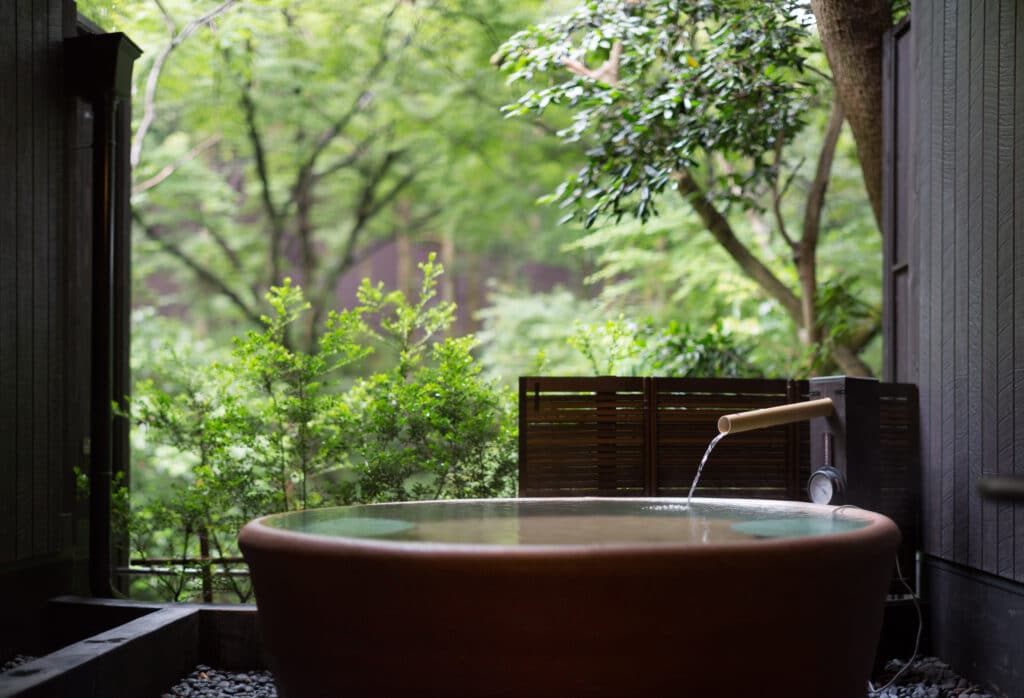
Hakone vs Kawaguchiko for an Overnight Stay
Both Hakone and Kawaguchiko become significantly better when you stay overnight. You escape the pressure of catching an evening train or bus back to Tokyo, experience the destination after many day-trippers have left, and gain access to some of the experiences that make these places special.
But the reason to stay overnight is different in each destination: Hakone is about the ryokan and onsen experience; Kawaguchiko is about having more time — and better timing — for Mt Fuji.
- Stay in a traditional ryokan
- Enjoy an evening and morning onsen
- Experience a traditional multi-course dinner
- Explore without rushing through the sightseeing loop
- Enjoy a quieter atmosphere after day-trippers leave
- Wake up close to Mt Fuji
- Reach viewpoints early in the morning
- Enjoy the lake before most day-trippers arrive
- Stay in a Fuji-view room or ryokan
- Get more than one opportunity for clear Fuji views
Why Hakone Is Better Overnight
A day trip allows you to see Hakone, but an overnight stay lets you experience the part of Hakone that is easiest to miss.
After sightseeing during the day, you can check into a ryokan, change into a yukata, soak in an onsen, enjoy dinner, and spend the evening doing very little. The following morning might begin with another bath and breakfast before you continue exploring or travel onward.
That slower rhythm creates a very different trip from rushing around the sightseeing loop and returning to Tokyo before dinner.
For many first-time visitors, one night in Hakone is also an easy way to add a traditional ryokan experience to a Tokyo–Kyoto itinerary, especially when the accommodation itself is treated as one of the highlights rather than simply somewhere to sleep.
Why Kawaguchiko Is Better Overnight
Kawaguchiko benefits from an overnight stay for another reason: timing matters enormously when you are trying to see Mt Fuji.
Day-trippers arriving from Tokyo may not reach the lake until later in the morning. Overnight visitors can be outside much earlier, when the atmosphere is quieter and conditions may be more favorable for clear views.
If Fuji was hidden when you arrived, staying overnight also gives you another opportunity the following morning rather than turning the entire journey into a single attempt.
And if you book accommodation facing the mountain, you may not even need to travel to a viewpoint. Opening the curtains and seeing Mt Fuji from your room can become one of the highlights of the trip.
One Night Is Usually Enough
For most first-time Japan itineraries, one night is the sweet spot for either destination.
In Hakone, that gives you enough time to combine sightseeing with a proper ryokan and onsen experience. In Kawaguchiko, it gives you an afternoon, evening, and crucially another morning to enjoy the lake and look for clear Fuji views.
Two nights can make sense if you deliberately want to slow down, explore more of the Fuji Five Lakes area, enjoy a resort stay, or make Hakone itself a larger part of the trip. But on a typical 10- to 14-day first visit to Japan, you usually do not need two nights simply to see the highlights.
If you can afford only one premium overnight experience during your trip, spend money on the experience rather than simply the room. In Hakone, prioritize a ryokan with a good onsen and dinner. In Kawaguchiko, decide whether paying extra for a genuine Fuji-facing room is important to you.
Choose Hakone for the stronger traditional overnight experience; choose Kawaguchiko for the stronger Mt Fuji overnight experience. Hakone is about slowing down in a ryokan and onsen after sightseeing. Kawaguchiko is about waking up close to Fuji and giving yourself the best possible opportunity to experience the mountain at its most impressive.
How Much Time Do You Need in Hakone or Kawaguchiko?
You can visit either Hakone or Kawaguchiko in a single day, but how much time you should spend depends on what you want from the trip. A day trip works well for the highlights; one overnight stay changes the experience considerably.
For most first-time visitors, the sweet spot is simple: one full day if your Japan itinerary is tight, or one night if the destination is an important part of your trip.
Half a Day: Usually Too Short
A half-day visit is difficult to justify from Tokyo because the journey itself takes a meaningful amount of time. Hakone is particularly poorly suited to a half day because its attractions are spread across the region and much of the appeal comes from moving between them.
Kawaguchiko can technically work as a short visit if your only goal is to see Mt Fuji from one or two viewpoints, but it leaves almost no margin for transport delays, changing weather, or slower exploration.
If you only have half a day available, it is usually better to use that time elsewhere rather than forcing either destination into the itinerary.
One Full Day: Enough for the Highlights
A full day works well for both destinations, provided you accept that you will not see everything.
In Hakone, focus on the parts of the sightseeing loop that interest you most. A combination of Owakudani, Lake Ashi, scenic transport, and perhaps one additional attraction can already create a satisfying day.
In Kawaguchiko, one day is enough to explore several strong Fuji viewpoints around the lake, spend time along the northern shore, and add one additional experience such as the panoramic ropeway or nearby Chureito Pagoda.
The important difference is that Kawaguchiko’s one-day experience is much more vulnerable to poor Fuji visibility. If the mountain remains hidden, there is no second morning to try again.
One Night / Two Days: The Sweet Spot
For travelers who can spare the time, one night is the best balance for both destinations.
Sightsee without rushing, check into a ryokan in the afternoon, enjoy dinner and an onsen, then continue exploring the following morning before traveling onward.
Explore the lake on arrival day, enjoy a Fuji-view stay if your budget allows, then head outside early the next morning for another chance at clear mountain views.
When Are Two Nights Worth It?
Two nights are not necessary for most first-time visitors, especially on a classic Tokyo–Kyoto–Osaka itinerary. But they can make sense if the destination itself is meant to be a slower break from city sightseeing.
In Hakone, a second night gives you more time for museums, gardens, onsen, and a relaxed resort-style stay without structuring everything around the sightseeing loop.
In Kawaguchiko, two nights make more sense if you want to explore beyond the main Lake Kawaguchi sights — perhaps seeing more of the Fuji Five Lakes area, cycling, hiking, or simply building extra flexibility around Fuji visibility.
On a first Japan trip, do not add extra nights simply because there are more attractions you could see. One night is usually enough to capture what makes either destination special while protecting valuable itinerary time for Tokyo, Kyoto, Osaka, or other regions.
For most travelers, one night is ideal in either Hakone or Kawaguchiko. Choose a day trip if your itinerary is tight. Stay one night if the destination matters to you. Consider two nights only if you deliberately want a slower mountain escape rather than simply more sightseeing.
Hakone vs Kawaguchiko by Travel Style
By this point, the choice between Hakone and Kawaguchiko becomes much easier if you stop asking which destination is “better” and instead ask which one fits the way you like to travel.
Hakone generally suits travelers who want variety, comfort, onsen, and a fuller sightseeing experience. Kawaguchiko is stronger for travelers whose trip revolves around Mt Fuji, photography, and slower scenic exploration.
Best for First-Time Visitors: Hakone
If you have never been to Japan and can choose only one, Hakone is arguably the more complete introduction. You can experience mountain scenery, an onsen, a traditional ryokan, unusual transport, volcanic landscapes, museums, and possibly Mt Fuji within the same short side trip.
That variety also makes Hakone easier to justify when your itinerary has room for only one excursion outside Japan’s major cities.
Best for Mt Fuji Lovers: Kawaguchiko
If seeing Mt Fuji is one of the experiences you have been looking forward to most, the recommendation changes. Kawaguchiko puts the mountain at the center of the trip rather than treating it as one possible highlight.
On a clear day, few accessible places offer such an easy combination of Mt Fuji, lake scenery, viewpoints, and seasonal landscapes.
Best for Couples: It Depends
Both destinations can work exceptionally well for couples, but they create different kinds of romantic stays.
If your ideal stay means a beautiful ryokan, private onsen, traditional dinner, forested surroundings, and an evening spent relaxing together.
If your ideal stay means a Fuji-facing room, sunrise views, lakeside scenery, photography, and waking up together with Mt Fuji outside the window.
Best for Families: Hakone
Hakone has an advantage for families because the transport itself can become part of the entertainment. Trains, cable cars, the ropeway, boats, volcanic scenery, and museums create more variety than a day focused primarily on viewpoints.
Kawaguchiko can still be excellent for families, particularly in good weather, but children who are less interested in scenery may appreciate Hakone’s changing activities more.
Best for Slow Travelers: Kawaguchiko
Kawaguchiko rewards travelers who are comfortable doing less. A good day might involve a lakeside walk, a bicycle ride, lunch or coffee with a view, and long periods simply watching the landscape change.
You do not need to keep moving for Kawaguchiko to feel worthwhile. In fact, trying to turn it into a checklist of attractions can work against what makes the destination appealing.
If you are still undecided, ask yourself one question: Would I still enjoy this trip if Mt Fuji were completely hidden? If the answer is yes because you want onsen, a ryokan, museums, and sightseeing, choose Hakone. If seeing Fuji is the reason you are making the trip in the first place, choose Kawaguchiko and build some weather flexibility into your itinerary.
Choose Hakone if you want more experiences. Choose Kawaguchiko if you want more Mt Fuji. That distinction solves the decision for most travelers faster than comparing individual attractions.
Hakone vs Kawaguchiko: Which Is Better in Each Season?

Hakone and Kawaguchiko are year-round destinations, but the experience changes considerably with the seasons. Cherry blossoms, summer greenery, autumn foliage, snow, and Mt Fuji visibility can all shift the balance between the two.
There is no single best season for everyone. If Mt Fuji is your priority, weather and visibility matter more. If you want onsen, scenery, and sightseeing regardless of whether Fuji appears, Hakone is less dependent on perfect conditions.
🌸 Spring: Kawaguchiko for the Classic Fuji + Cherry Blossom View
Spring is beautiful in both destinations, but Kawaguchiko has the more iconic potential. On the right day, cherry blossoms, Lake Kawaguchi, and snow-capped Mt Fuji can appear in the same landscape.
Nearby Fujiyoshida adds another famous spring composition around Chureito Pagoda, although peak bloom timing varies from year to year.
Hakone is also attractive in spring, especially as the mountains become greener, but it does not offer quite the same concentration of classic Fuji-and-blossom scenery.
☀️ Summer: Hakone Is the Safer Choice
Summer changes the comparison because Mt Fuji is often harder to see clearly. Warmer, more humid conditions can bring haze and clouds, particularly later in the day.
Kawaguchiko remains a pleasant mountain and lake escape, but if Fuji stays hidden, a large part of its visual appeal disappears.
Hakone is less vulnerable to this problem. You still have Lake Ashi, Owakudani, museums, forest scenery, scenic transport, onsen, and other attractions even if Mt Fuji never appears.
🍁 Autumn: Almost Impossible to Choose
Autumn is one of the strongest times to visit either destination.
Hakone offers excellent foliage across forests, mountain slopes, gardens, and the Lake Ashi area. Because you move through different elevations, the autumn scenery can become part of the entire sightseeing experience.
Kawaguchiko combines autumn colors with something Hakone cannot match as consistently: large-scale views of Mt Fuji rising behind the seasonal landscape. The area around the lake becomes especially photogenic when the leaves change.
❄️ Winter: Kawaguchiko for Fuji, Hakone for Onsen
Winter may be the most interesting season in this comparison because each destination plays to one of its greatest strengths.
Cold weather makes a ryokan and outdoor onsen especially appealing. Clear winter conditions can also produce excellent Fuji views from selected parts of Hakone.
Crisp winter conditions can deliver spectacular views of snow-capped Mt Fuji, making this one of the strongest seasons for travelers primarily coming to see the mountain.
If your priority is the classic Mt Fuji experience, Kawaguchiko gets the winter advantage. But if your dream is soaking in a hot spring on a cold evening and staying in a traditional ryokan, Hakone may actually be the more satisfying winter escape.
Do not choose Kawaguchiko based only on the season. Check the short-term weather forecast as close to your visit as your itinerary allows. A clear winter day can be extraordinary, but even during a generally favorable season, clouds can completely hide Mt Fuji.
Choose Kawaguchiko in spring or winter when iconic Mt Fuji scenery is your priority. Choose Hakone in summer when Fuji visibility is less reliable. In autumn, either destination can be spectacular. More than the calendar, however, your choice should still depend on whether you want a Fuji-centered trip or a broader mountain, onsen, and sightseeing experience.
What If the Weather Is Bad?
Weather matters in both Hakone and Kawaguchiko, but it matters much more in Kawaguchiko. A cloudy or rainy day can hide Mt Fuji completely — and when Fuji is the main reason for your visit, that changes the experience dramatically.
This is one of the strongest arguments for choosing Hakone if your travel dates are fixed and the forecast looks uncertain.
- Enjoy an onsen or ryokan
- Visit museums
- Explore despite limited Fuji visibility
- Enjoy atmospheric forest and mountain scenery
- Keep several worthwhile backup options
- Mt Fuji may disappear completely
- Lake scenery remains attractive
- Some indoor attractions are available
- Photography becomes much less rewarding
- The destination loses more of its core appeal
Hakone Still Works Without Mt Fuji
One of Hakone’s biggest strengths is that seeing Mt Fuji is not essential to having a good trip.
You can visit the Hakone Open-Air Museum, spend time in an onsen, enjoy your ryokan, explore the mountain landscape, and experience parts of the sightseeing route even if Fuji never appears.
Rain can even add atmosphere to Hakone. Mist around the forested mountains and a quiet ryokan can feel very different from the clear-sky version of the destination, but not necessarily worse.
Severe weather can still affect outdoor attractions and transport, of course, so conditions should always be checked before setting out.
Kawaguchiko Is Much More Weather-Dependent
Kawaguchiko has other things to do, but there is no avoiding the central issue: most travelers go there because of Mt Fuji.
If thick clouds cover the mountain all day, the lake is still pleasant and you can visit museums, cafés, or other local attractions. But the experience is fundamentally different from the one most visitors imagined when they added Kawaguchiko to their itinerary.
This does not mean you should skip Kawaguchiko whenever the forecast shows a few clouds. Mountain weather changes, forecasts are imperfect, and Fuji can appear unexpectedly. But if the forecast shows persistent rain and heavy cloud cover throughout the day, moving the trip to another day can be the smarter decision if your itinerary allows it.
Do Not Confuse a Sunny Forecast with Guaranteed Fuji Views
A common mistake is assuming that sunshine automatically means Mt Fuji will be visible.
Fuji visibility depends on more than whether it is raining. Clouds can form directly around the mountain even when the surrounding area looks relatively clear, and haze can reduce visibility as the day progresses.
This is why early mornings are often valuable, particularly in Kawaguchiko. If you wake up and Fuji is completely visible, do not save your best viewpoint for later in the afternoon.
The Advantage of Staying Overnight
Weather uncertainty is another reason an overnight stay can be valuable, particularly in Kawaguchiko.
A day-tripper effectively gets one window of opportunity. An overnight visitor gets an arrival afternoon, an early morning, and potentially part of a second day. If Fuji is hidden when you arrive but appears the following morning, the decision to stay overnight can suddenly feel very worthwhile.
If Kawaguchiko is a day trip from Tokyo and your schedule has some flexibility, avoid locking it to a specific day too early. Keep one or two possible days open and use the short-term forecast to choose the better opportunity. This can improve your chances of getting the Fuji experience you actually traveled there for.
Hakone is clearly the better choice when the weather is poor. Fuji may be a wonderful bonus, but the destination still offers onsen, ryokan, museums, scenery, and sightseeing without it. Kawaguchiko has alternatives too, but when Mt Fuji disappears, you lose much more of the reason most travelers came.
Common Mistakes When Choosing Between Hakone and Kawaguchiko
Hakone and Kawaguchiko are both excellent additions to a Japan itinerary, but travelers often choose between them for the wrong reasons. The biggest mistake is assuming they are interchangeable simply because both are associated with Mt Fuji.
A better decision starts with understanding what you actually want from the trip — and what each destination can realistically deliver.
Hakone can offer beautiful Fuji views, but they are not the destination’s main strength. If your number-one goal is to spend the day looking at and photographing Mt Fuji, Kawaguchiko is usually the stronger choice.
Kawaguchiko has lakeside scenery and other attractions, but Fuji is what makes the destination exceptional. If seeing the mountain is only a minor priority, Hakone may give you more variety for the same itinerary time.
No itinerary can guarantee a Fuji view. Clouds can hide the mountain completely, sometimes even when conditions elsewhere look reasonably good. Never treat a famous viewpoint as a guaranteed sight.
Hakone’s attractions are spread across the region, while Kawaguchiko’s viewpoints can also require more local travel than expected. A focused itinerary usually creates a better day than a long checklist.
Particularly in Hakone, the accommodation can be one of the main reasons to stay overnight. Arriving late and leaving early may mean paying premium prices while missing the onsen, dinner, atmosphere, and slower rhythm that justify the stay.
A Fuji-view room can be worth paying extra for in Kawaguchiko, but check exactly what you are booking. Room orientation, floor, surrounding buildings, and whether the view is from the room, balcony, or bath all matter.
Mistake #7: Ignoring Where Hakone or Kawaguchiko Fits in Your Route
The decision should not be made in isolation. Your wider Japan itinerary matters.
If you are traveling from Tokyo toward Kyoto or Osaka, Hakone can fit naturally into a broader journey via the Odawara area. Kawaguchiko often works more naturally as a dedicated excursion from Tokyo or as part of a larger Fuji-region itinerary.
This does not mean one route is always better, but adding unnecessary backtracking for a destination you only moderately want to visit is rarely a smart use of limited travel time.
Mistake #8: Booking Kawaguchiko Too Rigidly
If Kawaguchiko is primarily a Mt Fuji day trip, weather flexibility can be more valuable than having every detail booked months ahead.
When possible, keep some flexibility in your Tokyo schedule and choose the clearest suitable day. This is easier outside peak travel periods and becomes harder when you need specific trains, buses, or accommodation, but the principle remains useful.
If your itinerary cannot be flexible, consider whether you would still enjoy Kawaguchiko if Fuji remained hidden all day. If the answer is no, Hakone may be the lower-risk choice.
Mistake #9: Visiting Both Just Because You Cannot Decide
Adding both destinations can look like the perfect compromise, but it is not automatically the best itinerary.
On a short first trip to Japan, Hakone and Kawaguchiko can compete for the same limited itinerary space: both are mountain escapes from Tokyo, both can involve Fuji views, and both are particularly attractive as one-night stays.
If visiting both forces you to cut meaningful time from Tokyo, Kyoto, Osaka, or another destination you care about more, choosing one is often the smarter decision.
Do not choose based on which destination has the longer list of attractions. Choose based on the experience you would regret missing. If that is seeing Mt Fuji dominate the landscape, prioritize Kawaguchiko. If it is staying in a ryokan, soaking in an onsen, and combining several different experiences, prioritize Hakone.
The biggest mistake is treating Hakone and Kawaguchiko as two versions of the same Mt Fuji trip. They are not. Hakone is a broader mountain, onsen, and sightseeing destination where Fuji can be a highlight. Kawaguchiko is a destination where Mt Fuji itself is often the reason for going.
Should You Visit Both Hakone and Kawaguchiko?
Yes — but most first-time visitors do not need to. Hakone and Kawaguchiko are different enough that visiting both is not necessarily repetitive, yet they often compete for the same limited space in a Japan itinerary.
If you have a longer trip, love mountain scenery, or consider Mt Fuji and a traditional ryokan stay major priorities, combining them can make sense. On a shorter trip, however, choosing the destination that best matches your priorities is usually the smarter option.
- You have a longer Japan itinerary
- Mt Fuji is a major trip priority
- You also want a dedicated ryokan and onsen experience
- You enjoy mountains and scenic destinations
- You prefer slower travel over adding more cities
- Your Japan trip is relatively short
- You already have several Tokyo day trips planned
- You want to protect enough time for Kyoto or Osaka
- Mt Fuji is not a major priority
- Visiting both would create unnecessary backtracking
Are Hakone and Kawaguchiko Too Similar?
Not really. The overlap is obvious — mountains, lakes, onsen, ryokan, and possible Mt Fuji views — but the actual travel experiences are quite different.
So if you genuinely want both experiences, visiting both is not redundant. The question is whether those two experiences deserve two separate slots in your particular itinerary.
For a 7-Day Japan Trip: Choose One
With only one week in Japan, visiting both is difficult to justify for most first-time visitors. Tokyo, Kyoto, and possibly Osaka already compete for limited time.
Choose Kawaguchiko if seeing Mt Fuji is one of your highest priorities. Choose Hakone if you want a broader mountain escape with a ryokan and onsen experience.
Trying to squeeze both into seven days usually creates more movement without adding enough value.
For a 10-Day Japan Trip: Usually Choose One
Ten days gives you more flexibility, but choosing one is still the best balance for most classic first trips.
A one-night stay in Hakone or Kawaguchiko can break up the major-city itinerary nicely without consuming too much time. Visiting both becomes reasonable only if Mt Fuji, mountain scenery, or ryokan stays rank unusually high among your priorities.
For a 14-Day Japan Trip: Both Can Make Sense
With two weeks, the decision changes. You have more room to include different experiences without sacrificing the major destinations.
For example, you could use Kawaguchiko as your dedicated Mt Fuji experience and Hakone later as a ryokan and onsen break. The two destinations then serve different purposes rather than competing with each other.
Even with 14 days, however, visiting both is optional. If you would rather use that time for Hiroshima, Kanazawa, Takayama, Koyasan, or another region, you are not missing an essential part of Japan by choosing only one.
Do Not Treat Hakone → Kawaguchiko as a Simple Side Trip
Hakone and Kawaguchiko look close together on a map, which can make combining them seem obvious. But travel between the two is less seamless than their geographic proximity suggests.
Public transport connections generally involve buses and transfers through the wider Fuji area rather than one simple high-speed rail connection. That makes the journey perfectly possible, but it should be treated as a real travel segment rather than an effortless hop between neighboring resorts.
If you plan to stay in both, allow enough time for the transfer and avoid building an overly ambitious sightseeing schedule around the same day.
If you visit both, give each destination a different job in your itinerary. Use Kawaguchiko for Mt Fuji views, photography, and lakeside scenery. Use Hakone for the ryokan, onsen, and sightseeing experience. That makes the combination far more worthwhile than trying to duplicate the same Fuji-focused trip twice.
For most first-time visitors, choosing either Hakone or Kawaguchiko is enough. Visit both when you have the itinerary space and genuinely want two different experiences: Kawaguchiko for a dedicated Mt Fuji stay and Hakone for onsen, ryokan, and varied sightseeing. Otherwise, choose the one that fits your priorities and use the saved time somewhere else in Japan.
Hakone vs Kawaguchiko: Quick Decision Guide
If you are still deciding between Hakone and Kawaguchiko, you do not need to compare every attraction, train route, or viewpoint. Your main reason for making the trip usually reveals the better choice.
Use this quick decision guide to match the destination to what matters most to you.
- You want a traditional ryokan and onsen experience
- You prefer several different things to do
- You enjoy scenic trains, ropeways, boats, and sightseeing routes
- You want museums and attractions in addition to scenery
- You are visiting when the Fuji forecast is uncertain
- You want a destination that still works if Fuji is hidden
- Mt Fuji would be a bonus rather than the entire purpose of the trip
- Seeing Mt Fuji is one of your top Japan priorities
- You want the classic Fuji-and-lake scenery
- You enjoy landscape photography
- You prefer slower exploration to attraction-hopping
- You want to walk or cycle around scenic areas
- You would pay extra for a room facing Mt Fuji
- The weather forecast looks particularly promising
Choose Based on Your #1 Priority
The 30-Second Decision
No → Kawaguchiko on a clearer day
If You Are Still 50/50…
Choose Hakone if this is your first trip to Japan and you want the more varied overall experience. It combines several elements travelers often want to experience at least once: onsen, ryokan, mountain scenery, unusual transport, and sightseeing.
Choose Kawaguchiko if Mt Fuji has been sitting near the top of your Japan wish list. When the weather cooperates, it delivers the stronger sense that you have actually traveled somewhere specifically to experience the mountain.
For a typical first Japan itinerary, Hakone is the safer all-round choice, while Kawaguchiko is the more specialized choice. Do not choose Kawaguchiko simply because you think every first trip needs a dedicated Mt Fuji stop. Choose it when seeing Fuji itself is important enough to justify building part of your itinerary around the mountain.
Want the best chance of iconic Mt Fuji scenery? Choose Kawaguchiko. Want the better all-round mountain escape? Choose Hakone. For most travelers, the decision really is that simple.
Final Verdict: Hakone or Kawaguchiko?
Hakone and Kawaguchiko are both excellent escapes from Tokyo, but they serve different purposes. Hakone is the better all-round destination. Kawaguchiko is the better choice for experiencing Mt Fuji.
Hakone Wins If You Want…
- A traditional ryokan experience
- Excellent onsen
- More sightseeing variety
- Scenic transport and the Hakone loop
- Museums and attractions
- A destination that works even without Fuji views
Kawaguchiko Wins If You Want…
- The strongest Mt Fuji experience
- Classic Fuji-and-lake views
- Landscape photography
- Fuji-view accommodation
- Slower lakeside exploration
- A trip built around the mountain itself
For Most First-Time Visitors: Hakone Has a Slight Edge
If this is your first trip to Japan and you have no strong preference, Hakone is my recommendation. Its combination of volcanic landscapes, Lake Ashi, scenic transport, museums, onsen, and traditional ryokan makes it a more varied experience.
Importantly, Hakone remains worthwhile even when Mt Fuji is hidden by clouds.
But If Mt Fuji Is on Your Bucket List: Choose Kawaguchiko
If seeing Mt Fuji is one of your biggest Japan travel dreams, choose Kawaguchiko. The mountain dominates the landscape, and the combination of Fuji, Lake Kawaguchi, and seasonal scenery is difficult to beat on a clear day.
Just remember that even Kawaguchiko cannot guarantee Fuji visibility.
Day Trip or Overnight?
The Simplest Way to Decide
What would disappoint you more?
“I went all the way there and barely saw Mt Fuji.”
→ Prioritize Kawaguchiko and choose the clearest day possible.
“I missed the chance to stay in a ryokan and soak in an onsen.”
→ Prioritize Hakone.
Do not add either destination simply because it appears on a standard Japan itinerary. Choose the experience that matters most to you — or keep that extra day for Tokyo, Kyoto, or another destination.
Hakone is the better all-round destination. Kawaguchiko is the better Mt Fuji destination. For first-time visitors without a strong preference, Hakone has a slight edge. But if seeing Mt Fuji is one of your biggest Japan travel priorities, Kawaguchiko is the better choice.
Hakone vs Kawaguchiko FAQ
Still deciding between Hakone and Kawaguchiko? These are the most common practical questions travelers have when choosing between Japan’s two popular Mt Fuji escapes.