
At the crossroads of East and West, the rugged landscapes of Bosnia and Herzegovina hold some of the most fascinating cultural and historical layers in the Balkans. Mountain ranges, emerald rivers, Ottoman bridges, medieval towns, and Austro-Hungarian architecture all coexist within a country that has been shaped by centuries of shifting empires and resilient traditions.
Traveling through Bosnia and Herzegovina often feels like stepping through different chapters of European history. The capital Sarajevo, surrounded by forested mountains, embodies this layered past more vividly than anywhere else. Here, mosques, churches, and synagogues stand within walking distance of one another, reflecting centuries of cultural exchange and coexistence.
The country’s story includes moments that changed the course of global history. In 1914, the Assassination of Archduke Franz Ferdinand took place in Sarajevo, triggering World War I. Yet despite its turbulent past, Bosnia and Herzegovina today welcomes travelers with remarkable warmth and hospitality.
Beyond the cities lies an extraordinary natural landscape. Crystal-clear rivers carve deep canyons through the Dinaric Alps, waterfalls tumble through lush forests, and traditional villages remain tucked into quiet mountain valleys.
Perhaps the most iconic sight in the country is the elegant stone arch of Stari Most in the historic town of Mostar. This 16th-century Ottoman bridge, spanning the turquoise Neretva River, has become a symbol of both heritage and resilience.
Bosnian cuisine adds another layer to the travel experience. Influenced by Ottoman, Mediterranean, and Central European traditions, dishes such as Ćevapi, Burek, and sweet pastries served with strong Bosnian coffee are staples of local culture.
Yet the country’s greatest charm may lie in its atmosphere. In Sarajevo’s old bazaars, on quiet riverbanks, or in remote mountain villages, visitors often find a sense of authenticity that feels increasingly rare in modern Europe.
Exploring Bosnia and Herzegovina means discovering a land where history, nature, and tradition intertwine — a destination both deeply moving and endlessly captivating.
20. Sarajevo
Nestled in a valley surrounded by forested mountains, Sarajevo stands as one of the most culturally diverse and historically rich capitals in Europe. Often called the “Jerusalem of Europe,” the city reflects centuries of coexistence among different religions and cultures within Bosnia and Herzegovina.
The heart of Sarajevo lies in Baščaršija, the city’s historic Ottoman bazaar founded in the 15th century. Narrow cobbled streets weave through rows of copper workshops, traditional cafés, mosques, and small shops selling handmade crafts.
Dominating the square is the elegant wooden fountain known as Sebilj Fountain, a beloved symbol of the city where locals and visitors gather beneath the fluttering wings of pigeons.
Sarajevo also witnessed one of the most pivotal events of the 20th century. Near the Latin Bridge, the Assassination of Archduke Franz Ferdinand took place in 1914, setting in motion the events that would lead to World War I.
Yet Sarajevo’s more recent history is equally powerful. During the Siege of Sarajevo in the 1990s, the city endured one of the longest sieges in modern warfare. Today, museums and memorials quietly honor those difficult years.
Despite its complex past, Sarajevo thrives with energy and warmth. Restaurants serve traditional dishes such as Ćevapi, grilled meat served with soft bread and onions, while cafés fill with locals enjoying Bosnian coffee.
As evening settles over the valley and the call to prayer echoes from nearby mosques, Sarajevo reveals a unique atmosphere — a city where cultures meet, history speaks, and hospitality remains at the heart of everyday life.
19. Mostar
Few places in the Balkans are as instantly recognizable as Mostar, the picturesque town in southern Bosnia and Herzegovina known for its breathtaking historic bridge.
Spanning the turquoise waters of the Neretva River, the graceful stone arch of Stari Most has become the defining symbol of the city. Built in the 16th century during the rule of the Ottoman Empire, the bridge once connected two thriving communities on either side of the river.
For centuries it served as both a practical crossing and a gathering place for locals. Young men would dive from the bridge into the cold river below — a daring tradition that continues today during summer festivals.
During the Bosnian War in 1993, the original bridge was tragically destroyed. Its reconstruction in 2004, using traditional building techniques and original stones recovered from the riverbed, became a powerful symbol of reconciliation.
The surrounding old town is equally captivating. Stone streets wind past Ottoman houses, mosques, and bustling market stalls selling handmade crafts.
Nearby stands the elegant Koski Mehmed Pasha Mosque, whose slender minaret offers one of the best views of the bridge and river below.
As evening arrives, the golden light of sunset reflects off the white stone buildings and emerald water, creating one of the most unforgettable scenes in the Balkans.
Mostar is more than a beautiful town — it is a place where history, resilience, and culture come together beneath a single iconic bridge.
18. Blagaj
At the base of a towering limestone cliff where the crystal waters of the Buna River emerge from a cave, the peaceful village of Blagaj hides one of the most enchanting sights in Bosnia and Herzegovina.
Here stands the historic Blagaj Tekke, a 16th-century monastery built beside the powerful spring that forms the source of the Buna River. The white wooden structure appears almost suspended between the cliff and the water, creating one of the most photographed scenes in the country.
The monastery was established by the Dervish Order, a mystical branch of Islamic spirituality that practiced meditation, poetry, and music as part of their religious tradition.
Visitors entering the tekke can explore simple prayer rooms and quiet spaces once used by the dervishes. The sound of rushing water from the nearby spring fills the air, adding to the tranquil atmosphere.
Outside, small wooden terraces line the riverbank where traditional restaurants serve fresh trout caught from the cold waters of the Buna.
The surrounding landscape adds to the beauty of the site. Massive cliffs rise above the monastery, while the clear turquoise river flows gently through the valley.
Blagaj offers a peaceful escape from busier destinations nearby, especially the popular town of Mostar, located only a short drive away.
In this quiet corner of Herzegovina, nature and spirituality blend into a place that feels timeless — a sanctuary where water, stone, and faith have shaped the landscape for centuries.
17. Kravica Waterfalls
Hidden within the lush landscapes of southern Bosnia and Herzegovina, the spectacular Kravica Waterfalls form one of the country’s most breathtaking natural attractions.
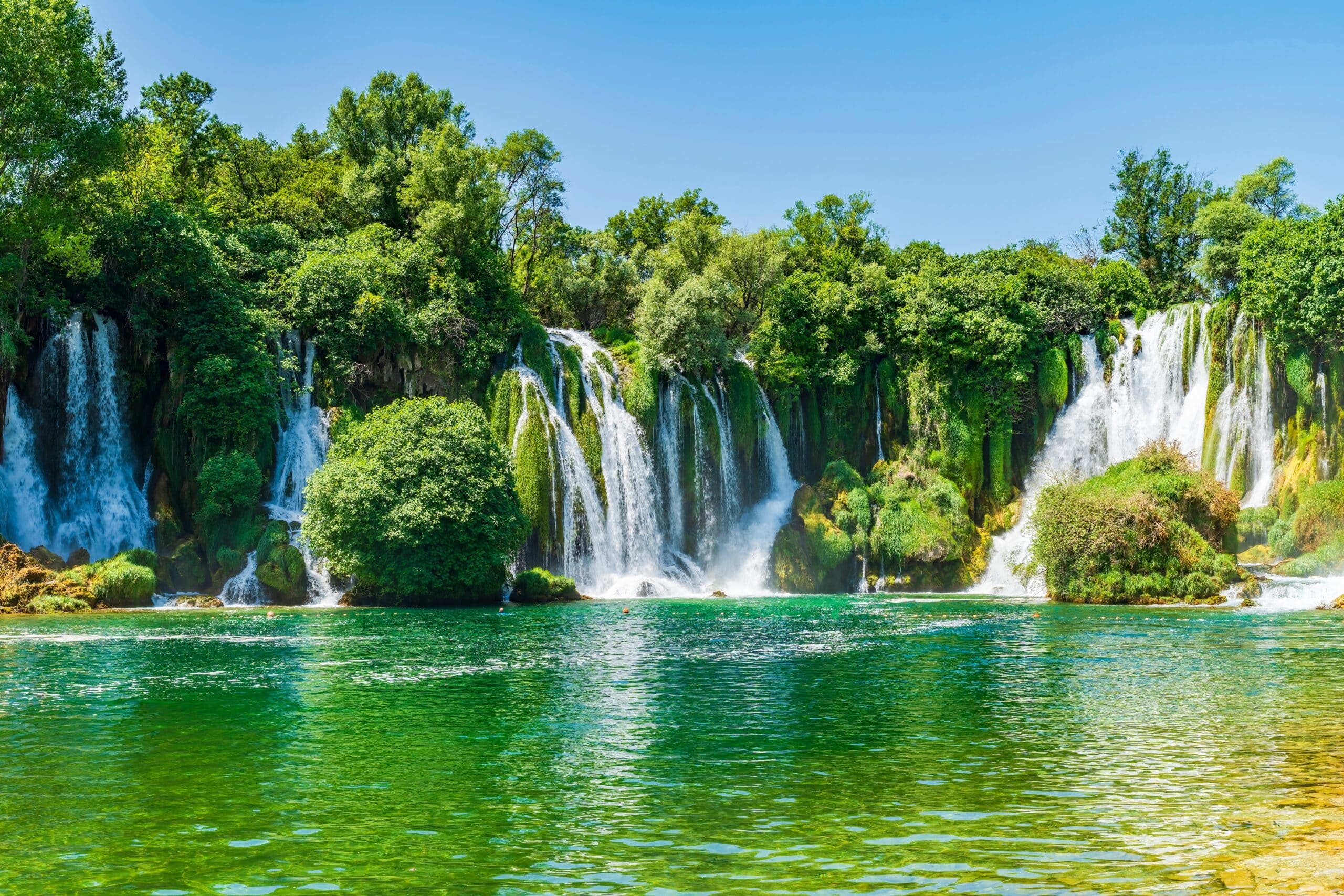
Located near the town of Ljubuški, the falls cascade over a wide horseshoe-shaped cliff where the waters of the Trebižat River plunge nearly 25 meters into a turquoise pool below. Surrounded by thick forests, the waterfall creates a scene that feels both wild and tranquil.
Unlike many European waterfalls that can only be admired from a distance, Kravica invites visitors to experience the landscape up close. Wooden paths lead down to the base of the falls, where the sound of rushing water fills the air and mist rises from the crashing cascade.
During the warm summer months, the pool at the base of the waterfall becomes a popular swimming spot. Travelers and locals alike dive into the refreshing water or relax along the pebble beaches that line the riverbank.
Small cafés and rustic restaurants sit nearby, serving traditional Herzegovinian dishes such as grilled meats, fresh salads, and local wines produced in the region.
The waterfall’s wide curtain of water is especially impressive in spring, when snowmelt and seasonal rains increase the river’s flow, creating an even more powerful display.
Despite growing popularity, Kravica still retains a peaceful atmosphere compared to many crowded European natural attractions.
For travelers exploring southern Bosnia and Herzegovina, the waterfalls offer a refreshing escape into nature — a place where emerald water, forested cliffs, and sunlight combine to create a true Balkan oasis.
16. Una National Park
In the northwestern corner of Bosnia and Herzegovina, the pristine landscapes of Una National Park protect one of the country’s most spectacular natural treasures.
The park follows the course of the Una River, famous for its vivid emerald color and crystal-clear water. Flowing through deep forests and limestone canyons, the river forms countless rapids, cascades, and waterfalls along its journey.
Among the park’s most impressive sights is Štrbački Buk, a powerful waterfall that plunges nearly 25 meters into a foaming pool below. The roar of the water echoes through the surrounding forest, creating one of the most dramatic natural scenes in the Balkans.
The nearby town of Bihać serves as the main gateway to the park. From here, visitors can explore the river by hiking along forest trails or joining rafting excursions that navigate the lively rapids.
The park is also rich in wildlife. Brown bears, wolves, deer, and numerous bird species inhabit the protected forests and valleys surrounding the river.
Despite its extraordinary beauty, Una National Park remains one of the lesser-known natural destinations in Europe, allowing visitors to enjoy the landscape without large crowds.
The clear waters, lush greenery, and constant sound of rushing rapids create an atmosphere that feels wild and untouched.
For nature lovers and adventure seekers alike, Una National Park reveals a side of Bosnia and Herzegovina defined not only by history, but by extraordinary natural beauty.
15. Jajce
Set among forested hills in central Bosnia and Herzegovina, the historic town of Jajce stands out as one of the most scenic and historically important destinations in the Balkans.
Jajce once served as the capital of the medieval Kingdom of Bosnia, and its stone fortress rising above the town still reflects that royal past. Perched on a hilltop, the Jajce Fortress offers sweeping views over the valleys and rivers that converge below.
What truly makes Jajce unique, however, is the dramatic waterfall located directly in the center of town. Here, the Pliva River plunges nearly 20 meters into the Vrbas River, creating the spectacular Pliva Waterfall.
Few cities in the world can claim such a powerful natural feature at their heart.
The old town of Jajce spreads beneath the fortress in layers of stone houses, narrow streets, and historic buildings. Walking through its winding alleys reveals centuries of architectural influences from medieval Bosnian, Ottoman, and Austro-Hungarian periods.
Just outside the city lie the peaceful Pliva Lakes, a pair of clear mountain lakes surrounded by forests and rolling hills.
Jajce is also historically significant for a major political event during World War II, when the Anti-Fascist Council for the National Liberation of Yugoslavia held a historic meeting here in 1943.
Today, the town welcomes visitors with quiet charm, historic monuments, and extraordinary natural scenery.
In Jajce, waterfalls roar beside medieval walls, reminding travelers how beautifully nature and history can coexist.
14. Pliva Waterfall
Few natural landmarks are as striking as Pliva Waterfall, which thunders dramatically at the center of Jajce in Bosnia and Herzegovina.
Here the emerald waters of the Pliva River cascade over a rocky cliff before merging with the Vrbas River below. The waterfall plunges roughly 20 meters into a misty basin surrounded by stone buildings and green hillsides.
What makes this waterfall extraordinary is its location. Rather than hidden deep within wilderness, it sits directly beneath the medieval town walls, making it one of the rare urban waterfalls in Europe.
From the viewing platforms built along the cliffs, visitors can watch the powerful stream tumble over the rocks while mist rises into the air. After heavy rains or spring snowmelt, the falls become even more dramatic as the river swells with rushing water.
Historically, the waterfall also played a practical role. The flowing rivers powered watermills and supported the town’s development for centuries.
Photographers especially love Pliva Waterfall at sunset, when the warm light illuminates the cascade and the surrounding stone buildings glow with golden tones.
Even from distant viewpoints around Jajce, the constant roar of falling water reminds visitors of the powerful forces that shaped this landscape.
Few places combine such dramatic scenery with historic architecture so naturally.
Pliva Waterfall remains not only one of Bosnia and Herzegovina’s most famous natural attractions, but also one of the most unique urban landscapes in the entire Balkan region.
13. Pliva Lakes
Just a few kilometers from Jajce, the tranquil Pliva Lakes offer a peaceful contrast to the dramatic waterfall found in the town center.
Located in the heart of Bosnia and Herzegovina, the lakes consist of two connected bodies of water — the Great Pliva Lake and the Small Pliva Lake — both formed along the gentle course of the Pliva River.
Surrounded by forested hills and quiet meadows, the lakes create a serene landscape where reflections of mountains and sky shimmer across calm waters.
One of the most charming sights along the lakeshore is the group of historic Pliva Watermills, a cluster of small wooden mills standing on stilts above flowing water. These traditional mills date back several centuries and were once used by local farmers to grind grain.
Their picturesque design has made them one of the most photographed scenes in the region.
Visitors often stroll along wooden walkways near the mills or relax beside the lakes while enjoying the quiet natural surroundings.
The area is also popular for outdoor recreation. Travelers can rent small boats, go fishing, or cycle along scenic paths that circle the lakes.
In summer, the lakes become a favorite destination for swimming and picnicking, while autumn brings colorful forests reflected in the still water.
Despite their beauty, the Pliva Lakes remain relatively peaceful compared to more famous European lake destinations.
Here, the rhythm of nature sets the pace — gentle waves, rustling trees, and the distant sound of water flowing toward the famous waterfall in Jajce below.
12. Travnik
Nestled in a green valley surrounded by mountains, Travnik is one of the most historically rich towns in Bosnia and Herzegovina. Often called the “Town of Viziers,” Travnik served as the administrative center of Ottoman Bosnia for more than 150 years.
During this period, dozens of Ottoman governors ruled from here, leaving behind mosques, fountains, and traditional houses that still shape the town’s character today.
Above Travnik rises the impressive Travnik Fortress, a medieval stronghold built during the time of the Kingdom of Bosnia. The fortress crowns the hill overlooking the town, its thick stone walls offering sweeping views of red rooftops and green valleys.
Walking through Travnik’s old streets reveals layers of history. Elegant Ottoman-era homes with wooden balconies line narrow lanes, while historic mosques punctuate the skyline.
One of the most famous landmarks is the colorful Sulejmanija Mosque, also known as the “Colorful Mosque.” Its vibrant interior decorations and beautifully painted walls make it one of the most unique mosques in the region.
Travnik is also known as the birthplace of Ivo Andrić, the Nobel Prize–winning writer whose novels captured the complex history of the Balkans.
Food lovers find Travnik equally memorable. The town is famous for Travnik ćevapi, a local variation of the beloved Balkan grilled meat dish served with fresh bread and onions.
Today Travnik blends quiet charm with deep historical significance. Its fortress, mosques, and mountain scenery create a setting that feels both peaceful and timeless.
For travelers exploring Bosnia’s interior, Travnik offers a perfect window into the country’s Ottoman past.
11. Višegrad
On the banks of the emerald Drina River, the town of Višegrad holds one of the most famous monuments in the Balkans: the majestic Mehmed Paša Sokolović Bridge.
This elegant stone bridge, built in the 16th century during the Ottoman Empire, stretches gracefully across the river with eleven arches. It was commissioned by Mehmed Paša Sokolović, an Ottoman grand vizier who was originally born in the region.
The bridge was designed by the legendary Ottoman architect Mimar Sinan, whose masterpieces can be found across southeastern Europe and Turkey.
Today the bridge is recognized as a UNESCO World Heritage Site and remains one of Bosnia and Herzegovina’s most iconic landmarks.
For centuries it served as a crucial crossing point connecting trade routes between Bosnia and the wider Ottoman world.
The bridge also became internationally famous through the novel The Bridge on the Drina by Ivo Andrić, which tells the story of the region’s turbulent history through the life of the bridge itself.
Standing on the bridge today, visitors can watch the calm Drina flow beneath its arches while mountains rise gently in the distance.
Nearby, the cultural complex Andrićgrad was built as a tribute to Andrić and the history of the region. Its streets combine architectural styles inspired by Byzantine, Ottoman, and Austro-Hungarian influences.
Višegrad is quiet, reflective, and steeped in stories.
Here the Drina flows steadily under centuries-old stone, reminding travelers that bridges can connect not only places, but entire eras of history.
10. Andrićgrad
Just beside the historic bridge in Višegrad, the unique cultural complex of Andrićgrad stands as a tribute to literature, architecture, and history.
Located in eastern Bosnia and Herzegovina, Andrićgrad was designed as a symbolic city celebrating the works of Ivo Andrić, the Nobel Prize–winning author of The Bridge on the Drina.
The project was developed by filmmaker Emir Kusturica, who envisioned a place where different periods of Balkan architecture could coexist in one imaginative setting.
Walking through Andrićgrad feels like stepping through multiple eras at once. Stone streets lead past buildings inspired by Byzantine monasteries, Ottoman bazaars, Austro-Hungarian townhouses, and classical European squares.
At the center stands a statue of Andrić, overlooking the square named in his honor.
The complex includes galleries, cafes, small shops, and cultural institutions that host film festivals, concerts, and literary events throughout the year.
Though newly built, the city blends naturally with the historic surroundings of Višegrad and the nearby Mehmed Paša Sokolović Bridge.
Visitors often walk from the centuries-old bridge into the modern cultural district, experiencing both history and contemporary creativity in a single stroll.
Andrićgrad also reflects the layered identity of the Balkans, where cultures, religions, and architectural traditions have overlapped for centuries.
Whether one arrives for literature, photography, or curiosity, the experience leaves a lasting impression.
In this small riverside town, a fictional city built from imagination and history now stands beside one of the most real and enduring monuments in the region.
9. Štrbački Buk
Hidden within the forests of Una National Park, the spectacular Štrbački Buk Waterfall is widely considered the most impressive waterfall in Bosnia and Herzegovina.
Here the emerald waters of the Una River cascade down a dramatic series of limestone terraces, forming powerful curtains of white water that plunge into turquoise pools below.
Standing nearly 25 meters high, the waterfall stretches across multiple tiers, creating a wide natural amphitheater of rushing water and mist.
Wooden walkways lead visitors through the surrounding forest, gradually revealing new perspectives of the falls. At each viewpoint, the sound of the river grows louder until the full power of Štrbački Buk appears before you.
The spray rising from the cascades fills the air with cool moisture, especially refreshing during the warm Balkan summers.
The surrounding landscape is equally captivating. Thick green forests climb the hillsides, while moss-covered rocks and small streams weave through the park’s valleys.
Adventure seekers often experience the waterfall during rafting trips along the Una River, navigating thrilling rapids surrounded by untouched wilderness.
Despite its dramatic beauty, Štrbački Buk remains relatively undiscovered compared to famous European waterfalls.
This quiet isolation only enhances the experience. Visitors often find themselves standing before the roaring cascades with little more than birdsong and rushing water for company.
In a region known for historic towns and cultural landmarks, Štrbački Buk reminds travelers that Bosnia’s natural landscapes are equally extraordinary.
8. Blagaj Tekke
Just outside the historic city of Mostar, one of the most magical places in Bosnia and Herzegovina sits at the base of a towering cliff.
The stunning Blagaj Tekke — a centuries-old Sufi monastery — rests beside the powerful spring of the Buna River, where icy turquoise water emerges dramatically from a cave beneath sheer limestone walls.
Built in the 16th century during the era of the Ottoman Empire, the monastery became an important spiritual center for Sufism, the mystical branch of Islam.
Its white wooden structure appears to cling to the cliffside, perfectly reflected in the calm waters below.
The setting is extraordinary. Behind the monastery rises a vertical rock wall hundreds of meters high, while the cave opening releases one of the strongest river springs in Europe.
Visitors can walk along the riverbank to admire the monastery from different angles, each view revealing how harmoniously the building blends with nature.
Inside, simple prayer rooms and quiet wooden halls preserve the spiritual atmosphere that once defined this sacred retreat.
The village of Blagaj surrounding the tekke adds to the charm. Small riverside restaurants serve traditional Bosnian dishes such as trout freshly caught from the cold waters of the Buna.
As evening light softens the cliffs and the river flows quietly past the monastery, Blagaj Tekke feels almost timeless.
Here architecture, spirituality, and nature combine to create one of the most unforgettable landscapes in the Balkans.
7. Počitelj
Along the winding banks of the Neretva River, the historic village of Počitelj rises dramatically up a hillside in southern Bosnia and Herzegovina.
Built almost entirely from pale stone, Počitelj appears like a medieval painting brought to life.
The village developed during the era of the Ottoman Empire, when it served as an important fortified settlement along regional trade routes. Today it remains one of the best-preserved examples of Ottoman-era architecture in the Balkans.
Narrow stone pathways wind upward through the village, connecting traditional houses with historic mosques, towers, and courtyards. Each turn reveals a new view of terraced rooftops and the bright green Neretva River flowing through the valley below.
One of the most prominent landmarks is the elegant Šišman Ibrahim Pasha Mosque, whose slender minaret rises above the village skyline.
Nearby stands the iconic Počitelj Fortress, perched high on the hilltop. From its walls, visitors enjoy sweeping views across the entire valley and surrounding countryside.
Artists have long been drawn to Počitelj’s atmosphere. The village has hosted international art colonies for decades, attracting painters and photographers inspired by its timeless scenery.
Small galleries and craft shops now fill some of the historic houses, adding creative energy to the ancient streets.
Walking through Počitelj feels like stepping back centuries.
With its stone stairways, historic monuments, and breathtaking views, the village remains one of Bosnia and Herzegovina’s most atmospheric historic destinations.
6. Trebinje
In the far south of Bosnia and Herzegovina, near the borders of Croatia and Montenegro, lies the charming town of Trebinje.
Bathed in Mediterranean sunshine and surrounded by rolling hills, Trebinje offers a slower rhythm of life compared to Bosnia’s larger cities. Stone houses with red rooftops cluster around shady squares where cafés spill onto cobbled streets.
The town is built along the clear waters of the Trebišnjica River, one of the longest sinking rivers in the world. Elegant plane trees line the riverbanks, creating peaceful promenades where locals gather in the evenings.
At the heart of the old town stands Kastel Fortress, a fortified complex dating back to the Ottoman Empire. Within its stone walls, narrow alleys lead to traditional markets, cafes, and quiet courtyards.
Trebinje is also closely associated with the famous Serbian poet Jovan Dučić, whose legacy is celebrated throughout the city.
Nearby vineyards and olive groves contribute to the region’s growing reputation for excellent wines and Mediterranean-influenced cuisine. Local restaurants serve dishes flavored with fresh herbs, olive oil, and regional cheeses.
One of the town’s most picturesque views appears at sunset, when golden light falls across the river and the surrounding hills glow softly in the evening air.
Despite its rich history and beautiful setting, Trebinje remains relatively peaceful and uncrowded.
For travelers exploring southern Bosnia, it offers a relaxing blend of culture, nature, and warm hospitality.
5. Arslanagić Bridge
Gracefully arching across the Trebišnjica River, the elegant Arslanagić Bridge is one of the most beautiful historic bridges in Bosnia and Herzegovina.
Located just outside Trebinje, the bridge dates back to the 16th century during the era of the Ottoman Empire.
Its graceful stone arches and carefully crafted masonry reflect the sophisticated engineering techniques of Ottoman builders, who constructed bridges that have endured for centuries.
Originally built further upstream, the bridge was relocated stone by stone in the 20th century when the construction of a hydroelectric dam threatened to submerge it beneath rising waters.
Thanks to this remarkable effort, the historic structure was preserved and rebuilt at its present location near Trebinje.
The bridge stretches elegantly across the calm river, its reflection shimmering in the water below. Surrounded by green hills and open countryside, the setting feels both peaceful and timeless.
Walking across the bridge offers sweeping views of the valley and nearby mountains.
At sunrise and sunset, the soft light transforms the pale stone arches into glowing shapes above the river, making the bridge a favorite subject for photographers.
Although smaller than some of the Balkans’ more famous bridges, Arslanagić Bridge possesses a quiet beauty that captures the imagination.
Its survival and careful restoration stand as a testament to the region’s dedication to preserving its architectural heritage.
4. Tvrdoš Monastery
Just a few kilometers from Trebinje, the historic Tvrdoš Monastery stands on a rocky hillside overlooking the Trebišnjica River.
This peaceful monastery is one of the most important spiritual centers of the Serbian Orthodox Church in Bosnia and Herzegovina.
Its origins date back to the 15th century, though archaeological evidence suggests that an even older Christian sanctuary once existed on the same site.
The monastery gained particular significance in the 17th century when Saint Basil of Ostrog served here as a monk before becoming one of the most revered saints in the region.
Despite being destroyed and rebuilt several times during turbulent periods of history, Tvrdoš Monastery has remained an enduring symbol of faith and resilience.
Today the monastery complex features stone churches, quiet courtyards, and underground wine cellars carved into the rock beneath the monastery.
These cellars produce some of the finest wines in the region, continuing a winemaking tradition that dates back centuries.
Visitors are often surprised to discover that monks here carefully cultivate vineyards and craft high-quality wines, blending spiritual life with agricultural heritage.
Inside the monastery church, beautifully preserved frescoes and icons create an atmosphere of deep serenity.
From the terrace outside, sweeping views stretch across the valley and surrounding hills.
The peaceful setting, combined with centuries of spiritual history, makes Tvrdoš Monastery one of the most meaningful places to visit in southern Bosnia and Herzegovina.
3. Lukomir
High in the rugged mountains of Bosnia and Herzegovina, perched at nearly 1,500 meters above sea level, lies the remote alpine village of Lukomir.
Often described as the country’s most traditional village, Lukomir feels like a living window into Bosnia’s rural past. Stone houses with steep wooden roofs cluster along a windswept ridge, overlooking the dramatic canyon carved by the Rakitnica River.
The village is part of the rugged Bjelašnica Mountain region, where harsh winters and long isolation have preserved centuries-old traditions.
During winter months, heavy snow cuts Lukomir off from the outside world, leaving only a handful of residents who remain in the village year-round.
In summer, however, hikers and travelers arrive to experience its remarkable scenery and unique cultural heritage.
Walking through Lukomir reveals scenes that seem unchanged for generations. Elderly villagers still wear traditional wool clothing, while sheep graze peacefully on surrounding hillsides.
Local cuisine reflects the simplicity of mountain life. Visitors are often welcomed with homemade dishes such as pita and freshly prepared dairy products from nearby farms.
The real highlight of Lukomir, however, lies in its breathtaking views. From the edge of the village, dramatic cliffs drop sharply into the deep canyon below, creating one of the most striking landscapes in the Balkans.
As the sun sets over the mountains and silence settles across the high plateau, Lukomir reveals a rare sense of timelessness.
For travelers seeking authentic culture and untouched mountain scenery, few places in Bosnia and Herzegovina are as unforgettable.
2. Prokoško Lake
Tucked high in the mountains of central Bosnia and Herzegovina, the peaceful Prokoško Lake lies like a mirror among the rolling peaks of Vranica Mountain.
At an altitude of more than 1,600 meters, this glacial lake is one of the most picturesque alpine landscapes in the country.
Surrounded by grassy meadows and wooden shepherd huts, the lake reflects the surrounding mountains with remarkable clarity on calm days.
Traditional wooden cottages, known locally as katuns, dot the hillsides around the lake. These rustic shelters have long been used by shepherds during the summer grazing season.
Many of these huts have been preserved, giving the area a timeless pastoral atmosphere.
The region is also known for its unique biodiversity. Prokoško Lake is home to the rare Bosnian alpine newt, a small amphibian species found only in this part of the Balkans.
Hiking trails wind through the surrounding mountains, offering visitors spectacular views across the highland landscape.
In summer, the area fills with the gentle sounds of grazing livestock, rustling grass, and distant mountain winds.
Travelers often spend hours simply sitting beside the water, enjoying the stillness and fresh alpine air.
Despite its beauty, Prokoško Lake remains relatively quiet compared to many famous European mountain destinations.
The journey to reach it — along winding mountain roads and scenic hiking paths — only adds to the sense of discovery.
For those seeking solitude in nature, Prokoško Lake offers a peaceful escape high above the valleys of Bosnia.
1. Sutjeska National Park
Deep in the southeastern mountains of Bosnia and Herzegovina, the wild landscapes of Sutjeska National Park protect one of Europe’s most extraordinary natural treasures.
Established in 1962, Sutjeska is the oldest national park in the country and one of the most pristine wilderness areas in the Balkans.
Its greatest natural wonder is the ancient Perućica Forest, one of the last remaining primeval forests in Europe.
Within this untouched forest, trees rise more than 50 meters high and some are over 300 years old. Thick vegetation covers the forest floor, creating an ecosystem that has remained largely undisturbed for centuries.
Exploring Perućica feels like stepping into a prehistoric landscape where nature grows freely without human interference.
The park also contains the dramatic Skakavac Waterfall, a powerful cascade plunging nearly 75 meters through dense forest.
Towering above the park is Maglić, the highest mountain in Bosnia and Herzegovina at 2,386 meters.
Climbing its rugged slopes rewards hikers with breathtaking views across the surrounding peaks and valleys that stretch into neighboring Montenegro.
Beyond its natural beauty, Sutjeska also holds historical significance as the site of the Battle of Sutjeska during World War II.
Today visitors come for hiking, wildlife observation, and the rare opportunity to witness truly untouched European wilderness.
With its ancient forests, towering mountains, and powerful rivers, Sutjeska National Park offers a fitting conclusion to any journey through Bosnia and Herzegovina.
Here, the wild heart of the Balkans continues to thrive.