
Small in size yet immense in character, Montenegro is one of Europe’s most captivating travel destinations. Wedged between dramatic mountains and the deep blue waters of the Adriatic Sea, the country feels like a place where nature decided to show off.
In just a few hours of travel, visitors can move from medieval coastal towns to alpine peaks, from quiet monasteries to lively seaside promenades. It is this remarkable variety that makes Montenegro so memorable. Ancient stone villages cling to cliffs above turquoise bays, while winding mountain roads lead to glacial lakes hidden deep in national parks.
The country’s most iconic landscape is Bay of Kotor, a spectacular fjord-like inlet where mountains plunge directly into the sea. At its heart lies Kotor, a beautifully preserved medieval town surrounded by towering fortress walls. Nearby, the elegant coastal city of Perast gazes across the water toward the tiny island church of Our Lady of the Rocks, one of the Adriatic’s most romantic sights.
Yet Montenegro is far more than a coastline. Inland, the rugged mountains of Durmitor National Park offer some of the Balkans’ most dramatic scenery, while the deep gorge of the Tara River cuts through limestone cliffs in what is often called Europe’s deepest canyon.
The country’s capital, Podgorica, serves as a gateway to these diverse landscapes, though many travelers find themselves drawn to the coastal charm of Budva, known for its historic old town and lively beaches.
But perhaps Montenegro’s greatest charm lies in its atmosphere. Life here unfolds slowly — over long seaside dinners, cups of strong coffee in sunny squares, and conversations that stretch late into the evening.
For travelers seeking history, dramatic landscapes, and a sense of discovery, Montenegro offers something rare: a country where ancient traditions and wild nature still shape everyday life.
And once you arrive, it is easy to understand why so many visitors leave wishing they had stayed longer.
20. Kotor
Few places in the Mediterranean capture the imagination like Kotor.
Nestled deep within the dramatic Bay of Kotor, this UNESCO-protected town feels almost frozen in time. High mountains rise steeply behind the city while calm Adriatic waters reflect its red-roofed houses and church towers.
Kotor’s history stretches back more than two thousand years. Romans, Byzantines, Venetians, and Ottomans all passed through this strategic harbor, leaving behind a fascinating blend of cultural influences. Yet it was during the centuries of rule by the Republic of Venice that Kotor gained much of its present architectural character.
Entering the old town through the ancient Sea Gate feels like stepping into a living museum. Narrow stone streets twist between medieval buildings, opening suddenly onto quiet squares filled with cafés and historic churches.
One of the most impressive landmarks is St. Tryphon Cathedral, built in the 12th century and dedicated to the city’s patron saint. Inside, ornate altars and precious relics reveal the deep religious heritage of the region.
Above the town, the massive Kotor Fortress climbs the mountainside in a dramatic zigzag of stone walls. Adventurous travelers often make the steep climb to the fortress ruins at sunrise or sunset, when the entire bay glows beneath the golden light.
Back in the old town, evenings bring a lively yet relaxed atmosphere. Restaurants serve fresh seafood, local wine, and Montenegrin specialties while musicians play in hidden courtyards.
Kotor is not just beautiful — it is atmospheric in a way few coastal towns can match.
It is a place where every alley seems to whisper stories from centuries past.
19. Budva
If Kotor represents Montenegro’s medieval charm, Budva embodies its vibrant seaside energy.
Located along the sparkling Adriatic coast, Budva is one of the country’s most popular destinations. Travelers come here for a combination of golden beaches, historic architecture, and lively nightlife.
At the heart of the city lies Budva Old Town, a fortified peninsula surrounded by stone walls built during centuries of Venetian rule. Inside the walls, narrow streets weave between churches, courtyards, and restaurants that spill out onto small squares.
Among the town’s historic landmarks is Church of St. John, whose tall bell tower rises above the red rooftops of the old town.
But Budva is equally famous for its beaches. Just beyond the city center stretches Mogren Beach, a pair of beautiful coves framed by cliffs and crystal-clear water.
A short distance away lies the luxurious island resort of Sveti Stefan, one of Montenegro’s most iconic sights. Connected to the mainland by a narrow causeway, the island’s pink stone houses create a view that has appeared in countless travel photographs.
As night falls, Budva transforms into one of the Adriatic’s liveliest nightlife centers. Beach clubs and open-air bars fill with music, while restaurants serve seafood, grilled meats, and glasses of local wine.
For travelers who want a balance of history, beach life, and energy, Budva offers the perfect introduction to Montenegro’s vibrant coastal culture.
18. Durmitor National Park
Far from the sunlit shores of the Adriatic, the mountains of northern Montenegro rise into a landscape of wild beauty and crisp alpine air. At the heart of this region lies Durmitor National Park, one of the most spectacular natural areas in the Balkans.
Designated as a protected park and recognized by UNESCO, Durmitor is a realm of dramatic limestone peaks, glacial lakes, and deep forest valleys. More than forty mountains rise above 2,000 meters, forming a rugged skyline that attracts hikers, climbers, and nature lovers from around the world.
The park’s gateway town, Žabljak, sits high on a plateau surrounded by pine forests. In winter it becomes Montenegro’s main ski center, while summer transforms it into a hub for mountain adventures.
Perhaps the park’s most beloved sight is Black Lake, a serene glacial lake hidden among dense pine trees. A walking path circles the water, offering ever-changing reflections of the surrounding peaks.
Further into the park, adventurous travelers can climb Bobotov Kuk, the highest summit in Durmitor. The hike rewards visitors with sweeping views across a sea of jagged mountains and distant valleys.
Durmitor is also rich in wildlife. Bears, wolves, and chamois roam the remote areas of the park, while golden eagles circle high above the cliffs.
Yet despite its dramatic landscapes, Durmitor retains a sense of quiet wilderness. On many trails, hikers may walk for hours without encountering another traveler.
For those seeking Montenegro’s wildest and most untamed landscapes, Durmitor offers an unforgettable journey into the mountains.
17. Tara River Canyon
Flowing through the rugged mountains of northern Montenegro, the emerald waters of the Tara River carve one of Europe’s most spectacular natural formations.
The Tara River Canyon plunges to depths of more than 1,300 meters, making it the deepest canyon in Europe and the second deepest in the world after the Grand Canyon. Its dramatic cliffs and pristine forests form part of the protected landscape of Durmitor National Park.
One of the most famous viewpoints across the canyon is the elegant Đurđevića Tara Bridge. Built in 1940, the graceful concrete arch stretches high above the river, offering breathtaking views of the gorge below.
Standing on the bridge, visitors can watch the Tara River winding through the valley in brilliant shades of turquoise. The surrounding mountains create a landscape that feels both immense and untouched.
For adventure seekers, the canyon offers one of Europe’s best white-water rafting experiences. Rafting trips along the Tara River pass beneath towering cliffs, through gentle rapids, and alongside waterfalls hidden in the forest.
The river is also known for its exceptionally clean water — so pure that it is often described as drinkable directly from the source.
Whether explored by raft, viewed from scenic roads, or admired from high viewpoints, the Tara River Canyon reveals Montenegro at its most dramatic.
It is a landscape that reminds travelers how powerful and beautiful nature can be.
16. Lovćen National Park
Rising dramatically above the Adriatic coast, Lovćen National Park holds a special place in the identity of Montenegro.
The mountain of Mount Lovćen has long been considered the spiritual heart of the nation. From its rugged slopes, sweeping views stretch across the Adriatic Sea, the winding Bay of Kotor, and the distant mountains of the interior.
The park’s most important landmark stands at its highest peak: the monumental Njegoš Mausoleum. This grand structure honors Petar II Petrović-Njegoš, a revered Montenegrin ruler, poet, and philosopher of the 19th century.
Reaching the mausoleum requires climbing a long stone staircase that passes through a tunnel carved into the mountain. At the top, visitors are rewarded with one of the most breathtaking panoramas in the Balkans.
Inside the mausoleum stands a massive statue of Njegoš carved from dark granite, symbolizing his enduring influence on Montenegrin culture and identity.
The surrounding park offers a network of scenic hiking trails through forests, rocky slopes, and traditional mountain villages. One of these villages, Njeguši, is famous for its traditional smoked ham and cheese, delicacies that reflect centuries of local culinary tradition.
Driving the serpentine road from the coast up to Lovćen is itself an unforgettable experience. Each turn reveals wider views of the Adriatic coastline and the mountains beyond.
For many travelers, standing atop Lovćen feels like standing at the crossroads of Montenegro’s history, culture, and natural beauty.
It is a place where the spirit of the country truly comes alive.
15. Lake Skadar
Straddling the border between Montenegro and Albania, the vast waters of Lake Skadar form one of the most beautiful and biodiverse landscapes in Southeast Europe.
As the largest lake in the Balkans, Skadar is a place where nature unfolds on a grand scale. In spring and summer, floating carpets of water lilies spread across its calm surface, while distant mountains rise softly from the horizon. Much of the lake is protected within Lake Skadar National Park, a haven for wildlife and traditional village life.
For bird lovers, the lake is extraordinary. More than 280 species have been recorded here, including the rare Dalmatian pelican, whose massive wings can stretch nearly three meters across.
One of the best ways to explore the lake is by boat from the small fishing village of Virpazar. Wooden boats glide quietly through narrow channels lined with reeds and floating lilies, passing small islands where ancient monasteries and abandoned fortresses stand watch over the water.
Along the shores, vineyards climb sunny hillsides, producing some of Montenegro’s best wines. A glass of local Vranac, paired with freshly grilled fish from the lake, makes for a simple but unforgettable meal.
At sunset, the lake becomes almost magical. The sky glows orange and pink while birds skim across the still water and fishermen return with their daily catch.
Lake Skadar offers a side of Montenegro far removed from busy beaches — a place where nature, tradition, and tranquility remain beautifully intertwined.
14. Cetinje
Hidden in a quiet valley beneath Mount Lovćen, the small city of Cetinje holds a special place in the story of Montenegro.
For centuries, Cetinje served as the political and cultural center of the Montenegrin state. Although the modern capital is now Podgorica, Cetinje remains the country’s historic royal capital and a symbol of national identity.
Walking through the town feels like stepping into Montenegro’s past. Elegant 19th-century buildings line quiet streets, many of them once used as foreign embassies when Cetinje was an important diplomatic center.
One of the city’s most important landmarks is the Cetinje Monastery, a spiritual heart of the Montenegrin Orthodox Church. The monastery is said to house several sacred relics, including the right hand of John the Baptist, making it an important pilgrimage site.
Nearby stands the former royal residence of King Nikola I Petrović-Njegoš, now preserved as the King Nikola Museum. Inside, visitors can see royal portraits, historical artifacts, and furnishings from Montenegro’s royal era.
Cetinje also hosts several cultural institutions, including art museums and archives that preserve the country’s heritage.
Yet despite its historic importance, the city remains calm and unhurried. Small cafés fill the main square, where locals sip coffee and discuss daily life beneath the mountain backdrop.
For travelers interested in Montenegro’s history and identity, Cetinje offers an intimate and meaningful glimpse into the nation’s royal past.
13. Ostrog Monastery
High in the rocky mountains of central Montenegro, one of the Balkans’ most extraordinary religious sites clings dramatically to a vertical cliff face: Ostrog Monastery.
Carved directly into the white rock of Ostroška Greda, the monastery appears almost suspended between earth and sky. From a distance, its white walls blend into the limestone cliff, creating a sight that feels both breathtaking and improbable.
The monastery was founded in the 17th century by Saint Basil of Ostrog, a revered Orthodox bishop whose remains are preserved within the monastery’s upper church. His relics are believed by many pilgrims to possess healing powers.
Because of this reputation, Ostrog has become one of the most important pilgrimage sites in the Balkans. Each year, thousands of believers travel here — some walking barefoot for kilometers up the mountain road as a sign of devotion.
The journey to the monastery is unforgettable. A narrow road winds through forests and steep cliffs before reaching the upper complex. From the terrace outside the chapel, sweeping views stretch across the valley far below.
Inside the monastery’s small cave-like churches, walls are covered with vivid frescoes painted directly onto the rock. The atmosphere is quiet and deeply spiritual, filled with the scent of candles and incense.
Visitors of all faiths often describe a powerful sense of calm when standing in this extraordinary place.
Whether approached as a spiritual pilgrimage or a journey of curiosity, Ostrog Monastery remains one of Montenegro’s most remarkable and unforgettable landmarks.
12. Sveti Stefan
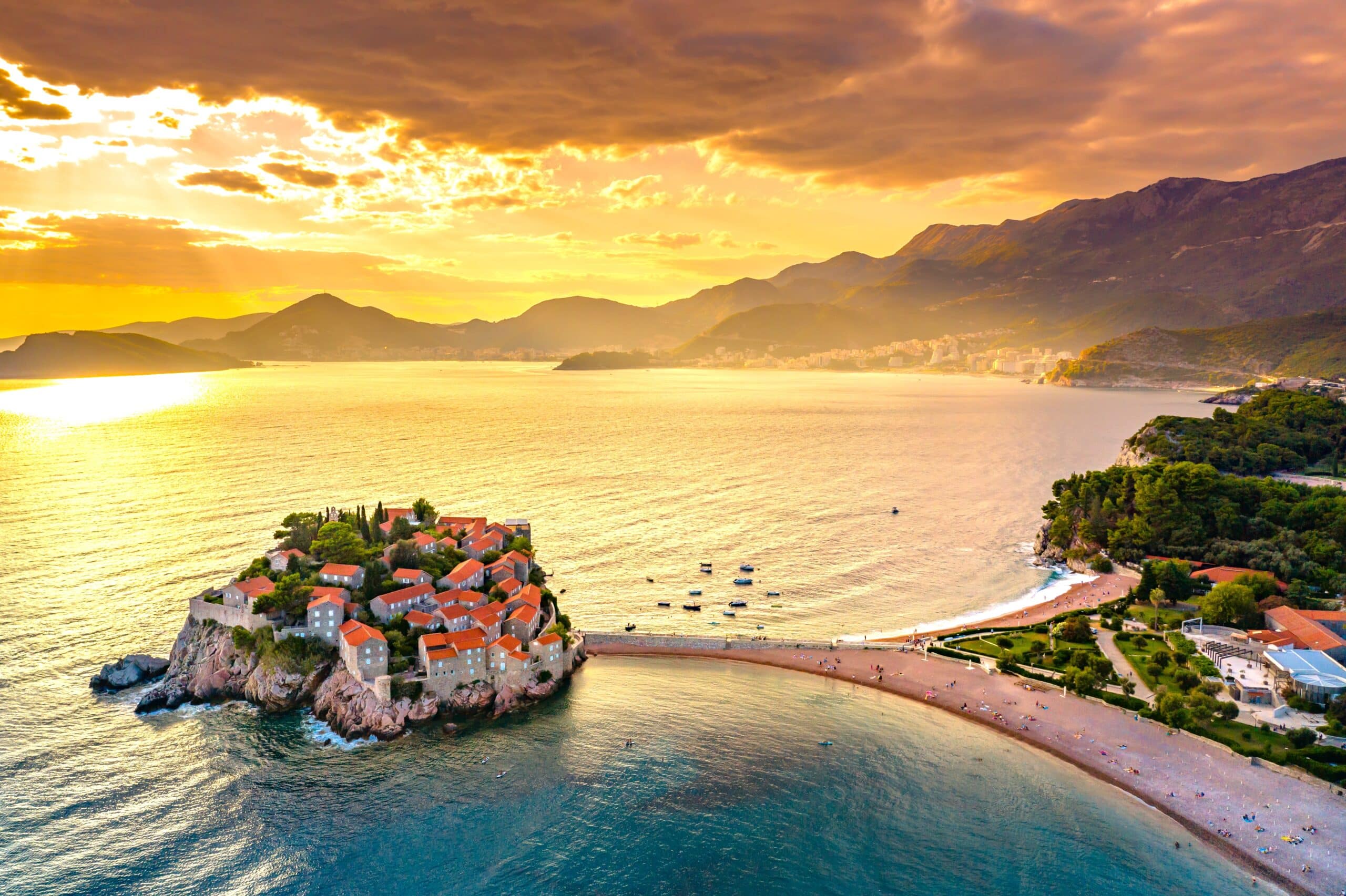
Few images represent Montenegro as powerfully as the pink-roofed stone houses of Sveti Stefan, rising from a tiny island connected to the mainland by a narrow strip of sand.
From a distance, the view feels almost unreal — a medieval village floating on turquoise Adriatic waters. The island was originally founded in the 15th century as a fortified settlement built to defend the coast from Ottoman attacks. Fishermen and merchants lived behind its stone walls for centuries, creating a tight community within the island’s narrow alleys.
By the mid-20th century, however, the village had begun to decline. In the 1950s, the Yugoslav government transformed it into an exclusive luxury resort, preserving the historic architecture while turning the interior homes into elegant suites. Today the island operates as part of the prestigious Aman Sveti Stefan, attracting celebrities, royalty, and travelers seeking privacy and beauty.
While access to the island itself is limited to guests, the surrounding beaches are among the most beautiful in Montenegro. The narrow causeway divides two beaches with soft pinkish sand and clear Adriatic water.
From the nearby hills, panoramic viewpoints reveal the island’s full beauty, especially at sunset when the stone walls glow golden against the sea.
Small restaurants along the mainland promenade serve fresh seafood, grilled fish, and local wines while overlooking the island’s timeless silhouette.
Though small, Sveti Stefan captures the essence of Montenegro’s Adriatic coast — ancient, elegant, and breathtakingly scenic.
11. Biogradska Gora National Park
In the mountainous interior of Montenegro, far from the Adriatic coast, lies one of Europe’s most precious natural treasures: Biogradska Gora National Park.
This extraordinary park protects one of the last remaining primeval forests on the continent. Some of its towering trees are more than 500 years old, creating a dense canopy that has remained largely untouched for centuries.
At the heart of the park sits the tranquil Biogradsko Lake, a glacial lake surrounded by lush forest and dramatic mountain slopes. A gentle walking path circles the lake, offering peaceful views of reflections shimmering on its calm surface.
The park itself was established in 1878 when King Nikola I Petrović-Njegoš declared the forest protected land — making it one of the oldest protected natural areas in Europe.
Today, the park covers part of the rugged Bjelasica Mountains, home to alpine meadows, wildflowers, and diverse wildlife. Bears, wolves, deer, and countless bird species live within its forests, though they remain elusive to most visitors.
Hiking trails lead deep into the mountains, where quiet valleys and panoramic viewpoints reward those willing to explore further. In summer, shepherds still graze livestock in highland pastures known as katuns — small seasonal settlements that preserve traditional mountain life.
The air here feels fresh and untouched, filled with the scent of pine and damp earth.
For travelers seeking Montenegro’s wild, unspoiled landscapes, Biogradska Gora offers a glimpse of Europe as it once was — ancient forests, pristine lakes, and a deep sense of natural serenity.
10. Herceg Novi
At the entrance to the spectacular Bay of Kotor, the historic town of Herceg Novi rises in terraces of stone houses, stairways, and fortresses overlooking the Adriatic Sea.
Often called the “City of Stairs,” Herceg Novi is built along a steep hillside where narrow lanes and staircases wind between churches, squares, and gardens filled with Mediterranean flowers.
The town’s history stretches back to 1382, when it was founded by the Bosnian king Tvrtko I of Bosnia as a strategic coastal settlement. Over the centuries it was ruled by the Ottoman Empire, Republic of Venice, and later the Austro-Hungarian Empire, each leaving traces in the city’s architecture.
Fortresses dominate the skyline. The most impressive is Kanli Kula, a massive stone fortress originally built by the Ottomans in the 16th century. Today it serves as an open-air theater, where concerts and cultural events take place beneath the stars.
Below, the charming Old Town of Herceg Novi invites visitors to wander its quiet squares and shaded courtyards.
Herceg Novi is also famous for its lush vegetation. Thanks to its mild climate, the town is filled with palm trees, bougainvillea, and exotic plants brought here by sailors over centuries of maritime trade.
Along the waterfront promenade, cafés and seafood restaurants overlook small beaches and the calm waters of the bay.
With more sunny days than most Adriatic towns and a relaxed Mediterranean atmosphere, Herceg Novi offers a warm and welcoming gateway to the beauty of Montenegro’s coast.
9. Black Lake
Nestled beneath towering peaks in Durmitor National Park, the mysterious waters of Black Lake form one of the most iconic natural scenes in Montenegro.
Known locally as Crno Jezero, the lake sits at the foot of the dramatic Međed Peak, surrounded by dense pine forest and alpine meadows. Despite its name, the lake’s waters are actually a deep emerald blue, reflecting the mountains and trees like a natural mirror.
The name “Black Lake” comes from the dark shadows cast by the surrounding forest, which make the water appear almost black during certain times of the day.
Formed by glacial activity thousands of years ago, the lake is actually composed of two connected basins — the Big Lake and the Small Lake — which merge during periods of high water.
A scenic walking path circles the shoreline, making it one of the most accessible yet beautiful spots in the park. As visitors stroll along the trail, the landscape changes constantly: quiet forest sections, open meadows, and viewpoints where the lake reveals its full reflection of the surrounding mountains.
During summer, kayakers glide across the calm surface while hikers rest along the shore.
Local legends add a mystical quality to the lake. According to folklore, the lake was formed when a monastery once stood in the valley and was cursed after false accusations were made against a holy monk.
Whether viewed in bright daylight or under the golden glow of sunset, Black Lake captures the quiet magic of Montenegro’s mountain wilderness.
8. Perast
Along the calm waters of the Bay of Kotor, the elegant stone town of Perast stands as one of the most beautiful historic settlements in Montenegro.
Unlike the busier streets of nearby Kotor, Perast feels almost frozen in time. The town is small — just a single waterfront street lined with grand palaces, churches, and quiet cafés facing the bay.
Perast flourished during the centuries when the region was part of the Republic of Venice. Wealthy maritime families built elegant Baroque mansions here, many of which still stand today with their stone balconies and ornate facades.
Rising above the town is the tall bell tower of St. Nicholas Church, offering panoramic views across the bay and the surrounding mountains.
Just offshore lie two of the most picturesque landmarks in Montenegro: the tiny islands of Our Lady of the Rocks and St. George Island.
According to legend, Our Lady of the Rocks was created over centuries as local sailors dropped stones into the water after discovering an icon of the Virgin Mary on a reef. Today, a beautiful church and small museum stand on the artificial island, accessible by short boat rides from the town.
In the evening, the stone waterfront glows in the soft Adriatic light as small boats drift quietly across the bay.
Perast’s peaceful atmosphere, rich maritime history, and stunning scenery make it one of the most romantic and memorable places in Montenegro.
7. Đurđevića Tara Bridge
Spanning the vast expanse of the Tara River Canyon, the elegant Đurđevića Tara Bridge stands as both an engineering marvel and one of the most dramatic viewpoints in Montenegro.
Completed in 1940, the bridge was designed by the engineer Mijat Trojanović and quickly became one of the most ambitious infrastructure projects in the region. At the time of its construction, it was the largest concrete arch bridge in Europe.
The bridge stretches 365 meters across the canyon and rises 172 meters above the turquoise waters of the Tara River below. Its graceful arches seem to float effortlessly between the canyon cliffs.
The structure also played a dramatic role during World War II. In 1942, a section of the bridge was deliberately destroyed by Yugoslav partisans in order to halt advancing Italian forces. The act of sabotage later became the subject of the Yugoslav war film The Bridge.
Today, the bridge has been fully restored and is one of Montenegro’s most photographed landmarks.
Visitors can walk across the bridge for spectacular views into the canyon far below. For thrill-seekers, a zipline stretches from the canyon rim across the gorge, offering an exhilarating flight over the river.
Standing on the bridge, with wind rushing through the canyon and mountains rising in every direction, travelers experience one of the most dramatic landscapes in the Balkans.
6. Ulcinj
At the southern edge of Montenegro, near the border with Albania, the coastal town of Ulcinj offers a fascinating blend of cultures, history, and Mediterranean beauty.
Ulcinj is one of the oldest settlements along the Adriatic coast, with roots stretching back more than 2,000 years. Over centuries it was influenced by the Roman Empire, the Ottoman Empire, and the Republic of Venice, each leaving its mark on the town’s architecture and traditions.
The historic Old Town of Ulcinj rises dramatically on a rocky cliff overlooking the sea. Within its stone walls are narrow alleys, ancient towers, mosques, and courtyards that reflect the town’s strong Ottoman heritage.
Ulcinj was once notorious for piracy. In the 17th and 18th centuries, pirates operating from this port captured ships across the Adriatic and Mediterranean.
Just south of the town lies one of Montenegro’s most remarkable beaches: Velika Plaža, meaning “Long Beach.” Stretching for more than 13 kilometers, it is the longest sandy beach on the Adriatic coast.
The wide shoreline and steady winds have also made the area popular for kite surfing and other water sports.
Ulcinj’s cultural atmosphere feels slightly different from the rest of Montenegro. The town has a strong Albanian influence, reflected in its language, cuisine, and traditions.
Restaurants serve flavorful dishes such as grilled seafood, spicy stews, and regional specialties influenced by both Balkan and Mediterranean cooking.
With its ancient history, expansive beaches, and vibrant cultural mix, Ulcinj offers travelers a unique and unforgettable perspective on Montenegro’s southern coast.
5. Njegoš Mausoleum
At the summit of Mount Lovćen, high above the surrounding mountains, stands one of the most symbolic monuments in Montenegro: the impressive Njegoš Mausoleum.
The mausoleum honors Petar II Petrović-Njegoš, the philosopher, poet, and ruler who played a defining role in shaping Montenegrin culture and identity during the 19th century. His epic poem The Mountain Wreath remains one of the most important works of South Slavic literature.
To reach the mausoleum, visitors climb 461 stone steps through a long tunnel carved into the mountain. At the top, the structure emerges dramatically against the sky, guarded by two massive black granite statues.
Inside, a large statue of Njegoš sits beneath a golden mosaic dome, while his tomb rests quietly in the chamber below.
But the true reward awaits outside. From the viewing platform behind the mausoleum, travelers are treated to one of the most breathtaking panoramas in the Balkans.
On clear days, nearly half of Montenegro can be seen from this height — from the shining Adriatic coastline to distant mountain ranges stretching far into the interior.
Standing here, surrounded by wind and sky, visitors feel the immense scale of the country’s landscapes and the powerful legacy of the man honored at its summit.
4. The Blue Cave
Along the rugged coastline of the Luštica Peninsula, one of the Adriatic’s most magical natural sights glows beneath the cliffs: the dazzling Blue Cave.
Accessible only by boat, the cave lies near the entrance of the Bay of Kotor and has become one of the most popular excursions for travelers exploring Montenegro’s coastline.
From the outside, the cave appears modest — a rocky opening carved into the limestone cliffs. But as boats glide inside, the water suddenly transforms into a brilliant glowing blue.
This striking color is created when sunlight enters through underwater openings and reflects off the cave’s white seabed, illuminating the interior with a shimmering turquoise light.
The effect can be mesmerizing. The entire cave seems to glow as if lit from within, with reflections dancing across the rocky ceiling.
Many visitors choose to jump from their boats into the glowing water, swimming through the illuminated chamber while sunlight flickers around them.
Boat tours to the Blue Cave often depart from coastal towns such as Herceg Novi, Kotor, and Budva, usually combining the visit with stops at nearby beaches and hidden coves.
Though relatively small, the Blue Cave offers one of Montenegro’s most unforgettable coastal experiences — a place where light, sea, and stone combine to create a natural Adriatic spectacle.
3. Ada Bojana
At the southernmost tip of Montenegro, where the Bojana flows into the Adriatic Sea, lies the serene island of Ada Bojana. Formed by the river’s delta, this triangular island is a natural playground for lovers of sun, sand, and sea.
Ada Bojana is unlike Montenegro’s rocky coastlines. Its soft sandy beaches stretch for kilometers, flanked by calm, shallow waters ideal for swimming and water sports. The island is especially famous among kite surfers and windsurfing enthusiasts, thanks to its steady coastal winds.
The island has a relaxed, almost bohemian atmosphere. Wooden bungalows, rustic seafood restaurants, and small bars line the edge of the sand, while locals sell freshly caught fish right on the beach. Dining here is an experience in itself — grilled calamari, fresh oysters, and the local specialty, river prawns, all served with a view of the sunset over the Adriatic.
Ada Bojana is also a natural reserve. The surrounding wetlands provide habitats for numerous bird species, including flamingos, herons, and migratory waterfowl. Birdwatchers can spend hours observing these elegant creatures in their natural environment.
For visitors seeking a combination of relaxation, adventure, and natural beauty, Ada Bojana is a hidden gem. Walking along its long, quiet beaches, feeling the river breeze and hearing the gentle lapping of water against the sand, it’s easy to forget the world beyond Montenegro’s southern tip.
This small, peaceful island embodies the laid-back side of Montenegro’s coast — where nature, water, and human life coexist in perfect harmony.
2. Morača Canyon
Cutting through the heart of Montenegro’s rugged mountains, Morača Canyon is a breathtaking natural corridor linking the highlands with the central Adriatic region. The canyon follows the path of the Morača, whose turquoise waters plunge between steep cliffs carved over millennia.
The Morača Canyon is both a geological wonder and a journey through history. Its rocky walls rise hundreds of meters above the river, creating a sense of dramatic scale that impresses every traveler passing through.
Driving along the canyon, visitors encounter winding roads with panoramic viewpoints that reveal the deep gorge and surrounding peaks. Small villages cling to the cliffs, and traditional stone bridges cross the river, blending seamlessly with the landscape.
Hiking trails lead from the canyon floor into forested slopes where the air is fresh and fragrant with pine and wild herbs. Wildlife is abundant — foxes, deer, and eagles are often spotted, while the river supports trout and other freshwater species.
Among the canyon’s most important landmarks is the Morača Monastery, a 13th-century Serbian Orthodox monastery. Carved into the cliffside, the monastery features beautiful frescoes and a serene courtyard overlooking the river below. Pilgrims and travelers alike come here for both its spiritual significance and its remarkable setting.
The combination of natural grandeur, historic architecture, and peaceful wilderness makes Morača Canyon one of Montenegro’s most unforgettable inland destinations.
Standing on a cliff above the turquoise waters or wandering among its ancient monastery walls, visitors gain a sense of Montenegro’s raw, untamed beauty — a country where mountains, rivers, and history meet in harmony.
1. Stari Bar
Hidden in the hills beneath Mount Rumija, a few kilometers inland from the Adriatic coast, lies one of the most atmospheric historical sites in Montenegro — the haunting ruins of Stari Bar, or “Old Bar.”
Unlike the lively coastal town of Bar nearby, Stari Bar feels like a city frozen in time. Stone walls climb the mountainside, broken towers rise above crumbling houses, and narrow streets wind through what was once a thriving medieval settlement.
The history of Stari Bar stretches back more than a thousand years. Because of its strategic location between the Adriatic Sea and the Balkan interior, the city became an important trading and military center. Over the centuries it passed through the hands of many powers, including the Byzantine Empire, the Republic of Venice, and the Ottoman Empire.
Walking through the ruins today feels like exploring a forgotten kingdom. Massive defensive walls surround the town, while inside stand the remains of churches, mosques, watchtowers, and homes. One of the most impressive landmarks is the Stari Bar Fortress, whose thick stone ramparts once protected the city from invasion.
During the Ottoman period, Stari Bar developed a distinct character influenced by both Mediterranean and eastern cultures. Minarets rose beside churches, and the town became known for its markets, olive oil, and trade.
But the city’s fate changed dramatically in the late 19th century. During conflicts between the Ottomans and Montenegrin forces, Stari Bar suffered heavy damage. A powerful explosion in 1878 destroyed large parts of the town, and many residents eventually moved to the new coastal settlement of Bar below.
Today the ruins have been carefully preserved and partially restored. As visitors climb the stone paths through arches and crumbling walls, the atmosphere is quiet and evocative.
From the highest terraces, sweeping views stretch across olive groves toward the Adriatic Sea. Nearby stands one of the oldest living olive trees in Europe — the legendary Stara Maslina, believed to be more than 2,000 years old.
Stari Bar is not just a historical monument — it is a place where centuries of Balkan history linger among the stones, offering travelers a glimpse into Montenegro’s layered and fascinating past.