
Lithuania lies along the eastern shore of the Baltic Sea and represents the southernmost of the three Baltic states. Though modest in size, the country carries a remarkable historical legacy shaped by medieval statehood, regional unions, occupations, and modern independence.
During the 14th and 15th centuries, the Grand Duchy of Lithuania became one of the largest political entities in Europe, stretching from the Baltic to the Black Sea. Its union with Poland formed the Polish–Lithuanian Commonwealth, a major European power known for political innovation and cultural diversity.
The capital, Vilnius, reflects this layered past. Gothic, Renaissance, Baroque, and neoclassical buildings line its old town streets, illustrating centuries of religious and ethnic coexistence. The city historically served as a center of scholarship, trade, and diplomacy.
Lithuania experienced profound transformations in the 20th century, including periods of independence, Soviet occupation, and eventual restoration of sovereignty in 1990. The peaceful independence movement demonstrated strong civic unity and national determination.
Geographically, Lithuania features lowland plains, dense forests, lakes, and a short but distinctive Baltic coastline. The Curonian Spit, a unique sand dune peninsula, highlights the interaction between nature and human settlement.
Culturally, Lithuania preserves ancient Baltic traditions, language, and folklore. Lithuanian is one of the oldest surviving Indo-European languages, maintaining archaic linguistic features.
Today, Lithuania is a member of the European Union and NATO, combining historical preservation with technological and economic modernization. Its cities balance medieval heritage with contemporary innovation, while rural regions maintain strong agricultural and cultural traditions.
This 30-destination edition will explore Lithuania’s historic towns, natural landscapes, and cultural landmarks, revealing a nation defined by resilience, continuity, and Baltic character.
30. Vilnius
Vilnius, the capital of Lithuania, stands at the confluence of the Neris and Vilnia rivers in the southeastern part of the country. Its Old Town is one of the largest preserved medieval centers in Central and Eastern Europe, reflecting centuries of political, religious, and cultural interaction.
Founded in the 14th century by Grand Duke Gediminas, Vilnius became the capital of the Grand Duchy of Lithuania. During this period, the city expanded rapidly as a center of trade and diplomacy. Gothic churches, Renaissance courtyards, and Baroque façades illustrate successive architectural influences.
Vilnius University, established in 1579, remains one of the oldest institutions of higher education in the region. The university complex, with its arcaded courtyards and historic library, symbolizes the city’s intellectual heritage.
The Cathedral Square forms the symbolic heart of Vilnius. The neoclassical cathedral and nearby Gediminas Tower connect modern Lithuania with its medieval foundations. From the tower, panoramic views reveal red rooftops and church spires rising above narrow streets.
Vilnius has historically been home to diverse communities, including Lithuanians, Poles, Jews, and Russians. This multicultural legacy shaped its artistic and religious landscape.
Today, Vilnius balances preservation with technological growth. Start-up companies, cultural festivals, and academic institutions contribute to a vibrant urban atmosphere.
Vilnius harmonizes medieval foundations, Baroque elegance, and contemporary innovation, standing as Lithuania’s political and cultural center.
29. Kaunas
Kaunas lies at the confluence of the Nemunas and Neris rivers and serves as Lithuania’s second-largest city. Historically a fortress and trading center, it became the temporary capital of Lithuania between 1919 and 1940.
Kaunas Castle, dating to the 14th century, represents one of the earliest defensive structures in the country. Its red-brick towers reflect Gothic military architecture.
During the interwar period, Kaunas experienced rapid modernization. Government institutions, banks, and cultural venues were constructed in modernist style, shaping the city’s architectural identity. This period left a legacy of functionalist buildings that distinguish Kaunas within the Baltic region.
Laisvės Alėja, a long pedestrian boulevard, forms the city’s commercial and social spine. Cafés, theaters, and shops line the avenue, reinforcing urban vitality.
Kaunas also developed as a center of education and industry. Universities and research institutions support innovation, while manufacturing historically played a central economic role.
The city’s rivers and nearby reservoirs provide recreational spaces that integrate natural scenery with urban life.
Kaunas harmonizes medieval defense, interwar modernism, and contemporary cultural renewal. Its role as temporary capital strengthened national identity during a formative historical period.
28. Klaipėda
Klaipėda, Lithuania’s principal seaport, lies on the Baltic Sea near the mouth of the Curonian Lagoon. Historically known as Memel, it developed under Germanic influence before becoming part of modern Lithuania.
The city’s Old Town reflects its Hanseatic heritage, with timber-framed buildings and narrow streets. Trade connections across the Baltic Sea shaped its economic foundation.
Klaipėda Castle once protected the harbor, emphasizing its strategic maritime role. Though partially reconstructed, it remains a symbol of the city’s medieval origins.
As Lithuania’s only major port, Klaipėda plays a critical role in national trade and transportation. Shipyards, logistics companies, and maritime services contribute significantly to the economy.
The nearby Curonian Spit, a narrow sand dune peninsula, forms a unique natural landscape shared with Russia. Ferry connections link Klaipėda with this UNESCO-protected area.
Cultural festivals, including sea celebrations, reinforce the city’s maritime identity. Universities and research centers support marine sciences and environmental studies.
Klaipėda harmonizes Baltic trade history, port infrastructure, and coastal landscapes. Its maritime orientation distinguishes it from inland Lithuanian cities and anchors the nation’s connection to the sea.
27. Šiauliai
Šiauliai is located in northern Lithuania and serves as an important regional center for industry, education, and culture. Though first mentioned in historical sources in the 13th century, the city grew significantly during the 19th and 20th centuries.
One of the most significant nearby landmarks is the Hill of Crosses, situated a short distance outside the city. This pilgrimage site contains thousands of crosses placed over generations as expressions of faith and national identity. During the Soviet period, repeated attempts to remove the crosses only strengthened their symbolic meaning.
Šiauliai developed as a manufacturing hub, particularly in leather, footwear, and bicycle production. Industrial growth shaped the city’s modern layout, with broad streets and functional buildings replacing much of the earlier architecture lost during wartime destruction.
The city maintains cultural institutions including museums, galleries, and a university, supporting regional education and research. Public squares and pedestrian areas encourage community life.
Šiauliai harmonizes industrial heritage, religious symbolism, and regional administration. Its resilience during periods of political upheaval reflects broader Lithuanian endurance.
26. Panevėžys
Panevėžys lies in central-northern Lithuania along the Nevėžis River. Established in the 16th century, it developed gradually as a trade and agricultural center.
The city expanded significantly during the 20th century through industrialization. Factories producing electronics, machinery, and textiles contributed to economic growth under Soviet administration. After independence, the economy diversified toward services and logistics.
Panevėžys is recognized for its theatrical tradition. The Juozas Miltinis Drama Theatre gained national prominence for innovative productions and cultural influence.
Urban development reflects a combination of older residential neighborhoods and modern districts. Parks along the Nevėžis River provide recreational spaces and connect communities across the city.
Educational institutions and vocational centers contribute to workforce development. The city’s location between Vilnius and Riga strengthens its role in regional transportation networks.
Panevėžys harmonizes industrial transformation, cultural creativity, and central geographic position within Lithuania.
25. Trakai
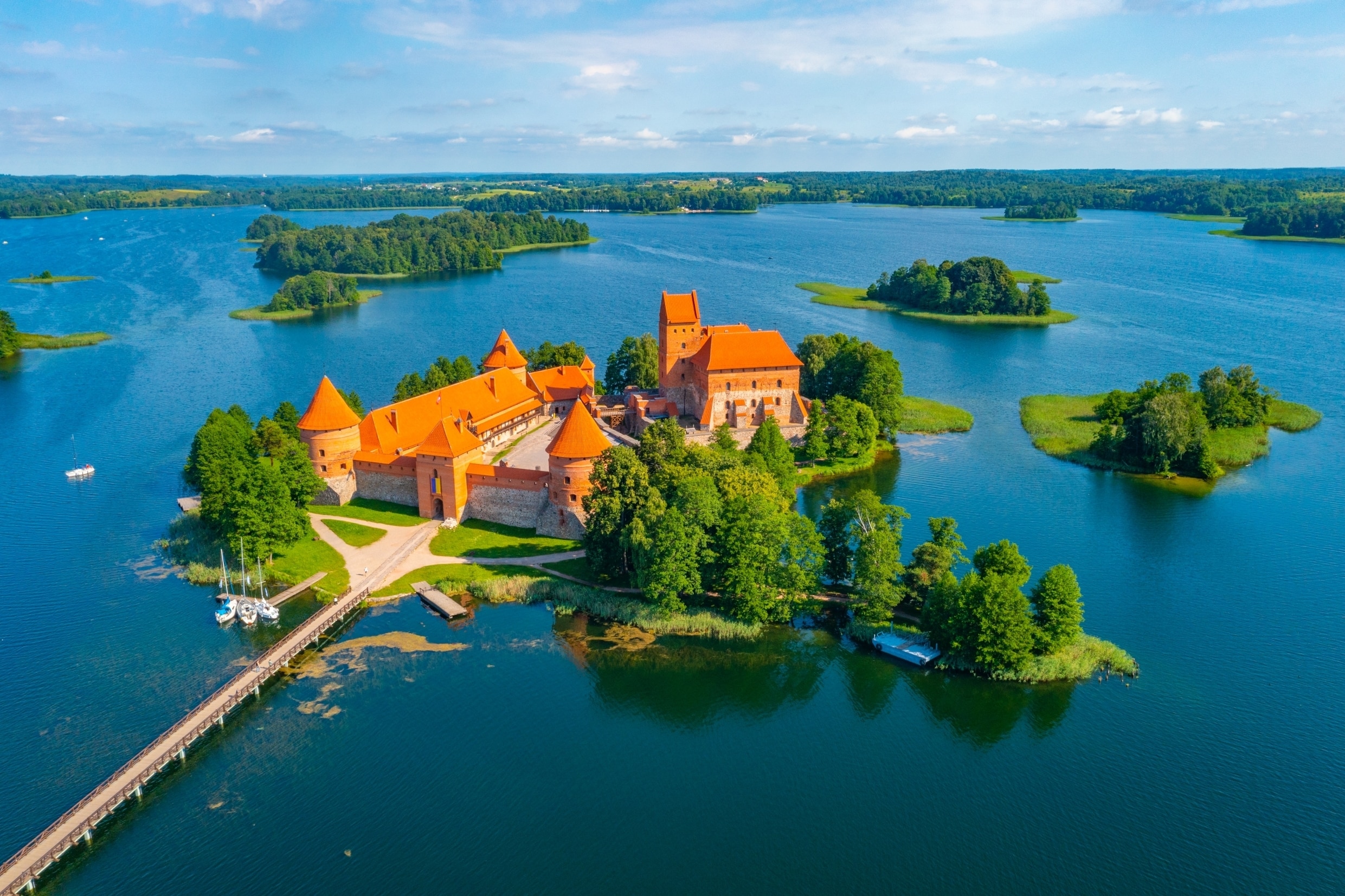
Trakai, located west of Vilnius, is one of Lithuania’s most historically significant towns. Surrounded by lakes, it served as an important political center during the era of the Grand Duchy of Lithuania.
The Island Castle, constructed in the 14th century, stands on an island in Lake Galvė and is connected to the shore by a wooden bridge. The red-brick fortress once functioned as a residence for Lithuanian rulers and a defensive stronghold.
Trakai was historically home to the Karaim community, a Turkic-speaking religious minority invited to settle in the region by Grand Duke Vytautas. Traditional wooden houses with characteristic street-facing windows remain visible today.
Tourism plays a major role in the local economy. Visitors explore the castle museum, sail on the lakes, and experience regional cuisine such as kibinai pastries associated with Karaim heritage.
The surrounding lakes and forests provide recreational opportunities including boating, hiking, and winter sports.
Trakai harmonizes medieval statehood, multicultural heritage, and scenic natural landscapes. Its preserved castle and lakeside setting make it one of Lithuania’s most iconic destinations.
24. Palanga
Palanga is Lithuania’s most prominent seaside resort, located along the Baltic coast west of Klaipėda. Known for its sandy beaches and pine forests, the town has developed as a center of tourism and recreation.
The settlement gained prominence in the 19th century under the patronage of the Tiškevičius family, who constructed a neo-Renaissance palace surrounded by landscaped gardens. Today, the palace houses the Palanga Amber Museum, displaying extensive collections of Baltic amber, a material long associated with regional trade.
J. Basanavičius Street serves as the main pedestrian promenade, lined with cafés, restaurants, and seasonal attractions. The long pier extending into the Baltic Sea provides panoramic views and has become a symbolic landmark of the resort.
Palanga’s economy depends largely on summer tourism, though cultural events and festivals extend activity beyond peak season. Wellness centers and spa facilities reflect the town’s historical association with health tourism.
Natural surroundings contribute significantly to Palanga’s appeal. Coastal dunes, botanical gardens, and protected forest areas integrate recreation with environmental conservation.
Palanga harmonizes seaside leisure, aristocratic heritage, and amber craftsmanship. Its coastal setting anchors Lithuania’s identity as a Baltic nation connected to maritime landscapes.
23. Druskininkai
Druskininkai lies in southern Lithuania near the borders with Poland and Belarus. Renowned for its mineral springs, it developed as a spa town in the 19th century.
The town’s name derives from the Lithuanian word for salt, referencing its mineral-rich waters. Spa complexes, sanatoriums, and wellness centers form the foundation of its economy. During the 19th century, Druskininkai attracted visitors from across the Russian Empire seeking therapeutic treatments.
Architecturally, the town features wooden villas, landscaped parks, and modern spa facilities. The Nemunas River flows nearby, enhancing the natural environment.
Druskininkai also hosts cultural institutions, including museums dedicated to artist Mikalojus Konstantinas Čiurlionis. Seasonal festivals and winter sports facilities diversify its tourist offerings.
After independence, investments modernized spa infrastructure while preserving historical character. Snow Arena, an indoor ski complex, exemplifies contemporary recreational development.
Druskininkai harmonizes natural mineral resources, artistic heritage, and modern wellness tourism. Its combination of therapeutic tradition and cultural life sustains its role as Lithuania’s leading spa destination.
22. Kėdainiai
Kėdainiai, situated in central Lithuania along the Nevėžis River, is one of the country’s oldest towns. First mentioned in the 14th century, it flourished under noble patronage during the 16th and 17th centuries.
The town is notable for its multicultural past. Scottish merchants, Jews, and Germans once lived alongside Lithuanians, contributing to trade and religious diversity. Remnants of synagogues and Reformed churches reflect this varied heritage.
Kėdainiai’s Old Town preserves Renaissance and Baroque buildings arranged around a historic market square. The town hall and churches illustrate architectural continuity.
Agriculture has long shaped the surrounding region, particularly grain cultivation and food processing industries. Modern enterprises complement traditional farming.
The Nevėžis River provides scenic walking routes and recreational spaces, linking historical and natural environments.
Today, Kėdainiai functions as a regional center balancing industry, agriculture, and heritage tourism. Its preserved architecture and multicultural legacy distinguish it within central Lithuania.
21. Marijampolė
Marijampolė is located in southwestern Lithuania near the border with Poland. Historically part of the Suvalkija region, the city developed as a market settlement in the 18th century around a Marian monastery, from which it derives its name.
The town expanded significantly in the 19th century due to its strategic position along trade routes connecting Lithuania with Central Europe. Agricultural trade and small-scale manufacturing formed the basis of early economic growth.
Marijampolė became an important cultural center during Lithuania’s national revival. Intellectual movements promoting Lithuanian language and identity found support in the region. Educational institutions continue to reflect this legacy.
The city’s layout features a central square surrounded by neoclassical and modern buildings. Renovations in recent decades modernized public spaces while maintaining historical references. Parks and pedestrian zones contribute to urban livability.
Industrial activities, particularly food processing and light manufacturing, support the local economy. Proximity to international highways enhances cross-border commerce.
Today, Marijampolė balances agricultural heritage, regional administration, and educational development. Its role within Suvalkija highlights the diversity of Lithuania’s regional identities and historical experiences.
20. Alytus
Alytus lies in southern Lithuania along the Nemunas River and is one of the country’s oldest settlements, with roots dating back to the medieval period. Its location along a major river fostered early trade and communication.
During the 19th and 20th centuries, Alytus developed into an industrial center, particularly in textiles and machinery production. Soviet-era expansion shaped the city’s urban structure, adding residential districts and infrastructure.
The Nemunas River remains central to Alytus’s identity. Bridges connect different parts of the city, and riverside parks provide recreational spaces. Surrounding forests and nature reserves support outdoor activities.
Cultural institutions, including theaters and art centers, contribute to civic life. Educational facilities support workforce development and regional engagement.
Alytus has diversified economically since independence, integrating services and small enterprises into its industrial base. Transportation connections link it with Vilnius and Kaunas.
The city harmonizes river landscapes, industrial heritage, and evolving urban identity. Alytus reflects Lithuania’s broader transformation from centrally planned industry toward diversified regional economies.
19. Utena
Utena is located in northeastern Lithuania amid lakes and forests. Mentioned in historical records as early as the 13th century, it developed as a regional trade and craft center.
The surrounding Aukštaitija region is known for its natural beauty. Numerous lakes and protected areas define the landscape, encouraging fishing, hiking, and rural tourism. Utena serves as a gateway to these natural attractions.
Industrial growth during the 20th century introduced textile and beverage production. Utenos Alus, one of Lithuania’s major breweries, contributed to the city’s economic profile.
Urban planning combines historical remnants with modern residential districts. Public squares, cultural centers, and educational institutions support community life.
Utena maintains strong ties to regional traditions, particularly folklore and seasonal festivals. Agricultural activity in nearby villages complements industrial enterprises.
Today, Utena balances small-city atmosphere with regional economic importance. Its lakeside setting and access to natural landscapes make it an essential destination within northeastern Lithuania.
18. Birštonas
Birštonas is a spa town located in southern Lithuania along a scenic bend of the Nemunas River. Surrounded by forests and gentle hills, it has long been recognized for its mineral springs and therapeutic mud treatments.
The town developed as a health resort during the 19th century, when visitors from across the Russian Empire traveled to experience its restorative waters. Sanatoriums and spa villas shaped its architectural identity, blending wooden resort buildings with landscaped parks.
Birštonas is characterized by its tranquil atmosphere. Pedestrian paths wind along the riverbanks, and observation towers provide panoramic views of the Nemunas loops. The surrounding regional park protects biodiversity while supporting eco-tourism.
In addition to wellness tourism, Birštonas hosts cultural events and music festivals that attract national audiences. Concert halls and cultural centers contribute to year-round activity beyond the summer season.
Modern spa complexes integrate contemporary treatments with traditional mineral therapies. Investments since independence have improved infrastructure while maintaining environmental sensitivity.
Birštonas harmonizes natural resources, health traditions, and river landscapes. Its compact size and focus on wellness make it one of Lithuania’s most peaceful and restorative destinations.
17. Anykščiai
Anykščiai lies in northeastern Lithuania within the forested Aukštaitija region. The town is closely associated with literature, nature, and regional identity.
Historically a small settlement along the Šventoji River, Anykščiai gained prominence through cultural heritage. It is linked to poet Antanas Baranauskas, whose work celebrated Lithuanian landscapes and language. Museums and memorial sites honor his legacy.
The Church of St. Matthew, one of the tallest churches in Lithuania, dominates the town center. Its twin towers rise above surrounding wooden houses and green hills.
Anykščiai is also known for its natural attractions. The Treetop Walking Path, elevated above forest canopy, offers panoramic views of pine woodlands. Nearby geological formations and river valleys encourage hiking and outdoor recreation.
Tourism plays a growing role in the local economy, complemented by agriculture and small enterprises. Cultural festivals celebrate folk traditions and crafts.
Anykščiai harmonizes literary heritage, forest landscapes, and rural tranquility. Its integration of culture and nature exemplifies northeastern Lithuania’s distinctive character.
16. Telšiai
Telšiai is the principal city of the Samogitia (Žemaitija) region in northwestern Lithuania. Located near Lake Mastis, it serves as a cultural and administrative center for this historically distinct area.
Founded in the 14th century, Telšiai developed around religious institutions and trade routes. Its old town reflects Baroque and classical influences, with churches and civic buildings arranged on rolling hills.
Telšiai is recognized as a center of Samogitian identity. Museums and cultural institutions preserve regional dialects, folklore, and traditions that distinguish Samogitia from other Lithuanian regions.
The city experienced demographic and political changes during the 20th century, including wartime destruction and Soviet transformation. Post-independence restoration has revitalized public spaces and historical monuments.
Educational institutions, including an art faculty affiliated with Vilnius Academy of Arts, contribute to the city’s creative environment.
Telšiai harmonizes regional pride, lakeside scenery, and cultural preservation. As the capital of Samogitia, it reflects Lithuania’s internal diversity and enduring local traditions.
15. Ukmergė
Ukmergė is located in central Lithuania along the Šventoji River, approximately midway between Vilnius and Panevėžys. First mentioned in the 13th century, it developed as a defensive settlement protecting trade routes across the region.
During the Grand Duchy of Lithuania, Ukmergė grew into a market town serving surrounding agricultural communities. Its central square and street layout reflect medieval planning, though many buildings were later reconstructed following fires and wartime destruction.
The town experienced substantial industrial growth during the 20th century, particularly in food processing and manufacturing. Soviet-era expansion introduced residential districts and infrastructure that reshaped the urban landscape.
Ukmergė’s cultural life centers on local museums and regional festivals celebrating Lithuanian traditions. Churches of various denominations testify to its historical religious diversity.
The surrounding countryside features rolling hills, forests, and river valleys that support agriculture and outdoor recreation. Infrastructure improvements have strengthened Ukmergė’s connection to major highways.
Today, Ukmergė harmonizes rural heritage, industrial adaptation, and regional service functions. Its strategic central location reinforces its historical role as a crossroads within Lithuania.
14. Mažeikiai
Mažeikiai lies in northwestern Lithuania near the Latvian border. Historically a small rural settlement, it expanded significantly during the 20th century due to industrial development.
The establishment of a major oil refinery transformed Mažeikiai into one of Lithuania’s key industrial centers. Energy production and related industries form the backbone of the local economy, providing employment and infrastructure growth.
Urban planning reflects its modern expansion, with residential neighborhoods and administrative buildings constructed during the Soviet period. Public parks and cultural centers provide community spaces within the industrial environment.
Mažeikiai also serves as a regional transportation hub, connecting Lithuania with Latvia through rail and road networks. Cross-border trade contributes to economic vitality.
Despite its industrial character, the surrounding region includes agricultural land and small forests, preserving elements of rural landscape. Cultural initiatives emphasize regional identity within Samogitia.
Mažeikiai harmonizes industrial specialization, cross-border connectivity, and evolving urban identity. Its economic role underscores Lithuania’s integration into regional energy networks.
13. Jonava
Jonava is situated in central Lithuania along the Neris River between Vilnius and Kaunas. Established in the 18th century, it initially developed as a trading settlement serving surrounding villages.
Industrialization during the 20th century significantly shaped Jonava’s growth. The construction of a large fertilizer plant established the city as an important chemical production center. This industrial base continues to influence the local economy.
Residential districts, schools, and cultural institutions expanded alongside factory operations. Public parks and riverfront areas provide recreational spaces for residents.
Jonava maintains historical traces in its churches and older neighborhoods, though much of its architecture reflects modern development. Its central location strengthens transportation connections across Lithuania.
Environmental initiatives have gained importance in recent years, balancing industrial activity with sustainability efforts. Community programs and festivals contribute to civic engagement.
Jonava harmonizes industrial production, river landscapes, and central geographic positioning. Its development illustrates Lithuania’s transition from agrarian roots to diversified economic structure.
12. Visaginas
Visaginas is located in northeastern Lithuania near the borders with Latvia and Belarus. Unlike many Lithuanian towns with medieval origins, Visaginas was established in the 1970s to serve the nearby Ignalina Nuclear Power Plant.
The city was purpose-built, designed with wide avenues, apartment blocks, and green spaces typical of late Soviet urban planning. Engineers and specialists from across the Soviet Union relocated to Visaginas, shaping its multicultural character.
Following Lithuania’s independence and the eventual closure of the nuclear plant as part of European Union agreements, Visaginas faced economic restructuring. Efforts to diversify the economy have focused on services, small enterprises, and cross-border cooperation.
Surrounding lakes and forests provide recreational opportunities, softening the industrial origins of the settlement. Cycling paths and lakeside areas contribute to quality of life.
Visaginas reflects a unique chapter in Lithuanian urban development. It harmonizes planned industrial origins, multicultural composition, and gradual economic transition within a natural northeastern landscape.
11. Rokiškis
Rokiškis lies in northeastern Lithuania near the Latvian border. Historically associated with noble estates, the town grew around a manor complex that remains one of its defining landmarks.
The Rokiškis Manor, rebuilt in the 19th century, reflects historicist architectural influences and now houses a regional museum. Exhibitions highlight local history, art, and traditional crafts.
Agriculture has long shaped the surrounding region, particularly dairy production and grain cultivation. Food processing facilities support the local economy, linking rural production with national markets.
The town center features churches and civic buildings arranged around open squares. Cultural festivals and folk events reinforce regional traditions within Aukštaitija.
During the 20th century, Rokiškis experienced political upheavals and demographic changes similar to many Lithuanian towns. Post-independence revitalization has strengthened heritage preservation.
Rokiškis harmonizes noble estate heritage, agricultural economy, and regional cultural identity. Its manor complex anchors both historical memory and contemporary community life.
10. Tauragė
Tauragė is located in western Lithuania near the border with Russia’s Kaliningrad region. Historically positioned along important trade and military routes, it developed as a regional administrative center.
The town expanded during the 19th century with the arrival of railway connections. Industrial enterprises, particularly in food processing and light manufacturing, supported economic growth.
Although wartime destruction altered much of its earlier architecture, Tauragė retains churches and civic buildings that reflect its historical development. Public squares and parks contribute to its urban character.
Proximity to the Jūra River and nearby regional parks provides natural recreational spaces. The surrounding countryside supports agriculture and small-scale industry.
Tauragė plays a strategic role due to its border location. Cross-border trade and transportation influence economic planning and infrastructure investment.
Today, Tauragė harmonizes regional governance, transportation links, and natural surroundings. Its borderland position underscores Lithuania’s geopolitical landscape and historical experiences.
9. Kretinga
Kretinga is located in northwestern Lithuania near the Baltic coast, a short distance from Palanga and Klaipėda. First mentioned in the 13th century, it developed as a regional trade settlement before gaining prominence under noble patronage.
The Kretinga Manor estate, established in the 19th century, remains a defining landmark. Its winter garden—an expansive glass conservatory—houses exotic plants and reflects aristocratic interest in landscape design and botany. The manor complex now functions as a museum, preserving regional history and art collections.
Religious heritage plays an important role in Kretinga’s identity. The Franciscan monastery and church have long served as spiritual and cultural centers. Pilgrimages and religious celebrations continue to attract visitors.
Agriculture has traditionally shaped the surrounding area, particularly grain cultivation and dairy production. Proximity to coastal resorts supports tourism-related businesses.
Urban development combines historical buildings with modern residential neighborhoods. Parks and public spaces contribute to community life.
Kretinga harmonizes noble estate heritage, religious tradition, and coastal proximity. Its blend of cultural landmarks and regional commerce underscores northwestern Lithuania’s historical continuity.
8. Plungė
Plungė lies in the Samogitia region of northwestern Lithuania. Historically a modest settlement, it gained prominence through the Oginski family, whose estate influenced the town’s development in the 19th century.
The Oginski Manor, surrounded by landscaped parkland, now houses the Samogitian Art Museum. The complex symbolizes aristocratic patronage of culture and music. Composer Mikalojus Konstantinas Čiurlionis once studied in the manor’s music school.
Plungė’s urban core features churches and civic buildings reflecting late 19th- and early 20th-century architectural styles. Industrial growth during the Soviet era introduced manufacturing facilities that diversified the local economy.
The town is surrounded by forests, rivers, and Lake Plateliai within the nearby Žemaitija National Park. This natural environment supports tourism and outdoor recreation.
Plungė maintains strong Samogitian identity through festivals, dialect preservation, and folk traditions. Educational and cultural institutions reinforce regional pride.
Plungė harmonizes aristocratic cultural legacy, industrial adaptation, and natural surroundings. Its historical manor remains a focal point connecting past and present.
7. Zarasai
Zarasai is located in northeastern Lithuania near the Latvian border, surrounded by lakes and forests. The town developed in the 19th century as a regional administrative center and resort destination.
The defining feature of Zarasai is its landscape. Lakes encircle the town, creating scenic viewpoints and recreational opportunities. An observation bridge overlooking Lake Zarasas provides panoramic perspectives of the water and surrounding greenery.
Historically, Zarasai served as a multicultural settlement with diverse religious communities. Churches and historical buildings reflect this varied past.
Tourism plays an increasing role in the local economy. Music festivals, water sports events, and camping attract visitors during summer months. Agriculture and small enterprises support year-round stability.
Infrastructure improvements have enhanced connections with other northeastern towns while preserving natural assets.
Zarasai harmonizes lake-dominated landscapes, regional administration, and cultural events. Its serene environment distinguishes it within Lithuania’s northeastern region.
6. Šilutė
Šilutė is situated in western Lithuania near the Curonian Lagoon and the Nemunas River Delta. Historically influenced by Prussian and German traditions, it developed as a trading town in the 18th and 19th centuries.
The town center features distinctive architecture reflecting its historical connections with East Prussia. Lutheran churches and civic buildings illustrate this heritage.
Šilutė serves as a gateway to the Nemunas Delta Regional Park, an area known for wetlands, bird migration routes, and fishing villages. Ecotourism and birdwatching have become significant economic activities.
Agriculture and fishery remain important in the surrounding region. Seasonal flooding shapes both the natural ecosystem and local traditions.
Modern Šilutė combines cross-cultural architectural heritage with environmental conservation efforts. Its proximity to the Curonian Lagoon strengthens links to Lithuania’s coastal identity.
Šilutė harmonizes delta landscapes, Prussian architectural influence, and ecological importance. Its unique environment concludes this segment of Lithuania’s diverse regional tapestry.
5. Molėtai
Molėtai is situated in northeastern Lithuania within a region defined by lakes, forests, and rolling hills. First mentioned in the 14th century, the town developed gradually as a small trade and craft center serving rural communities.
The surrounding lake district forms Molėtai’s most distinctive feature. Dozens of interconnected lakes attract visitors interested in fishing, boating, and seasonal recreation. Summer tourism significantly contributes to the local economy, with guesthouses and campsites operating along the shorelines.
Molėtai is also known for its Lithuanian Ethnocosmology Museum, located near the town. The observatory complex reflects Lithuania’s interest in astronomy and cosmic studies, combining scientific inquiry with cultural interpretation of humanity’s relationship to the universe.
Agriculture remains important in the surrounding countryside, particularly dairy farming and grain cultivation. Small enterprises complement traditional rural livelihoods.
The town center includes churches, schools, and civic institutions that support community life. Public spaces and lakefront paths encourage outdoor activity and social interaction.
Molėtai harmonizes lakeside recreation, scientific curiosity, and rural tradition. Its integration of natural beauty with educational initiatives distinguishes it within northeastern Lithuania.
4. Jurbarkas
Jurbarkas lies in western Lithuania along the Nemunas River, near the border with Russia’s Kaliningrad region. Historically positioned along river trade routes, it developed as a market town connecting inland Lithuania with Baltic commerce.
The town is closely associated with noble estates, particularly the former manor complex that now houses a regional museum. Architectural elements reflect 19th-century historicist styles.
The Nemunas River remains central to Jurbarkas’s identity. Riverside parks and walking paths highlight the scenic landscape, while agriculture in the surrounding region supports economic stability.
Jurbarkas experienced political and demographic changes during the 20th century, including wartime destruction and Soviet-era restructuring. Post-independence restoration efforts have emphasized heritage preservation and local entrepreneurship.
Cultural festivals and regional traditions reinforce community cohesion. Transportation links connect Jurbarkas with Kaunas and Klaipėda, supporting trade and mobility.
Jurbarkas harmonizes riverine heritage, estate architecture, and borderland geography. Its history reflects Lithuania’s broader experience as a crossroads between eastern and western Europe.
3. Šakiai
Šakiai is located in southwestern Lithuania within the Suvalkija region. Established as a small settlement in the early modern period, it grew as an agricultural and administrative center.
The town’s layout centers around a modest square with civic buildings, schools, and churches. Architecture reflects 19th- and 20th-century development rather than medieval origins.
Agriculture dominates the surrounding landscape, particularly grain cultivation and livestock farming. Food processing and small-scale manufacturing contribute to local employment.
Šakiai played a role in Lithuania’s national revival movement, with regional intellectuals supporting Lithuanian language and education initiatives. Cultural events continue to celebrate Suvalkija traditions.
Infrastructure improvements have strengthened connections with nearby cities, promoting economic integration while maintaining rural character.
Šakiai harmonizes agricultural productivity, regional identity, and community-centered development. Its modest scale reflects the importance of small towns within Lithuania’s national fabric.
2. Raseiniai
Raseiniai lies in central-western Lithuania and is one of the country’s older settlements, mentioned in medieval chronicles. It historically served as an administrative center within Samogitia.
The town experienced multiple periods of destruction and rebuilding due to wars and shifting political borders. As a result, much of its present architecture reflects reconstruction from the 19th and 20th centuries.
Raseiniai’s economy traditionally relied on agriculture and trade. Markets connected rural producers with regional buyers, strengthening its administrative role.
Cultural memory plays an important role in local identity. Monuments and museums commemorate historical events, including resistance movements and national struggles.
Public institutions, schools, and community organizations maintain civic life. The surrounding countryside features fields and small forests typical of western Lithuania.
Raseiniai harmonizes historical resilience, agricultural foundations, and regional governance. Its repeated reconstruction underscores Lithuania’s enduring adaptability.
1. Nida
Nida is located on the Curonian Spit along the Baltic Sea, near the border with Russia. Surrounded by towering sand dunes and coastal forests, it represents one of Lithuania’s most distinctive landscapes.
Historically a fishing village, Nida developed as an artists’ colony in the late 19th and early 20th centuries. Writers and painters were drawn to its unique light and shifting dunes. Traditional wooden houses with colorful shutters reflect its maritime heritage.
The Curonian Spit, recognized as a UNESCO World Heritage Site, protects fragile dune ecosystems shaped by wind and sea. Strict environmental regulations preserve this dynamic landscape.
Tourism forms the backbone of Nida’s economy. Visitors explore dune trails, cycle along forest paths, and observe migratory birds near the Curonian Lagoon.
Cultural institutions and seasonal festivals sustain artistic traditions. Despite modern amenities, Nida maintains a tranquil atmosphere distinct from larger coastal resorts.
Nida harmonizes maritime history, artistic inspiration, and protected natural beauty. With this final chapter, the Lithuania 30-destination edition is complete.