
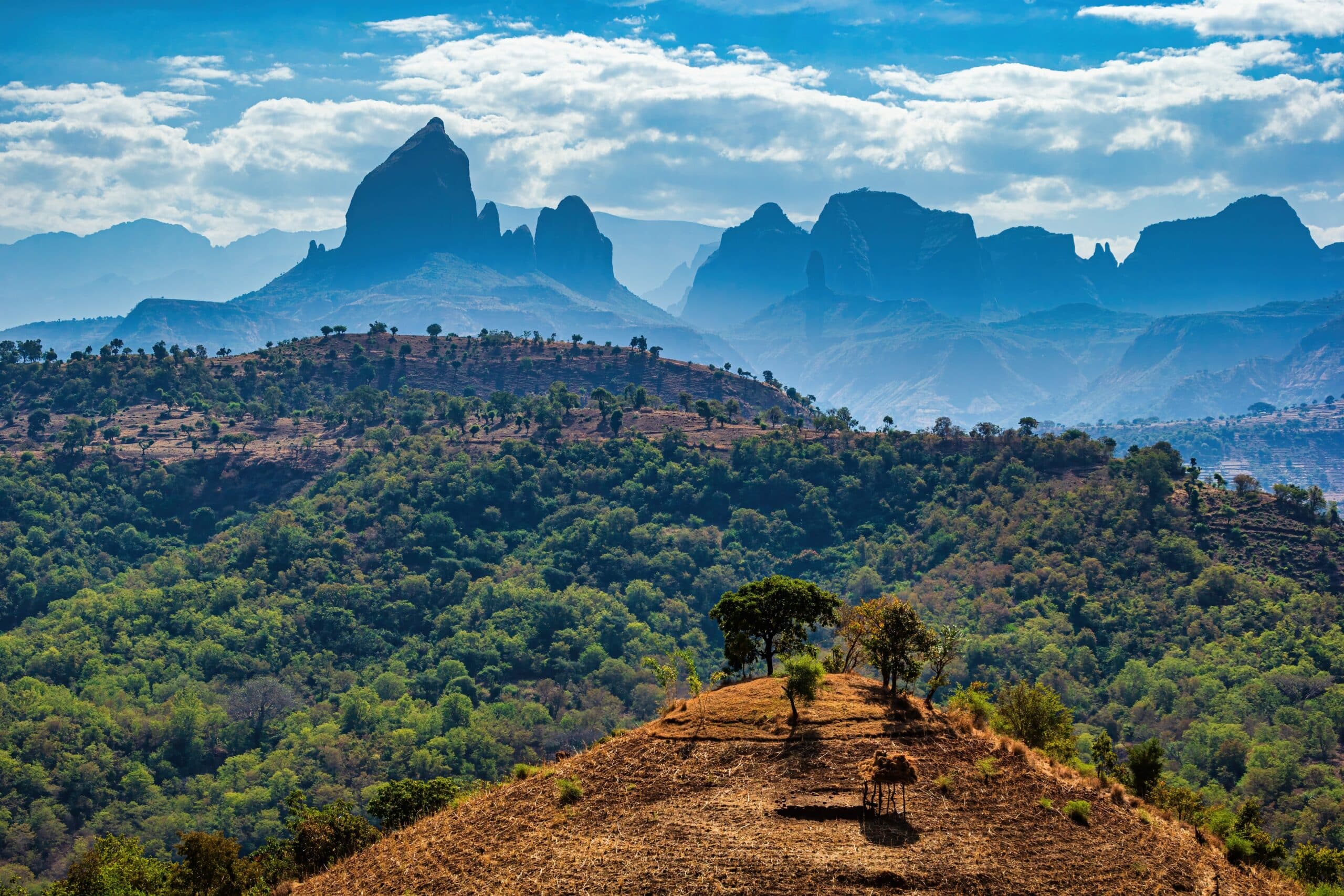
Ethiopia is a land of beginnings. Long before empires rose elsewhere, human footsteps marked these highlands, valleys, and rift plains. Often called the cradle of humanity, Ethiopia carries a depth of time that feels elemental rather than distant. Here, history is not layered gently—it is carved deeply into faith, language, landscape, and memory.
This is a country shaped by continuity. Ancient kingdoms, enduring religious traditions, and distinct cultural identities have survived waves of change without losing their core. Ethiopia was never colonized in the conventional sense, and this independence has preserved a worldview rooted firmly in self-definition. Its civilization developed along its own rhythm, guided by highland geography, spiritual devotion, and resilience.
Ethiopia’s landscapes are as varied as its history. Dramatic mountains rise into cool, clouded air, while the Great Rift Valley opens into lakes and volcanic plains. Lush highlands give way to arid deserts, and fertile fields surround ancient cities where stone churches and royal compounds still define daily life.
Faith plays a central role in Ethiopia’s identity. Ethiopian Orthodox Christianity, one of the world’s oldest continuous Christian traditions, shapes architecture, ritual, and calendar. Islam also holds deep historical roots, reflecting centuries of coexistence and exchange. Spiritual life here is immersive, expressed through fasting, music, procession, and prayer.
Ethiopia invites a different kind of travel—one that rewards patience, humility, and curiosity. It does not offer easy spectacle, but profound substance. This article explores Ethiopia’s most remarkable destinations, places where origin, belief, and landscape merge to tell a story that feels both ancient and urgently alive.
13. Addis Ababa: Political Heart and Cultural Crossroads
Addis Ababa is a city of contrasts and momentum, standing at the intersection of ancient heritage and modern ambition. As Ethiopia’s capital and the diplomatic center of Africa, it carries political significance while remaining deeply connected to the nation’s cultural roots.
Wide avenues and growing skylines coexist with traditional neighborhoods, markets, and coffee ceremonies that anchor daily life. Addis is often loud and chaotic, yet beneath the surface lies a profound sense of continuity. The city reflects Ethiopia’s ongoing dialogue between past and future.
Cultural institutions such as the National Museum reveal Ethiopia’s deep historical narrative, including some of humanity’s earliest ancestors. Elsewhere, churches, mosques, and cultural centers illustrate the spiritual diversity that shapes the city’s identity.
Addis Ababa is also a city of ideas. Universities, artists, musicians, and thinkers contribute to a vibrant intellectual life. Music flows through cafés and cultural halls, blending ancient rhythms with contemporary expression.
Addis may not reveal itself immediately, but it rewards attention. It is a city defined by resilience, debate, and movement—a living introduction to Ethiopia’s complexity.
12. Lalibela: Faith Carved from Stone
Lalibela stands as one of the world’s most extraordinary expressions of devotion. High in Ethiopia’s northern mountains, this sacred town is home to eleven monolithic churches carved directly into volcanic rock during the twelfth century. Unlike built structures, these churches were excavated downward, creating spaces shaped by removal rather than addition.
Each church is connected through trenches and tunnels, forming a symbolic representation of Jerusalem. Cross-shaped windows, carved columns, and shadowed interiors create an atmosphere of profound stillness. The stone absorbs sound, light, and time.
Lalibela remains a living place of worship. Pilgrims dressed in white gather during religious festivals, chanting prayers that echo through carved passageways. Faith here is not historical—it is continuous.
The surrounding landscape reinforces the spiritual gravity of the site. Hills roll gently beneath open skies, isolating Lalibela from distraction. Visitors often feel less like observers and more like participants in something deeply sacred.
Lalibela is not about architectural perfection—it is about belief made tangible. Few places in the world demonstrate so clearly how faith can shape space, identity, and endurance.
11. Axum: Kingdom of Legends
Axum was once the capital of one of the greatest ancient empires in the world, rivaling Rome and Persia in power and influence. Located in northern Ethiopia, it stands today as a place of legend, faith, and archaeological mystery.
Massive granite stelae rise from the earth, carved and erected over a thousand years ago. Their purpose remains partly unknown, adding to Axum’s mystique. Ruins of palaces, tombs, and ancient inscriptions reveal a civilization deeply connected to trade, diplomacy, and belief.
Axum also holds immense religious significance. According to Ethiopian tradition, it is home to the Ark of the Covenant, housed within the Church of St. Mary of Zion. While unseen, this belief shapes the city’s spiritual gravity.
Axum feels solemn and dignified. It is a city where myth and history overlap seamlessly, offering a rare glimpse into Africa’s ancient global connections.
10. Gondar: Castles in the Highlands
Gondar surprises first-time visitors with its unexpected architecture. Often called the “Camelot of Africa,” this former imperial capital features a collection of castles and palaces built during the seventeenth century.
Stone towers, fortified walls, and grand halls rise against a backdrop of green hills and open sky. The structures reflect a unique blend of Ethiopian, Portuguese, and Indian influences, shaped by diplomacy and trade.
Nearby churches are adorned with vivid frescoes depicting biblical scenes in distinctive Ethiopian style. Religious festivals bring color, music, and ritual into public space, reinforcing Gondar’s cultural vitality.
Gondar offers elegance rather than grandeur. It reveals a period of centralized power, artistic expression, and royal ambition that shaped Ethiopia’s identity for centuries.
9. Simien Mountains: Roof of Africa
The Simien Mountains rise dramatically in northern Ethiopia, forming one of Africa’s most breathtaking highland landscapes. Sheer cliffs plunge into deep valleys, while jagged peaks stretch into cloud-filled skies. This UNESCO World Heritage site feels elemental, shaped by erosion, altitude, and time.
The terrain is both beautiful and demanding. Alpine meadows, terraced fields, and high plateaus support rare wildlife such as the Ethiopian wolf, gelada baboon, and walia ibex. These species, found nowhere else on Earth, reflect Ethiopia’s ecological uniqueness.
Walking through the Simien Mountains is an experience of scale and silence. Paths wind along escarpments that reveal endless horizons, inviting humility and reflection. Villages appear unexpectedly, offering warmth and hospitality in a harsh environment.
Life here is shaped by altitude and resilience. Farming practices adapt to steep slopes, while traditions preserve strong community bonds. The mountains are not separate from culture—they define it.
The Simien Mountains offer more than scenery. They reveal a way of life balanced with nature, reminding travelers that endurance, patience, and respect are essential to survival in extreme beauty.
8. Harar: City of Saints and Stories
Harar is one of the oldest continuously inhabited cities in Africa and a spiritual center of Islam in the region. Enclosed by ancient walls, the old city of Harar Jugol is a dense maze of narrow alleys, colorful houses, and sacred spaces.
Over eighty mosques and shrines reflect Harar’s religious importance, earning it the title “City of Saints.” Faith shapes daily rhythm, guiding movement, sound, and social life. The city’s compact design encourages interaction, reinforcing a strong sense of community.
Harar is also renowned for storytelling, poetry, and tradition. Markets overflow with spices, woven baskets, and handcrafted goods. The city’s visual identity—bright walls, patterned doors, and painted interiors—creates an atmosphere of warmth and creativity.
At night, the centuries-old ritual of feeding wild hyenas continues outside the city gates, symbolizing coexistence between humans and nature. This practice reflects Harar’s deep-rooted respect for balance.
Harar feels intimate and timeless. It offers an immersive cultural experience, where history is lived rather than displayed, and identity is protected through continuity and devotion.
7. Danakil Depression: Earth in Its Rawest Form
The Danakil Depression is one of the most extreme environments on Earth. Located in northeastern Ethiopia, it lies below sea level and experiences some of the planet’s highest temperatures. Yet within this harshness lies extraordinary geological beauty.
Vivid sulfur springs, salt flats, and volcanic formations create a landscape that feels otherworldly. Colors shift dramatically—neon yellows, deep reds, and mineral greens dominate the terrain. Active volcanoes such as Erta Ale reveal glowing lava lakes, offering a rare glimpse into Earth’s inner forces.
The Afar people have inhabited this region for centuries, navigating its dangers through deep knowledge of land and survival. Salt caravans continue ancient trade routes, linking past and present through endurance and tradition.
The Danakil is not a place of comfort. It challenges perception, testing limits of heat, space, and resilience. Yet it offers unmatched insight into the planet’s formation and humanity’s adaptability.
Here, Ethiopia reveals its raw power—a reminder that creation and destruction often share the same ground.
6. Lake Tana: Source of the Blue Nile
Lake Tana lies peacefully in Ethiopia’s northwest, serving as the source of the Blue Nile. Its wide waters and scattered islands create a serene landscape rich in history, spirituality, and biodiversity.
Ancient monasteries sit hidden among trees on island shores, preserving illuminated manuscripts, religious artifacts, and sacred art. These monastic communities have long protected Ethiopia’s intellectual and spiritual heritage.
Fishermen glide across the lake in traditional papyrus boats, maintaining practices passed down for generations. Birdlife flourishes along wetlands and shores, reinforcing Lake Tana’s ecological importance.
The lake feels contemplative. It reflects Ethiopia’s relationship with water, faith, and continuity. Visitors experience a slower rhythm that invites observation rather than activity.
Lake Tana offers calm perspective—a gentle contrast to Ethiopia’s dramatic highlands and deserts.
5. Bale Mountains: Highlands of Biodiversity
The Bale Mountains in southeastern Ethiopia form a vast highland ecosystem defined by forests, moorlands, and alpine plateaus. This national park protects some of Africa’s most important biodiversity.
Rare species such as the Ethiopian wolf find refuge here, while rivers and wetlands feed communities far beyond the mountains. The landscape changes dramatically with elevation, offering forests, grasslands, and open plains.
Local communities maintain strong ties to the land, balancing conservation with traditional livelihoods. Agriculture, grazing, and cultural identity are shaped by the highlands’ rhythms.
The Bale Mountains offer Ethiopia’s quieter beauty—one rooted in ecology, balance, and sustainability. They reflect the country’s natural depth beyond historical monuments.
4. Omo Valley: Diversity at Humanity’s Roots
The Omo Valley in southern Ethiopia is one of the most culturally diverse regions on Earth. Home to numerous Indigenous communities, it preserves ways of life shaped by environment, ancestry, and ritual rather than modern uniformity. Each group maintains distinct languages, clothing, traditions, and social systems, creating a living mosaic of human expression.
Life in the Omo Valley follows seasonal rhythms tied to the Omo River, agriculture, and cattle herding. Ceremonies mark transitions such as adulthood, marriage, and harvest, reinforcing identity and continuity. Body painting, scarification, and ornamentation are not decoration alone—they are expressions of history, status, and belonging.
The landscape itself is vast and open, ranging from grassy plains to riverbanks and low hills. This physical openness mirrors the deep connection between people and land. Survival here depends on cooperation, environmental knowledge, and respect for tradition.
Visiting the Omo Valley requires sensitivity and humility. It is not a place for consumption, but for learning. The communities here are not relics of the past; they are contemporary societies navigating change while protecting cultural autonomy.
The Omo Valley offers profound insight into humanity’s adaptability and diversity. It reminds travelers that civilization has many forms, each shaped by place, memory, and choice.
3. Debre Damo: Monastery Above the World
Debre Damo is one of Ethiopia’s most isolated and sacred monasteries, perched atop a sheer plateau in the northern highlands. Accessible only by climbing a rope up a vertical cliff, it embodies spiritual withdrawal in its purest form.
Founded in the sixth century, the monastery has remained a center of religious life and scholarship for centuries. Its isolation preserves ancient traditions, manuscripts, and architectural forms rarely found elsewhere. Stone structures and timber beams reflect early Ethiopian Christian design.
Only monks are permitted to live within its walls, maintaining a life defined by prayer, study, and simplicity. From the plateau, views stretch endlessly across rugged terrain, reinforcing the sense of separation from worldly distraction.
Debre Damo is not about visibility—it is about devotion. Its very inaccessibility defines its meaning. The monastery stands as a symbol of faith chosen over comfort, continuity over convenience.
This sacred site reveals Ethiopia’s spiritual depth, where belief shapes not only architecture, but geography itself.
2. Awash National Park: Rift Valley Crossroads
Awash National Park lies within the Great Rift Valley, where geology, wildlife, and ancient migration routes converge. This region has played a crucial role in human evolution, offering fertile ground and water sources that supported early communities.
The park’s landscape is diverse, featuring savannah, volcanic rock, acacia woodland, and riverbanks. Awash Falls cascade dramatically through basalt cliffs, providing both beauty and ecological importance.
Wildlife thrives here, including antelope, baboons, and bird species adapted to Rift Valley conditions. The park also holds archaeological significance, with nearby sites yielding early human fossils.
Awash reflects Ethiopia’s role as both origin and crossroads. It connects natural history with human story, reinforcing the country’s foundational place in global heritage.
1. Konso: Living Cultural Landscape
Konso is recognized as a UNESCO World Heritage site for its remarkable cultural landscape shaped entirely by human ingenuity. Terraced hillsides prevent erosion, manage water, and sustain agriculture in a challenging environment.
Stone-walled villages are carefully planned, reflecting social organization and collective responsibility. Totem-like wooden sculptures mark graves and honor ancestors, reinforcing memory and lineage.
Konso society values cooperation, environmental stewardship, and continuity. Traditions guide land use, governance, and ritual, ensuring survival across generations.
Konso demonstrates how culture can function as sustainable design. It is a living example of harmony between people and landscape, shaped through patience and communal wisdom.