
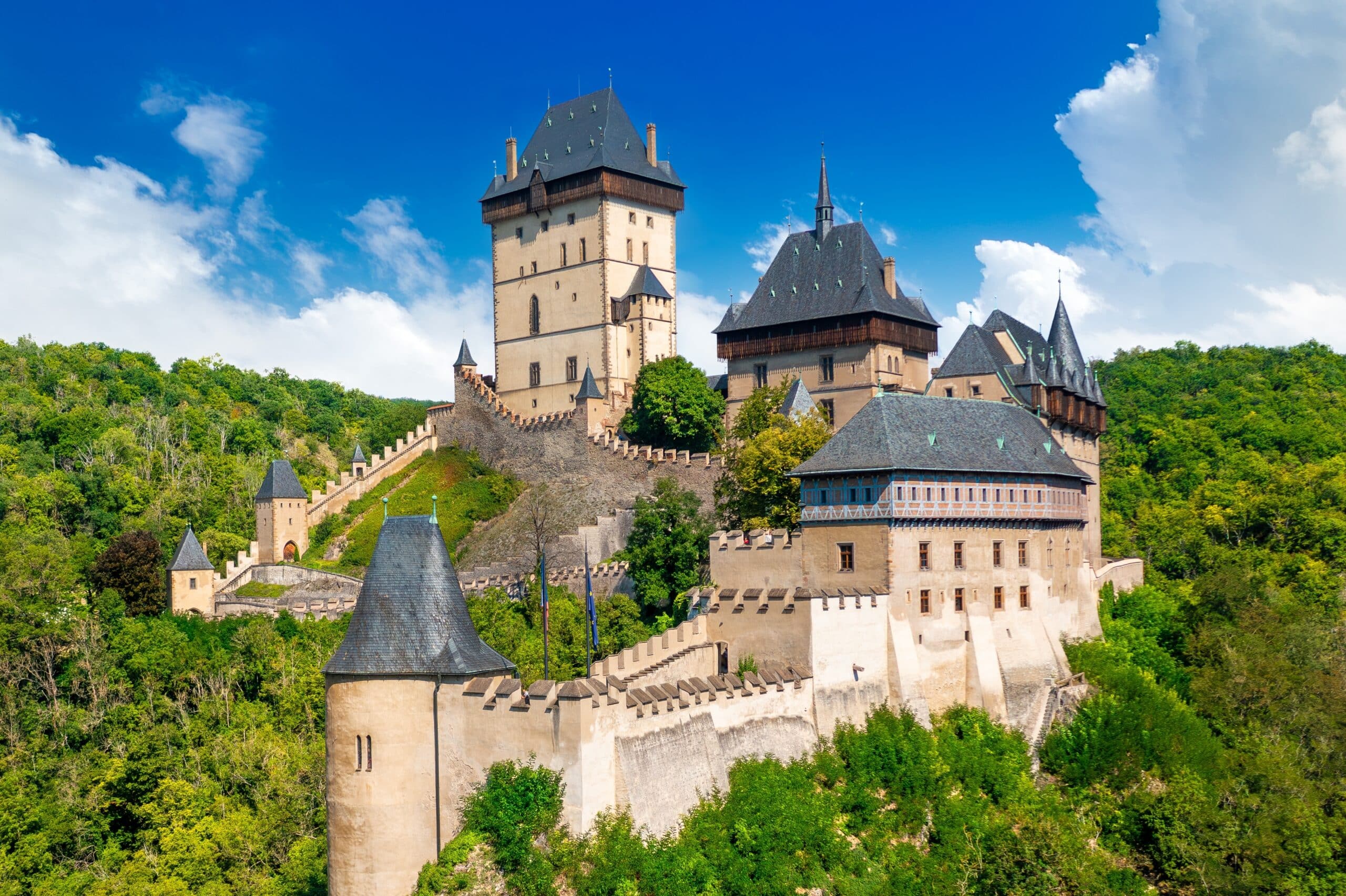
The Czech Republic lies at the geographic center of Europe, shaped by rolling highlands, river valleys, and centuries of cultural exchange. Historically known as the lands of Bohemia, Moravia, and Czech Silesia, the country has long stood at the crossroads of Germanic and Slavic worlds.
Its capital, Prague, embodies this layered history. Gothic spires, Baroque domes, and Art Nouveau façades rise above the Vltava River, reflecting royal dynasties, religious reformations, and intellectual movements. Prague’s prominence within the Holy Roman Empire and later the Habsburg monarchy positioned it as a political and cultural center of Central Europe.
The Czech lands experienced profound transformations in the 20th century: the formation of Czechoslovakia in 1918, occupation during World War II, decades under communist rule, and the peaceful Velvet Revolution of 1989. In 1993, the country emerged as an independent state following the dissolution of Czechoslovakia.
Beyond Prague, the Czech Republic reveals medieval towns, spa cities, castle-dotted landscapes, and industrial heritage. Bohemian forests, Moravian vineyards, and sandstone rock formations illustrate geographic diversity within a relatively compact territory.
Culturally, the nation is renowned for literature, music, glassmaking, and brewing traditions. Czech beer culture remains central to social life, while composers such as Antonín Dvořák and Bedřich Smetana shaped European classical music.
Modern Czech society combines historical preservation with technological development and European integration. As a member of the European Union, the country maintains strong regional connections while preserving a distinct linguistic and cultural identity.
30. Prague
Prague stands along the Vltava River as the political, cultural, and historical heart of the Czech Republic. Often called the “City of a Hundred Spires,” it preserves one of Europe’s most complete architectural landscapes.
Prague Castle dominates the skyline. Founded in the 9th century, it developed into the seat of Bohemian kings, Holy Roman Emperors, and modern Czech presidents. Within its complex stands St. Vitus Cathedral, a Gothic masterpiece symbolizing spiritual and royal authority.
The Old Town Square reflects medieval prosperity. The Astronomical Clock, installed in 1410, continues to mark time with mechanical precision. Charles Bridge, completed in the 14th century, connects the Old Town with Lesser Town and remains one of Europe’s most recognizable stone bridges.
Prague played a decisive role in European intellectual and political history. It was central to the Protestant Reformation, the Thirty Years’ War, and later the Velvet Revolution of 1989, which peacefully ended communist rule.
Today, Prague combines preserved heritage with a vibrant contemporary scene. Universities, theaters, and technology companies operate alongside centuries-old churches and courtyards. Tourism is a major economic driver, yet the city maintains strong residential communities beyond its historic core.
Prague harmonizes Gothic, Renaissance, Baroque, and Art Nouveau influences within a compact urban fabric. Its layered architecture and political legacy establish it as both a historic capital and a modern European metropolis.
29. Brno
Brno, located in the Moravian region, is the Czech Republic’s second-largest city and an important center of education and industry. Historically positioned on trade routes between Vienna and Poland, it developed as a fortified settlement.
Špilberk Castle overlooks the city from a hilltop. Originally a royal castle, it later served as a military fortress and prison during Habsburg rule. Today it houses exhibitions documenting regional history.
Brno Cathedral, officially the Cathedral of St. Peter and Paul, dominates the skyline with twin spires. The city also showcases significant modernist architecture, including Villa Tugendhat, an early 20th-century functionalist masterpiece.
Brno is home to major universities and research institutions. Student life strongly influences the city’s atmosphere, supporting cafés, galleries, and cultural festivals.
The city has evolved from textile manufacturing to technology and innovation sectors. International trade fairs and exhibitions contribute to economic development.
Brno blends Moravian traditions with cosmopolitan openness. Its manageable size, academic energy, and architectural diversity position it as a dynamic counterpart to Prague.
28. Český Krumlov
Český Krumlov lies in southern Bohemia along a dramatic bend of the Vltava River. Its compact medieval center and castle complex make it one of the Czech Republic’s most visually distinctive towns.
The Český Krumlov Castle complex, developed from the 13th century onward, ranks among the largest in Central Europe. Renaissance and Baroque renovations reflect noble patronage, particularly under the Rosenberg family.
Narrow streets wind through preserved Gothic and Renaissance buildings. Colorful façades, arcaded courtyards, and riverside views create a cohesive historic atmosphere. The Baroque theater within the castle remains one of the best-preserved examples in Europe.
The town’s economy historically relied on trade and craftsmanship. Today tourism plays a central role, supported by cultural festivals and heritage preservation initiatives.
The surrounding South Bohemian landscape includes forests, hills, and waterways, encouraging outdoor recreation such as rafting and hiking.
Český Krumlov demonstrates how smaller towns can maintain architectural integrity while adapting to modern tourism demands. Its harmonious integration of castle, river, and townscape reflects centuries of careful development.
27. Karlovy Vary
Karlovy Vary, located in western Bohemia near the German border, is the Czech Republic’s most renowned spa town. Founded in the 14th century during the reign of Emperor Charles IV, the city developed around natural hot springs believed to possess therapeutic properties.
Elegant colonnades line the Teplá River, sheltering mineral fountains where visitors traditionally drink the warm, mineral-rich waters. The Mill Colonnade and the Market Colonnade exemplify the town’s 19th-century spa architecture, reflecting a period when European aristocracy frequented the city.
Karlovy Vary became an international meeting point for cultural and political elites. Figures such as Goethe and Beethoven visited during the spa’s golden age. Grand hotels, theaters, and promenades were constructed to accommodate distinguished guests.
The town also hosts the Karlovy Vary International Film Festival, one of Central Europe’s most important cinematic events, reinforcing its cultural relevance beyond health tourism.
Architecturally, pastel façades and ornate balconies climb the valley slopes, creating a unified aesthetic shaped by historic preservation laws. The surrounding forested hills add to the tranquil atmosphere.
Today, Karlovy Vary balances medical tourism with cultural events and heritage conservation. The spa industry remains central to the local economy, supported by hospitality services and glass production.
The town exemplifies how natural resources, royal patronage, and 19th-century leisure culture combined to create a lasting European spa tradition.
26. Plzeň
Plzeň, internationally known as Pilsen, is synonymous with brewing innovation. Located in western Bohemia, the city gained global recognition in 1842 with the creation of pale lager beer, a style that transformed brewing worldwide.
The Pilsner Urquell Brewery remains a major industrial landmark and tourist attraction. Its underground cellars and historic brewing facilities illustrate advances in fermentation and storage techniques.
Plzeň’s historic center is anchored by Republic Square, one of the largest medieval squares in Europe. The Cathedral of St. Bartholomew rises prominently with the tallest church tower in the Czech Republic.
Industrial development shaped the city’s 19th- and 20th-century growth. Engineering and manufacturing complemented brewing, contributing to economic resilience.
Plzeň was designated a European Capital of Culture in 2015, highlighting its artistic and community initiatives. Revitalized industrial spaces now host galleries and cultural venues.
Modern Plzeň blends historical architecture with active industry. Its brewing heritage remains central, yet the city’s broader cultural and economic landscape demonstrates diversification.
Through beer, architecture, and industry, Plzeň represents the intersection of tradition and innovation within Czech society.
25. Olomouc
Olomouc, situated in Moravia, is one of the Czech Republic’s most historically significant ecclesiastical cities. Once the capital of Moravia, it served as a religious and administrative center during the Middle Ages.
The Holy Trinity Column, located in the Upper Square, is a monumental Baroque structure commemorating the end of plague epidemics. It reflects the city’s deep Catholic heritage and artistic ambition.
Olomouc Cathedral, dedicated to Saint Wenceslas, forms part of a historic complex that includes a bishop’s palace and chapter buildings. The city’s university, founded in the 16th century, contributes to a strong academic tradition.
Fountains and civic buildings illustrate Renaissance and Baroque urban planning. Despite damage during various conflicts, Olomouc retains an architectural coherence distinct from Prague.
Student life energizes the city, creating a lively yet manageable atmosphere. Cafés, bookstores, and cultural events flourish within the historic streets.
Olomouc combines ecclesiastical grandeur with educational vitality. Its preserved monuments and active university community make it a key Moravian destination within the Czech Republic’s broader cultural landscape.
24. Kutná Hora
Kutná Hora emerged in the 13th century as one of Central Europe’s richest towns due to extensive silver mining. Its prosperity rivaled Prague, and the wealth extracted from nearby mines significantly strengthened the Bohemian kingdom.
The Cathedral of St. Barbara, dedicated to the patron saint of miners, dominates the skyline with its distinctive Gothic roofline. Construction spanned several centuries, reflecting both economic fluctuations and architectural evolution. The cathedral symbolizes the town’s mining heritage and civic pride.
Another prominent landmark is the Sedlec Ossuary, a small chapel decorated with human bones arranged in artistic patterns. Created in the early modern period, it reflects medieval attitudes toward mortality and remembrance.
Kutná Hora’s historic center preserves narrow streets, merchant houses, and former minting facilities. The Italian Court once housed the royal mint where Prague groschen coins were produced, influencing trade across Europe.
Following the decline of silver production in the 16th century, the town’s economic importance diminished. However, preservation efforts have maintained its architectural integrity.
Today, Kutná Hora is recognized as a heritage destination that illustrates medieval urban wealth and ecclesiastical ambition. Its monuments reflect the economic foundations of Bohemia and the cultural achievements funded by mining prosperity.
23. Ostrava
Ostrava lies in the northeastern part of the country near the Polish and Slovak borders. Historically shaped by coal mining and heavy industry, it developed rapidly during the 19th century industrial expansion of the Austro-Hungarian Empire.
The Lower Vítkovice industrial complex represents the city’s industrial heritage. Former blast furnaces and steelworks have been transformed into cultural and educational venues, illustrating successful post-industrial revitalization.
Ostrava differs architecturally from Prague and other historic Czech cities. Functionalist buildings, workers’ housing, and industrial infrastructure dominate its urban character. This industrial aesthetic forms a distinctive identity rather than a liability.
The city hosts the Colours of Ostrava music festival, attracting international performers and reinforcing its contemporary cultural role. Universities and research institutions now support technological innovation and diversification beyond mining.
Environmental rehabilitation has become a priority, with parks and public spaces emerging on reclaimed industrial land.
Ostrava exemplifies transformation from heavy industry to cultural and technological development. Its identity remains rooted in labor history, yet it demonstrates how industrial cities can adapt within modern Europe.
22. Liberec
Liberec is located in northern Bohemia near the borders with Germany and Poland. Historically associated with textile production, it prospered during the 19th century industrial era.
The city hall, built in Neo-Renaissance style, reflects civic ambition during Liberec’s economic peak. Ještěd Tower, situated on a nearby mountain, combines a hotel and television transmitter in a futuristic architectural form, becoming a regional symbol.
Liberec is closely connected to the Jizera Mountains, making it a center for winter sports and outdoor recreation. The surrounding landscape encourages hiking, skiing, and nature tourism.
Industrial restructuring after the fall of communism reshaped the city’s economy. Textile production declined, while services, education, and tourism expanded.
The Technical University of Liberec contributes to research and innovation, particularly in engineering and material sciences.
Liberec integrates industrial heritage with natural surroundings. Its combination of mountainous terrain, distinctive architecture, and cross-border position strengthens its role as a regional center in northern Bohemia.
21. České Budějovice
České Budějovice, located in southern Bohemia, is a historic city closely associated with brewing traditions and regional administration. Founded in the 13th century by the Bohemian king Ottokar II, it developed as a royal town intended to strengthen authority in the region.
The city’s central square, Přemysl Otakar II Square, is one of the largest in Central Europe. Surrounded by arcaded houses and dominated by the Black Tower, it reflects Renaissance and Baroque architectural influences. The Samson Fountain at its center remains a prominent civic symbol.
Brewing has long defined the city’s international recognition. The Budvar brewery continues a tradition that dates back centuries, contributing to economic stability and cultural identity. The local brewing heritage has influenced global beer branding and trade discussions.
The confluence of the Vltava and Malše rivers adds geographical importance. Waterways historically facilitated commerce and communication across southern Bohemia.
Modern České Budějovice balances historical preservation with regional governance functions. Educational institutions and cultural festivals sustain civic life beyond tourism.
Today, the city represents southern Bohemia’s administrative and economic center while preserving a coherent historic core that illustrates medieval urban planning and long-standing brewing culture.
20. Telč
Telč is a small Moravian town renowned for its harmonious Renaissance architecture. Originally founded in the 14th century, it flourished under noble patronage during the 16th century, when Italian Renaissance influences reshaped its urban character.
The town square forms a near-perfect rectangle lined with pastel-colored houses featuring arcades and decorative gables. These structures were rebuilt after a fire and unified in style, creating a visually cohesive ensemble.
Telč Château stands at one end of the square, reflecting Renaissance and later Baroque modifications. Its interiors contain period furnishings and artistic details that document noble lifestyles.
Fishponds surrounding the town were constructed for both defense and economic purposes. These water systems remain integral to the landscape and ecological balance.
Due to limited industrialization, Telč avoided large-scale urban disruption. Preservation efforts have maintained its architectural authenticity, making it an exemplary model of Renaissance town planning in Central Europe.
Tourism plays a significant economic role, yet the town retains a residential atmosphere. Cultural events, small businesses, and seasonal festivals animate the historic streets.
Telč demonstrates how Renaissance aesthetics, noble influence, and careful preservation can sustain a small town’s identity across centuries.
19. Třebíč
Třebíč, situated in the Vysočina region, is notable for its unique combination of Christian and Jewish heritage. The town developed around a Benedictine monastery founded in the 12th century, which played a central role in regional administration.
The Basilica of St. Procopius reflects Romanesque and early Gothic architectural features. Adjacent monastery buildings illustrate medieval religious influence in Moravia.
Equally significant is Třebíč’s preserved Jewish Quarter, one of the most complete in Europe. Narrow streets, synagogues, and residential houses document centuries of coexistence between Christian and Jewish communities.
The Jewish cemetery, with thousands of gravestones, provides insight into burial traditions and social history. Preservation of this area emphasizes cultural dialogue and historical continuity.
During the 20th century, industrial development altered parts of the town, yet its historic districts remain intact. Heritage conservation has strengthened Třebíč’s cultural relevance.
Today, Třebíč symbolizes intercultural interaction and layered religious history. Its preserved architecture offers insight into medieval monastic life and the long-standing presence of Jewish communities in Moravia.
18. Hradec Králové
Hradec Králové is located in eastern Bohemia at the confluence of the Elbe and Orlice rivers. Historically a royal dowry town belonging to Bohemian queens, it developed as a fortified settlement of strategic importance.
During the Middle Ages, its defensive walls and towers protected regional trade routes. Though many fortifications were later dismantled, the city retained its structured urban plan centered around the Great Square.
Hradec Králové gained particular recognition in the late 19th and early 20th centuries for progressive urban planning. Architects such as Jan Kotěra and Josef Gočár introduced modernist and functionalist designs that transformed the city into a model of early modern Czech architecture.
Wide boulevards, public buildings, and educational institutions reflect this architectural experimentation. The Cathedral of the Holy Spirit, originally Gothic, remains a key landmark within the historic core.
The rivers shape both the landscape and recreational life. Parks and walking paths line the riverbanks, integrating natural spaces into the urban fabric.
Today, Hradec Králové functions as a regional administrative and educational center. Its blend of medieval heritage and early modern planning creates a distinctive urban character within eastern Bohemia.
17. Pardubice
Pardubice lies east of Prague along the Elbe River and developed as a Renaissance noble residence. Its prosperity during the 16th century shaped the architectural character visible today.
Pardubice Castle, redesigned in Renaissance style, combines defensive features with decorative sgraffito façades. The castle complex remains a central symbol of noble patronage and regional governance.
The historic square preserves arcaded houses and a civic layout reflecting early modern urban planning. The Green Gate tower provides views across the city and surrounding lowlands.
Pardubice is widely associated with the Velká pardubická, one of Europe’s most challenging steeplechase horse races. This annual sporting event contributes to the city’s national recognition.
Industrial growth during the 19th and 20th centuries introduced chemical manufacturing and engineering sectors. Modern infrastructure and rail connections strengthened economic development.
Despite industrialization, Pardubice retains a compact historic center. Parks and river landscapes enhance environmental quality.
The city harmonizes Renaissance architecture, equestrian tradition, and industrial advancement. Its strategic location and preserved monuments reinforce its importance in eastern Bohemia.
16. Zlín
Zlín, situated in southeastern Moravia, is closely associated with 20th-century industrial and architectural innovation. The city expanded rapidly under the leadership of the Bata shoe company, which transformed it into a model industrial town.
Uniform red-brick factory buildings and residential blocks were constructed according to functionalist principles. This systematic urban design emphasized efficiency, hygiene, and social welfare for workers.
The Bata skyscraper, completed in 1938, symbolized modern industrial ambition. Equipped with advanced technology for its time, it demonstrated forward-looking corporate planning.
Zlín’s layout differs markedly from medieval Czech towns. Wide streets, green spaces, and standardized housing reflect early modernist ideals. The influence of American industrial architecture is visible in its grid structure.
After the fall of communism, Zlín diversified beyond footwear manufacturing. Universities and creative industries now contribute to its economy.
The surrounding Moravian hills provide natural contrast to the city’s structured urban form. Cultural festivals and film events strengthen its contemporary profile.
Zlín represents industrial modernization and architectural experimentation within the Czech context. Its planned design and corporate legacy make it one of the country’s most distinctive urban environments.
15. Jihlava
Jihlava is located in the Vysočina region on the historical border between Bohemia and Moravia. Founded in the 13th century after the discovery of silver deposits, it quickly became one of the most important mining towns of medieval Central Europe.
Fortified walls and gates once protected the prosperous settlement. Portions of these defenses remain visible, reflecting Jihlava’s strategic and economic significance. The town’s underground corridors, originally created for mining and storage, form an extensive labyrinth beneath the historic center.
The main square preserves Gothic and Renaissance houses with arcades and decorative façades. The Church of St. James, with its twin towers, dominates the skyline and symbolizes the city’s medieval heritage.
During the Habsburg period, Jihlava developed as an administrative center and later expanded through textile manufacturing. Industrial growth reshaped parts of the urban landscape, though the historic core remained intact.
Today, Jihlava hosts an international documentary film festival, contributing to its modern cultural profile. Educational institutions and regional government offices sustain its contemporary role.
Jihlava harmonizes medieval mining wealth, fortified urban planning, and modern cultural initiatives. Its location between Bohemia and Moravia reinforces its historical function as a crossroads of trade and governance.
14. Kroměříž
Kroměříž, situated in Moravia, is distinguished by its Baroque architecture and ecclesiastical heritage. Historically governed by the bishops of Olomouc, the town flourished under church patronage.
The Archbishop’s Palace stands as the principal landmark. Rebuilt in Baroque style after war damage in the 17th century, it contains richly decorated halls and extensive art collections. The adjacent gardens, including the Flower Garden, represent formal European landscape design influenced by Italian models.
Kroměříž’s central square retains Renaissance and Baroque houses, arcaded walkways, and a Marian column reflecting Catholic devotion. The town’s orderly layout illustrates planned development shaped by clerical authority.
Throughout the 19th century, Kroměříž played a role in political discussions during the revolutionary period of 1848, when representatives convened in the Archbishop’s Palace.
Modern Kroměříž balances heritage preservation with regional administration and education. Tourism supports the local economy, particularly visitors drawn to its gardens and palace interiors.
The town harmonizes ecclesiastical power, artistic patronage, and Baroque landscape architecture. Its preserved monuments reflect the cultural influence of the Moravian church within the broader Czech lands.
13. Tábor
Tábor lies in southern Bohemia and was founded in the 15th century as a stronghold of the Hussite movement. Named after the biblical Mount Tabor, the town symbolized religious reform and resistance.
Its strategic hilltop location provided defensive advantages during the Hussite Wars. Fortifications and narrow streets were designed to strengthen protection against invading forces.
The central square preserves Gothic and Renaissance buildings, while the Town Hall houses a museum dedicated to Hussite history. Underground tunnels beneath the town once served defensive and storage purposes.
Tábor’s identity remains closely connected to the legacy of Jan Hus and religious reform. Annual historical reenactments and cultural events commemorate this period.
Over time, Tábor evolved into a regional center for education and light industry. Modern residential districts expand beyond the medieval core, yet preservation efforts maintain architectural integrity.
The nearby Lužnice River and surrounding countryside offer recreational opportunities and scenic landscapes.
Tábor harmonizes revolutionary history, fortified medieval planning, and contemporary regional life. Its origins as a religious stronghold continue to define its distinctive place within Czech history.
12. Litomyšl
Litomyšl, located in eastern Bohemia, is best known for its Renaissance château and cultural legacy. Originally a monastic settlement, the town developed under noble patronage during the 16th century.
Litomyšl Château stands as one of the finest examples of Renaissance architecture north of the Alps. Its façades are decorated with intricate sgraffito patterns, creating a distinctive visual rhythm. Arcaded courtyards and elegant proportions reflect Italian artistic influence adapted to Bohemian conditions.
The historic square preserves arcaded burgher houses that illustrate early modern prosperity. The Church of the Finding of the Holy Cross and former monastic buildings reinforce the town’s ecclesiastical origins.
Litomyšl is also associated with composer Bedřich Smetana, who was born here. Annual music festivals celebrate his contribution to Czech national identity and classical music tradition.
Unlike heavily industrialized centers, Litomyšl retained its cultural and administrative focus. Careful preservation has protected the architectural coherence of its core.
Today, Litomyšl balances heritage tourism with education and regional governance. Cultural institutions, galleries, and festivals maintain its reputation as a refined artistic center.
The town harmonizes Renaissance elegance, musical heritage, and civic continuity, offering insight into Bohemia’s noble and cultural traditions.
11. Český Těšín
Český Těšín lies on the eastern border with Poland, divided from the Polish town of Cieszyn by the Olza River. The town’s history reflects shifting borders and multicultural interaction.
Originally part of the Duchy of Teschen, the settlement developed as a regional trade center. After World War I, new national boundaries divided the town between Czechoslovakia and Poland, creating parallel communities with shared heritage.
Architecturally, Český Těšín features late 19th- and early 20th-century buildings rather than medieval monuments, as the historic core lies largely on the Polish side. Nonetheless, churches, schools, and public buildings illustrate Central European urban development.
The town remains bilingual and culturally interconnected. Cross-border cooperation supports commerce, education, and cultural events, reflecting European integration in practice.
Railway connections historically strengthened its economic position. Today, regional services and small industries sustain local employment.
Český Těšín symbolizes coexistence and adaptation in a borderland environment. Its divided yet cooperative character demonstrates how political change reshapes urban identity while preserving shared traditions.
10. Mikulov
Mikulov is situated in southern Moravia near the Austrian border, surrounded by vineyards and limestone hills. Historically influenced by both Czech and Austrian cultures, it developed as a noble and Jewish center.
Mikulov Castle rises above the town, reflecting Renaissance and Baroque reconstruction after earlier fortifications. It served as a residence for powerful noble families and now houses regional exhibitions.
The town’s Jewish Quarter and cemetery testify to centuries of Jewish presence in Moravia. Mikulov once functioned as a significant center of Jewish scholarship and administration.
Wine production defines the surrounding landscape. Vineyards cover nearby slopes, and wine festivals celebrate regional traditions rooted in favorable climate and soil conditions.
The Holy Hill (Svatý kopeček), crowned by a pilgrimage chapel, overlooks the town and provides panoramic views across the Moravian countryside.
Modern Mikulov thrives on tourism, viticulture, and cross-border trade. Preservation efforts maintain its architectural cohesion while supporting economic vitality.
Mikulov harmonizes noble residence, Jewish heritage, and wine culture. Its scenic location and layered history position it as one of southern Moravia’s most distinctive towns.
9. Cheb
Cheb is located in western Bohemia near the German border and has long reflected cross-cultural influences between Czech and German traditions. Originally part of the Holy Roman Empire, it later became integrated into the Bohemian Crown.
The town preserves a remarkable Romanesque chapel within Cheb Castle, one of the few surviving examples of imperial architecture in the Czech lands. The castle complex illustrates medieval defensive planning and political authority.
Cheb’s central square features colorful merchant houses with decorative façades, many rebuilt after fires in Gothic and Baroque styles. The Špalíček, a group of narrow medieval houses, remains one of the town’s most distinctive architectural features.
Due to its border location, Cheb experienced demographic and political changes during the 20th century, particularly after World War II. These shifts reshaped the cultural composition of the region.
Today, Cheb serves as a regional administrative center and gateway to spa towns and forested highlands nearby. Tourism, retail, and cross-border commerce contribute to the local economy.
Cheb harmonizes imperial medieval heritage, borderland transformation, and preserved urban architecture. Its strategic position underscores centuries of political and cultural exchange in western Bohemia.
8. Jindřichův Hradec
Jindřichův Hradec lies in southern Bohemia amid lakes and forests. Founded in the 13th century, it developed around a Gothic castle that later expanded into a Renaissance residence.
The castle complex is among the largest in the Czech Republic, featuring arcaded courtyards and richly decorated interiors. Noble families shaped its architectural evolution, reflecting changing artistic trends.
The historic square preserves Renaissance and Baroque houses with arcades and painted façades. A column dedicated to the Holy Trinity illustrates the town’s Catholic heritage.
Water plays a central role in the surrounding landscape. Fishponds constructed in the medieval period supported local economies and remain integral to regional ecology.
The town also gained recognition for its narrow-gauge railway, which connects it with nearby rural areas and preserves historic transport traditions.
Today, Jindřichův Hradec combines tourism with regional services and education. Cultural festivals and museum exhibitions sustain civic engagement.
The town harmonizes noble architecture, aquatic landscapes, and preserved small-town character, reflecting southern Bohemia’s historical and environmental richness.
7. Klatovy
Klatovy is situated in western Bohemia near the Šumava Mountains. Founded as a royal town in the 13th century, it functioned as a defensive and trading center.
The Black Tower dominates the skyline and symbolizes the town’s medieval fortifications. Jesuit influence during the Baroque period left a lasting architectural imprint, particularly in church design.
The Jesuit catacombs beneath the Church of the Immaculate Conception contain naturally preserved mummies, reflecting burial practices and religious traditions of the early modern era.
Klatovy’s square features Renaissance and Baroque houses that demonstrate post-medieval prosperity. Agriculture and trade supported the town’s growth.
Proximity to the Šumava region makes Klatovy a gateway to forested landscapes and hiking routes. Tourism increasingly complements traditional economic activities.
Klatovy harmonizes defensive medieval origins, Baroque religious influence, and access to mountainous nature. Its preserved monuments highlight western Bohemia’s layered history.
6. Šumperk
Šumperk lies in northern Moravia near the Jeseníky Mountains. Established as a medieval market town, it prospered during the early modern period through textile production.
Renaissance houses with decorative façades line the central square, reflecting economic success during the 16th century. The town’s architecture conveys both civic pride and regional wealth.
Šumperk experienced religious conflict during the 17th century, including episodes associated with witch trials. These events left a historical imprint still referenced in local narratives.
Industrialization in the 19th century strengthened its textile industry, shaping urban expansion and employment patterns. Later economic restructuring required diversification.
Today, Šumperk serves as a regional center providing services, education, and access to nearby mountain recreation. The Jeseníky landscape encourages skiing and hiking.
Šumperk harmonizes Renaissance heritage, industrial tradition, and mountain proximity. Its evolution reflects broader patterns of Moravian economic and social development.
5. Teplice
Teplice is one of Central Europe’s oldest spa towns, located in northwestern Bohemia near the Ore Mountains. Thermal springs have attracted visitors since at least the medieval period, shaping the town’s identity for centuries.
During the 18th and 19th centuries, Teplice became a fashionable destination for European aristocracy. Spa houses, parks, and neoclassical buildings transformed the urban landscape. Figures such as Ludwig van Beethoven visited, reinforcing its cultural reputation.
The town’s layout centers around spa complexes and landscaped gardens designed for relaxation and social interaction. Colonnades and bathhouses reflect both medical practice and leisure culture.
Industrial development in nearby regions introduced mining and manufacturing influences, yet Teplice maintained its therapeutic focus. After political shifts in the 20th century, spa services continued as a significant economic pillar.
Today, Teplice balances medical tourism with regional services and cultural events. Renovated facilities combine historical architecture with modern treatments.
Teplice harmonizes natural thermal resources, aristocratic heritage, and contemporary wellness traditions, illustrating the enduring appeal of Bohemian spa culture.
4. Františkovy Lázně
Františkovy Lázně lies in western Bohemia near the German border and forms part of the West Bohemian spa triangle. Founded in the late 18th century, it was planned specifically as a spa resort.
Its symmetrical layout, classical colonnades, and pastel spa houses reflect Enlightenment-era urban design. Mineral springs, mud baths, and landscaped parks define the town’s character.
The statue of a small boy known as “František” became an emblem of the spa, symbolizing local tradition. The town attracted European nobility and bourgeois visitors seeking treatment and leisure.
Unlike organically developed medieval towns, Františkovy Lázně was intentionally constructed for health tourism. This planned structure contributes to its architectural coherence.
The surrounding countryside includes meadows and forested areas that enhance the tranquil atmosphere. Preservation policies maintain visual harmony across the spa district.
Today, the town continues to specialize in therapeutic treatments while welcoming general tourism. Františkovy Lázně harmonizes classical spa architecture, landscaped serenity, and medical heritage within western Bohemia.
3. Opava
Opava, located in Czech Silesia near the Polish border, developed as a medieval ducal residence. Its strategic position facilitated trade and political influence in the region.
Although much of its historic architecture was damaged during the Second World War, reconstruction preserved significant landmarks, including churches and administrative buildings.
Opava historically functioned as a cultural and educational center. The Silesian Museum documents regional history and identity, emphasizing connections across borders.
Industrial growth during the 19th century strengthened economic development, particularly in textiles and food production. Modern infrastructure links Opava to Ostrava and surrounding areas.
Parks and promenades contribute to the city’s livability. Educational institutions support contemporary economic diversification.
Opava harmonizes Silesian heritage, reconstructed urban identity, and regional cooperation. Its position near Poland underscores centuries of cross-border interaction.
2. Písek
Písek, located in southern Bohemia on the Otava River, is known for its medieval stone bridge, considered the oldest preserved bridge in the Czech Republic.
Founded as a royal town in the 13th century, Písek prospered through gold panning along the river. Its name derives from the sandy riverbanks that facilitated this activity.
The historic square retains Gothic and Renaissance buildings, reflecting periods of prosperity. Defensive walls once protected the settlement, emphasizing its strategic importance.
Písek later developed as an educational and cultural center. Schools and theaters contributed to its civic life, while modest industrialization shaped economic activity.
The river remains central to recreation and urban scenery. Parks and walking paths line its banks, integrating natural and built environments.
Písek harmonizes medieval engineering, river-based economy, and preserved small-town character, offering insight into southern Bohemia’s early royal settlements.
1. Uherské Hradiště
Uherské Hradiště lies in southeastern Moravia near the Slovak border. Founded in the 13th century as a fortified royal town, it protected trade routes and regional boundaries.
The historic core features Renaissance and Baroque houses arranged around Masaryk Square. Churches and civic buildings reflect both religious and administrative functions.
The town is closely associated with Moravian folklore traditions. Festivals celebrating regional music, dance, and costume sustain cultural continuity.
Archaeological findings indicate earlier Slavic settlements in the surrounding area, linking the town to Great Moravian history.
Modern Uherské Hradiště serves as a cultural center hosting film festivals and educational institutions. Viticulture and agriculture remain important in the surrounding countryside.
Its proximity to Slovakia encourages cross-border cooperation and shared cultural initiatives.