
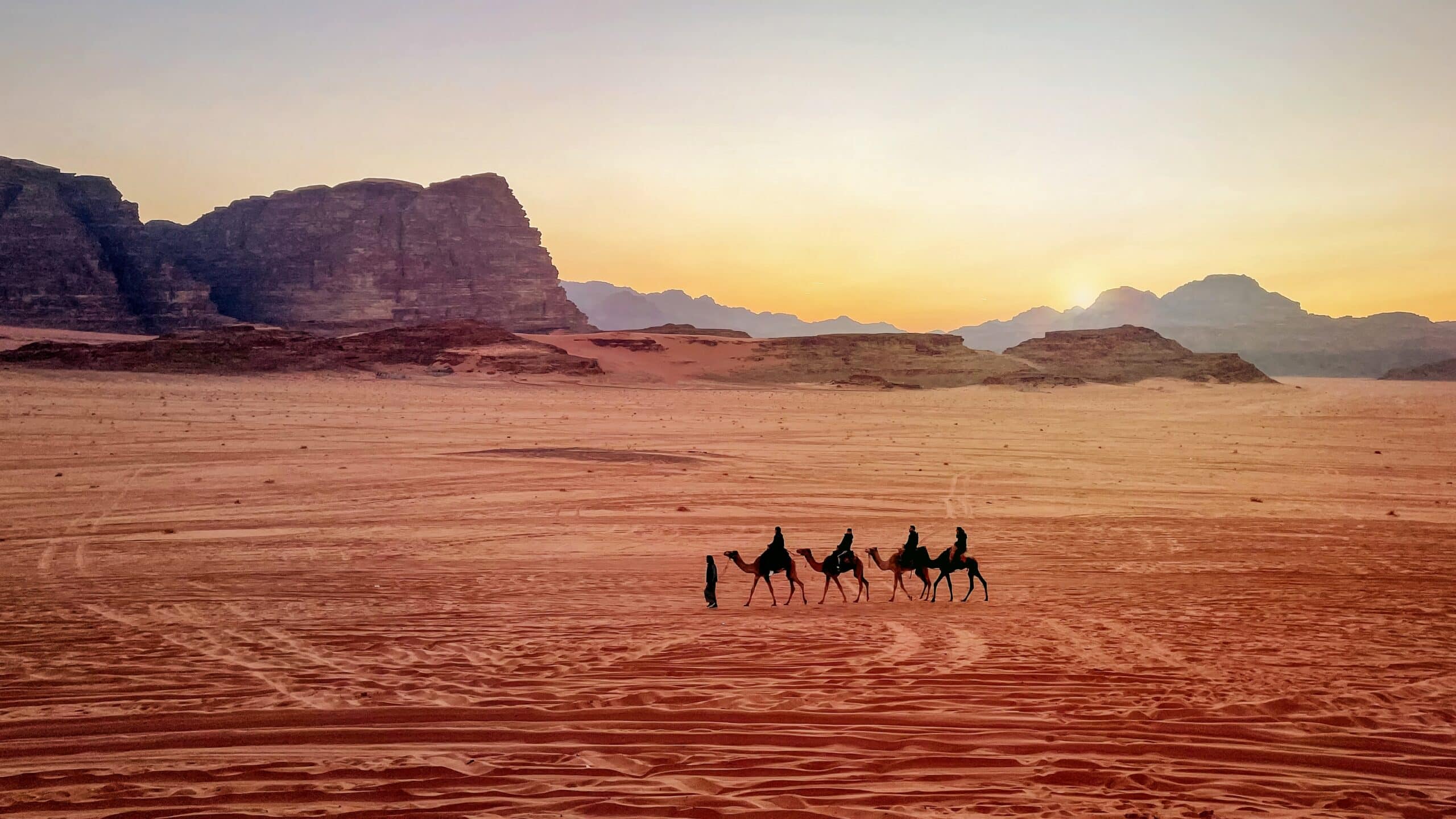
Jordan sits at the meeting point of desert, plateau, valley, and rift, where geography shapes identity through contrast rather than continuity. Though modest in size, the country holds some of the Middle East’s most dramatic shifts in elevation and terrain. Land here drops, rises, fractures, and opens, demanding constant adjustment in how people settle, move, and endure.
To the west, the Jordan Rift Valley cuts deep into the earth, pulling land downward toward the Dead Sea, the lowest exposed point on the planet. This vertical geography defines climate and agriculture, concentrating fertility along river corridors while intensifying aridity beyond them. Elevation, more than distance, becomes the dominant measure.
Eastward, the land lifts into plateaus and deserts that stretch outward in muted tones. Here, space expands and movement slows. Rainfall thins, settlements disperse, and survival depends on foresight rather than abundance. Geography teaches restraint and planning, rewarding those who understand seasonal limits.
Jordan’s cities reflect these conditions. Urban centers cluster where land allows water access, trade routes, or defensible elevation. Growth is shaped by terrain that resists sprawl and demands efficiency. There is little geographic neutrality; every settlement responds directly to land.
Water defines everything. Its absence structures daily life as decisively as its presence once did. Springs, rivers, and ancient channels continue to dictate where life gathers and persists. Geography in Jordan is never passive—it is directive.
To travel through Jordan is to move across vertical extremes and environmental boundaries in short succession. Each destination reveals how people adapt to land that offers little margin for error. Our article approaches Jordan through places where geography speaks clearly, showing how endurance, culture, and continuity emerge from a landscape that insists on awareness at every step.
15. Amman
Amman rises across a series of hills in northwestern Jordan, where elevation defines movement and perception. Geography here is vertical and folded. Neighborhoods climb slopes and descend into shallow valleys, shaping a city that expands through elevation rather than breadth.
The hills regulate climate, cooling evenings and shaping airflow, while limited water availability dictates density and infrastructure. Roads curve and climb, responding to terrain rather than overriding it. Geography resists linearity, reinforcing a city built through accumulation rather than design.
Amman’s position reflects mediation. It sits between the fertile Jordan Valley and the eastern deserts, drawing people inward from contrasting landscapes. Geography encourages convergence without openness; space is earned, not given.
The city inspires through persistence. Growth here is negotiated with land that offers little flat ground and fewer resources. Buildings adapt to slope, and life proceeds through adjustment rather than ease. Geography rewards familiarity.
Amman teaches that capital cities need not dominate terrain to endure. Its authority comes from adaptation—learning how to occupy hills without flattening them. The city reflects Jordan’s broader geography: constrained, elevated, and resilient, shaped by land that demands awareness at every turn.
14. Petra
Petra lies hidden within southern Jordan’s sandstone mountains, carved directly into rose-colored rock. Geography here is protective and theatrical. Narrow canyons conceal open spaces, controlling access and concentrating attention.
The surrounding desert intensifies Petra’s enclosure. Water once flowed through carefully engineered channels, sustaining settlement in an otherwise hostile environment. Geography demanded ingenuity, and survival depended on mastering terrain rather than expanding across it.
Movement through Petra is deliberate. Paths wind through rock corridors that narrow vision before releasing it. Geography stages experience, teaching patience and restraint before revelation.
Petra inspires through precision. Every space reflects negotiation with stone, slope, and scarcity. The land does not allow excess; it rewards intelligence and restraint.
The site teaches that geography can be both barrier and shelter. Petra endured because it understood land deeply—where to hide, where to build, where to guide water. It stands as a testament to how adaptation to extreme terrain can produce endurance, beauty, and lasting meaning.
13. Wadi Rum
Wadi Rum stretches across southern Jordan as a vast desert of sandstone towers, open valleys, and immense sky. Geography here emphasizes scale and exposure. The land is horizontal and monumental, offering few markers of distance beyond shadow and light.
Rain is rare, vegetation sparse, and survival historically depended on movement and memory. Geography teaches orientation through stars, rock formations, and seasonal knowledge rather than infrastructure.
Movement across Wadi Rum is slow and deliberate. Space itself becomes instructive. The land resists haste, demanding respect for distance and climate. Geography strips experience to essentials.
Wadi Rum inspires through immensity. The desert does not overwhelm through force, but through silence and scale. Meaning emerges from attentiveness.
The desert teaches that geography can form clarity by removing excess. In Wadi Rum, land reduces life to fundamentals—water, shelter, timing—reminding visitors that endurance often begins with understanding limits rather than conquering space.
12. Dead Sea
The Dead Sea lies deep within the Jordan Rift Valley, marking the lowest exposed point on Earth. Geography here is extreme and unmistakable. Land drops sharply, air thickens, and water concentrates salt beyond life.
This vertical descent shapes climate and perception. Heat intensifies, evaporation accelerates, and movement slows. Geography alters the body’s experience, making the land impossible to ignore.
The surrounding cliffs and plateaus reinforce enclosure. Access routes descend dramatically, reinforcing awareness of elevation and gravity. Geography dictates arrival as much as presence.
The Dead Sea inspires through contradiction. It is lifeless yet sustaining, hostile yet therapeutic. Geography compresses meaning into sensation.
The site teaches that geography’s extremes can redefine value. Here, land is not productive in conventional terms, yet it holds significance through uniqueness. The Dead Sea stands as Jordan’s most dramatic reminder that geography shapes experience not only through what it provides, but through what it withholds.
11. Jerash
Jerash sits in northern Jordan’s highlands, where fertile valleys interrupt the plateau. Geography here allows cultivation, settlement, and continuity. Rainfall is higher, soil richer, and slopes gentler than in the south.
The land supported long-term urban life, and ruins remain embedded within surrounding hills. Geography offered sustainability rather than concealment.
Movement through Jerash follows open paths rather than confinement. The land invites settlement without demanding defense through isolation. Geography encourages visibility.
Jerash inspires through durability. The landscape supported continuity by offering balance—enough water, enough protection, enough access.
The city teaches that geography’s moderate zones often sustain civilization longest. Jerash reflects a Jordan shaped not only by desert and extremes, but by fertile highlands where endurance grows quietly through land that supports life without spectacle.
10. Aqaba
Aqaba sits at Jordan’s southern edge, where desert mountains give way abruptly to the Red Sea. Geography grants the city rarity. It is Jordan’s only access to open water, and that singular opening reshapes climate, movement, and national orientation.
The sea moderates temperature, softening the extremes common inland. Water introduces humidity, color, and biodiversity unfamiliar to most of the country. Coral reefs lie close to shore, anchoring fishing, trade, and tourism. Geography here looks outward rather than inward, encouraging exchange rather than enclosure.
Behind Aqaba, granite and sandstone mountains rise steeply, forming a hard boundary. Expansion is forced into a narrow corridor between sea and rock. Geography limits sprawl, reinforcing linear development along the coast and concentrating infrastructure.
Movement reflects this compression. Roads parallel the shoreline, ports anchor global connection, and land routes funnel inward toward desert highways. Geography channels flow deliberately, making Aqaba both gateway and threshold.
Aqaba inspires through contrast. Within a land defined by restraint and scarcity, water introduces openness and horizon. The sea shifts perception, reminding visitors that Jordan’s geography is not only vertical and arid, but also connected and fluid.
The city teaches that a single geographic opening can reshape identity. Aqaba stands as Jordan’s outward face, proving that access, when carefully held, can be as formative as limitation in defining a nation’s relationship to land and world.
9. Madaba
Madaba rests on Jordan’s central plateau, where elevation flattens and land opens into cultivated fields. Geography here favors balance. Rainfall is modest but reliable, soil workable, and slopes gentle enough to sustain continuous settlement.
Agriculture shapes the surrounding landscape. Orchards, grain fields, and grazing land reflect a geography that supports life without dramatic intervention. The land neither hides nor overwhelms; it sustains quietly.
Movement across Madaba is direct. Roads extend outward with fewer curves, reflecting terrain that allows efficiency rather than negotiation. Geography reduces friction, encouraging connection between settlements.
Madaba inspires through steadiness. The land does not demand constant adaptation to extremes. Instead, it offers predictability, reinforcing endurance through rhythm rather than struggle.
The town reflects a middle geography often overlooked. Neither desert nor rift, Madaba demonstrates how plateau landscapes support culture through moderation. It reminds visitors that geographic strength is not always found in spectacle, but in land that allows life to persist without interruption.
8. Dana
Dana lies at the edge of a dramatic escarpment where Jordan’s highlands collapse into deep valleys and arid lowlands. Geography here is abrupt and exposed. Elevation shifts rapidly, compressing climates and ecosystems into close proximity.
The land supports remarkable biodiversity precisely because of this verticality. Temperature, vegetation, and wildlife change over short distances. Geography rewards protection rather than exploitation, and settlement remains minimal by necessity.
Movement through Dana is cautious and deliberate. Trails descend steeply, narrowing paths and slowing pace. Geography demands attention, making each step an act of awareness rather than momentum.
Dana inspires through fragility. Beauty here is inseparable from risk. The land reveals how easily balance can be disrupted and how carefully it must be maintained.
The reserve teaches that extreme geography requires stewardship. Dana reflects a Jordan where endurance depends not on control of land, but on restraint and respect. It stands as a reminder that some landscapes endure only when humans choose to occupy them lightly.
7. Karak
Karak rises from Jordan’s central highlands, commanding broad views over surrounding valleys. Geography here emphasizes elevation and control. The land narrows access, concentrating visibility and authority.
The plateau supports agriculture, but settlement remains compact. Geography favors cohesion and defensibility over expansion. Roads climb steadily, reinforcing the effort required to reach the town.
Movement toward Karak is defined by ascent. Geography announces arrival through elevation, shaping perception long before entry.
Karak inspires through solidity. The land offers position rather than abundance. Geography teaches that endurance can be built on placement as much as productivity.
The town demonstrates how elevation shapes identity. Karak stands as a reminder that geography often grants influence through height and perspective, anchoring continuity in land that rewards those who understand its vantage.
6. Azraq
Azraq lies in eastern Jordan’s basalt desert, where flat plains stretch outward and water becomes rare. Geography here is austere and exposed. Space expands while resources contract.
The oasis once sustained migration, wildlife, and settlement, concentrating life into a single fragile point. Geography assigns significance through scarcity rather than scale.
Movement across Azraq is linear and vulnerable. Roads cut through open land, offering little shelter or variation. Geography strips travel to essentials.
Azraq inspires through endurance. Life persists not because the land is generous, but because knowledge adapts to its limits.
The town teaches that harsh geography sharpens understanding. Azraq reflects a Jordan where survival depends on reading land precisely as it is, reminding visitors that endurance often begins with respect for scarcity.
5. Umm Qais
Umm Qais sits on a northern ridge overlooking the Jordan Valley, Lake Tiberias, and the Golan Heights. Geography here is expansive and elevated. The land opens outward, granting long sightlines across borders and water, shaping perception through distance rather than enclosure.
Basalt stone dominates the terrain, lending weight and durability to both ruins and ground. Fertile soils nearby support agriculture, while elevation moderates climate. Geography balances productivity with perspective, allowing settlement to endure without isolation.
Movement toward Umm Qais is gradual. Roads climb steadily, widening views with elevation. Geography reveals itself slowly, emphasizing approach rather than arrival.
Umm Qais inspires through vantage. The land teaches that seeing far can shape understanding deeply. Geography here encourages reflection, reminding visitors that position can expand awareness without requiring dominance.
The site demonstrates how elevated landscapes sustain identity through outlook. Umm Qais reflects a Jordan where geography grants meaning through breadth of vision, anchoring endurance in land that connects multiple horizons at once.
4. Al-Salt
Al-Salt rises in Jordan’s western highlands, where hills cluster tightly and valleys carve narrow passages. Geography here is intimate and layered. Stone buildings follow slope and contour, shaping a city that grows through adaptation rather than expansion.
Rainfall supports orchards and agriculture on surrounding hillsides. Geography rewards careful land use, encouraging terracing and dense settlement. The land does not permit excess space; it demands efficiency.
Movement through Al-Salt is vertical. Streets climb sharply, reinforcing awareness of elevation and effort. Geography slows pace, shaping interaction through proximity.
Al-Salt inspires through cohesion. The land gathers people close, reinforcing social continuity shaped by shared terrain.
The city teaches that geography can foster unity through compression. Al-Salt reflects a Jordan where hills shape belonging, reminding visitors that endurance often grows strongest where land brings people together rather than spreading them apart.
3. Ma’an
Ma’an lies in southern Jordan between plateau and desert, where land opens and rainfall thins. Geography here is transitional and exposed. Space expands, settlements disperse, and survival depends on foresight.
Historically, Ma’an served as a waypoint, shaped by routes rather than resources. Geography positioned it as passage rather than destination. Water scarcity defined rhythm and restraint.
Movement across Ma’an emphasizes distance. Roads stretch long and straight, reinforcing exposure and scale. Geography teaches patience.
Ma’an inspires through endurance. The land offers little generosity, but it sustains those who understand its limits.
The town reflects how transitional landscapes shape resilience. Ma’an stands as a reminder that geography does not always nurture permanence, but it can sustain continuity through movement, memory, and adaptation.
2. Wadi Mujib
Wadi Mujib cuts dramatically from Jordan’s plateau down toward the Dead Sea, forming one of the country’s most striking river gorges. Geography here is forceful and vertical. Water and rock shape space through erosion and descent.
The canyon compresses ecosystems into narrow corridors. Temperature, vegetation, and light shift rapidly with elevation. Geography rewards attentiveness, as conditions change quickly.
Movement through Wadi Mujib follows water. Paths descend steeply, often within the river itself. Geography dictates pace and direction, leaving little room for deviation.
Wadi Mujib inspires through immersion. The land surrounds completely, making experience physical and immediate.
The reserve teaches that geography can instruct through engagement. Wadi Mujib reflects a Jordan where endurance is learned by entering the land directly, allowing terrain to guide movement, awareness, and respect.
1. Shobak
Shobak rises from Jordan’s southern highlands, isolated by distance and elevation. Geography here is defensive and austere. The land narrows access, emphasizing separation rather than connection.
Cooler temperatures support limited agriculture, but settlement remains sparse. Geography favors vigilance over abundance.
Movement toward Shobak requires commitment. Roads climb steadily through open terrain, reinforcing isolation. Geography announces remoteness through effort.
Shobak inspires through solitude. The land teaches endurance through distance and elevation, shaping identity through separation.
The site demonstrates how geography can preserve presence through isolation. Shobak reflects a Jordan where land protects history by limiting access, reminding visitors that endurance sometimes depends on being hard to reach.