
Côte d’Ivoire occupies a pivotal stretch of West Africa, where the Atlantic coast gives way to forested interiors and, farther north, to open savannah. Its geography unfolds in clear bands, each shaping how life is organized, how people move, and how meaning accumulates across the land. This layered terrain makes the country legible not through a single symbol, but through gradual transition.
Along the southern coast, lagoons soften the boundary between land and sea. Water slows movement, moderates climate, and anchors settlement patterns that favor trade, fishing, and exchange. Inland, dense forests once supported expansive agricultural systems and long-distance routes linking coast to interior. These forests still influence rhythm and identity, even as cultivation and urban growth reshape them.
Farther north, the land opens. Savannah replaces forest, rainfall thins, and distance begins to dominate perception. Here, geography demands foresight and adaptation, rewarding those who understand seasonal change and scale. The country’s north and south do not oppose each other; they complete a geographic continuum that encourages movement and interdependence.
Côte d’Ivoire’s cities reflect this geography. Coastal urban centers emphasize circulation and outward connection, while interior towns draw strength from agriculture, trade corridors, and land-based continuity. No single region contains the nation’s meaning. Instead, significance emerges through passage—between coast and forest, forest and savannah, tradition and change.
To travel through Côte d’Ivoire is to move through environments that instruct differently. The land does not overwhelm with extremes; it teaches through sequence. Each place builds on the last, forming a geographic narrative shaped by water, soil, and distance.
15. Abidjan
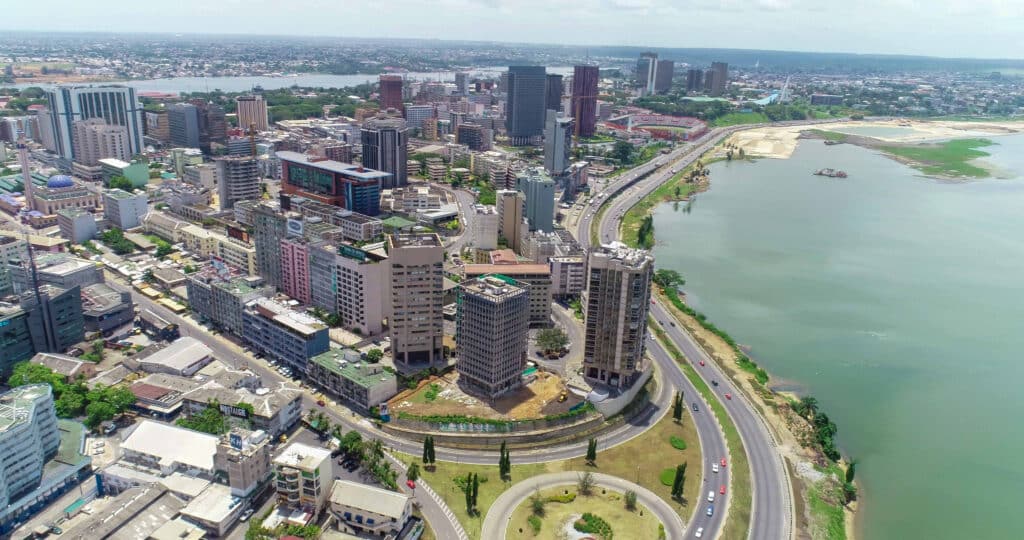
Abidjan unfolds across lagoons, peninsulas, and low coastal land along Côte d’Ivoire’s southern edge. Geography fragments the city into distinct districts separated by water, shaping an urban form defined less by continuity than by connection. Bridges, ferries, and causeways become essential, turning movement itself into the city’s organizing principle.
The Atlantic Ocean moderates climate, while lagoons regulate flow, commerce, and daily rhythm. Water slows certain routes and accelerates others, forcing adaptation rather than dominance. Neighborhoods grow along edges, facing channels as much as streets. Geography discourages enclosure and vertical compression, favoring circulation and openness instead.
Abidjan’s scale is sustained by geography that tolerates expansion without erasing distinction. Districts maintain individual character because water preserves separation even as infrastructure links them. The city’s energy emerges from passage—between shores, cultures, and economies—rather than from concentration alone.
Abidjan inspires through fluidity. Geography teaches that complexity can function when connection replaces control. The city’s resilience lies in its ability to absorb motion without losing orientation. Water becomes both boundary and bridge, shaping identity through constant negotiation.
As Côte d’Ivoire’s economic anchor, Abidjan demonstrates how coastal geography can sustain ambition without rigidity. Its authority comes from movement—of people, goods, and ideas—supported by land that insists on flow. Here, geography does not demand stillness; it rewards adaptability, allowing a city to remain grounded while continuously in transit.
14. Grand-Bassam
Grand-Bassam lies along a narrow coastal strip east of Abidjan, where the Atlantic Ocean, lagoon waters, and land meet in close succession. Geography compresses experience here, shaping a town where distance is limited and awareness heightened. Space feels intentional because the land allows little excess.
The ocean defines daily rhythm. Fishing, tides, and weather patterns influence movement and livelihood, while the lagoon buffers settlement from inland sprawl. Geography restricts outward expansion, preserving a compact form that keeps routines close and visible. Paths follow water edges, reinforcing linear movement shaped by shoreline rather than grid.
Grand-Bassam’s layout encourages continuity. Buildings, markets, and gathering spaces exist within short reach of one another, and daily life unfolds within clearly perceived boundaries. Geography quietly protects cohesion by limiting how far the town can stretch.
Grand-Bassam inspires through restraint. The land does not invite accumulation or speed; it insists on balance. Change arrives slowly, absorbed rather than imposed. Geography holds memory not through deliberate preservation, but through form that resists erasure.
The town teaches that places shaped by constraint often retain depth. Where land restricts expansion, meaning concentrates. Grand-Bassam stands as a reminder that geography can preserve identity simply by refusing to make space for forgetting, allowing continuity to emerge naturally through closeness and repetition.
13. Yamoussoukro
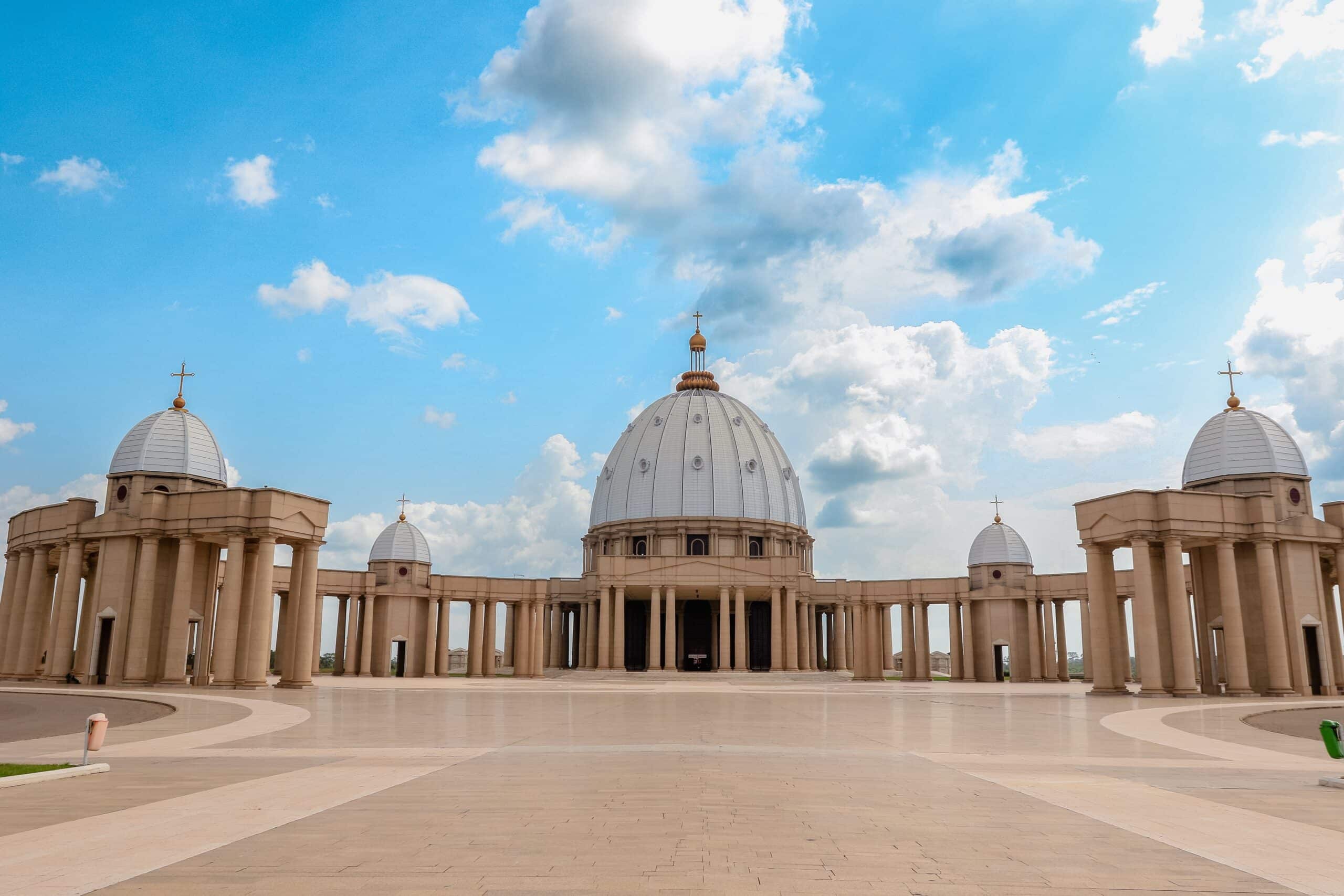
Yamoussoukro sits inland on gently rolling terrain, removed from the coast’s constant movement. Geography here emphasizes openness, symmetry, and visibility. The land allows long sightlines and broad planning, creating a spatial order distinct from the fragmented coastal cities.
The climate remains warm, moderated by interior position and distance from the sea. Roads extend outward in deliberate lines, reinforcing orientation and balance. Geography supports intentional design rather than reactive growth, allowing space to be shaped with clarity.
Yamoussoukro’s environment fosters steadiness. Agriculture in surrounding areas benefits from predictable terrain and rainfall patterns, while the city itself maintains a measured pace. Geography does not rush development; it absorbs it gradually.
Yamoussoukro inspires through deliberateness. The land functions as a stabilizing surface, encouraging permanence over improvisation. Here, geography becomes a canvas that supports long-term vision rather than immediate response.
The city teaches that interior landscapes offer grounding through removal from urgency. Without coastal pressure or mountainous constraint, Yamoussoukro reflects a relationship with land based on order and continuity. Geography allows the city to exist as an anchor—quiet, centered, and oriented toward endurance rather than acceleration.
12. Man
Man lies in western Côte d’Ivoire’s mountainous region, where elevation reshapes climate, movement, and perception. Geography asserts itself strongly here. Hills and peaks interrupt distance, creating enclosure and variation that contrast sharply with the country’s flatter regions.
Rainfall is higher, vegetation dense, and air cooler. The land channels settlement into valleys and along slopes, guiding where people build and how they move. Roads curve and climb, responding to terrain rather than imposing straight lines. Geography demands negotiation.
Man’s environment encourages attentiveness. Visibility shifts with elevation, and orientation depends on understanding the land’s contours. Daily life aligns with gradients—of slope, temperature, and rainfall—that define possibility.
Man inspires through contrast. Geography refuses uniformity, reminding visitors that terrain can direct rhythm decisively. Identity here forms through adaptation to elevation and climate rather than through expansion.
The town teaches that geography’s intensity can cultivate resilience. Where land complicates movement, knowledge becomes essential. Understanding slope, soil, and season is not optional; it is survival. Man reflects a Côte d’Ivoire shaped not only by flow and openness, but also by places where the land insists on being met on its own terms.
11. Korhogo
Korhogo rests in northern Côte d’Ivoire’s savannah, where land opens wide and rainfall thins. Geography emphasizes scale, distance, and seasonal change. The terrain stretches outward with few interruptions, shaping perception and routine.
Agriculture adapts carefully to climate variability. Crops, grazing, and water use depend on timing and foresight. Settlements spread rather than cluster, reinforcing awareness of space and effort. Geography rewards planning more than immediacy.
Movement follows long horizons. Roads extend directly, and journeys are measured in distance rather than density. Geography encourages patience, shaping a rhythm aligned with land rather than urgency.
Korhogo inspires through endurance. The openness demands attentiveness to cycles—rainy seasons, dry periods, and soil limits. Life persists through understanding rather than abundance.
The town teaches that northern geography forms resilience quietly. Scale itself becomes instructive. Korhogo stands as a reminder that identity can be shaped by familiarity with space, where knowing how far the land extends matters as much as knowing what it provides.
10. Bouaké
Bouaké sits near the geographic center of Côte d’Ivoire, where forested zones thin and transition toward open savannah. Geography positions the city as a point of passage rather than enclosure, shaping identity through movement and exchange instead of isolation.
Roads from multiple regions converge here, reinforcing Bouaké’s role as an inland crossroads. The land is relatively flat and accessible, encouraging circulation across long distances. Geography favors connection, making the city a natural hub for trade, transport, and regional interaction.
The surrounding terrain supports agriculture suited to transitional climates. Farmers adapt to both forest and savannah conditions, and markets reflect this diversity. Geography allows Bouaké to mediate between ecological zones, strengthening its relevance beyond its immediate boundaries.
Urban form follows function. Neighborhoods spread outward along transport routes, and activity clusters where movement concentrates. Geography does not impose dramatic limits, but it quietly directs growth along paths of exchange.
Bouaké inspires through resilience shaped by position. The city’s importance lies not in spectacle, but in its ability to endure disruption by remaining useful. Geography grants relevance through accessibility.
The city teaches that centrality can be geographic rather than symbolic. Bouaké exists because land invites convergence, reminding visitors that places shaped by movement often develop strength through adaptability. Here, geography sustains identity by keeping the city connected, responsive, and grounded in its role as a bridge across regions.
9. Daloa
Daloa lies within Côte d’Ivoire’s forested interior, where fertile soil and consistent rainfall shape agricultural life. Geography here emphasizes productivity and continuity, anchoring the city within one of the country’s most active farming zones.
The land supports cocoa, coffee, and food crops, linking Daloa closely to surrounding rural communities. Roads connect farms to markets, reinforcing exchange rooted in soil rather than transit alone. Geography sustains relevance through cultivation.
Urban growth remains steady and dispersed. Development follows land that accommodates expansion without disruption. Geography favors integration between town and countryside, keeping agriculture visible within daily life.
Daloa inspires through grounded reliability. The land does not demand urgency or adaptation to extremes. Instead, it rewards care, timing, and familiarity. Geography encourages endurance through repetition.
The city teaches that stability often grows from fertile landscapes. Where land gives consistently, communities learn continuity. Daloa reflects a Côte d’Ivoire shaped by soil as much as movement, reminding visitors that productivity can anchor identity quietly and persistently.
8. San-Pédro
San-Pédro stretches along Côte d’Ivoire’s southwestern coast, where dense forest meets the Atlantic Ocean. Geography here emphasizes export and outward connection, shaping a city oriented toward sea-based exchange.
The coastline provides deep-water access, while inland forests support agriculture and timber. Geography positions San-Pédro as a conduit between interior production and global routes. Movement flows seaward, reinforcing the city’s maritime focus.
Urban form aligns with port activity. Infrastructure clusters near the shoreline, and roads extend inland toward farming regions. Geography concentrates energy along water’s edge.
San-Pédro inspires through purpose. The land does not invite ambiguity; it directs attention outward. Geography reinforces clarity of function.
The city teaches that coastal geography can define role as much as identity. San-Pédro exists to move goods, people, and effort beyond national borders. Here, geography sustains relevance by aligning land, labor, and sea into a single outward-facing rhythm.
7. Odienné
Odienné sits in northwestern Côte d’Ivoire near the country’s borders, where savannah landscapes dominate and distance shapes awareness. Geography emphasizes remoteness and scale rather than density.
The land is open and dry for much of the year, requiring careful agricultural adaptation. Settlements spread across wide areas, reinforcing familiarity with space and effort. Geography rewards foresight.
Movement through Odienné reflects long horizons. Roads stretch outward, connecting dispersed communities across regional boundaries. Geography encourages regional linkage rather than isolation.
Odienné inspires through persistence. Life here is shaped by knowledge of land limits and seasonal cycles. Geography teaches endurance through understanding scarcity.
The town demonstrates how borderland geography fosters resilience. Odienné stands as a reminder that places far from centers often develop strength through self-reliance, shaped by land that demands attentiveness rather than abundance.
6. Bondoukou
Bondoukou lies in northeastern Côte d’Ivoire, where savannah meets trade routes extending beyond national borders. Geography positions the town as a historical gateway between regions, shaping identity through exchange.
The terrain is gently rolling and accessible, allowing movement across long distances. Agriculture adapts to seasonal rainfall, while markets reflect cross-border interaction. Geography supports connection rather than enclosure.
Settlement patterns reflect openness. Communities spread along routes rather than clustering tightly. Geography reinforces awareness of movement and distance.
Bondoukou inspires through continuity. The land sustains relevance by enabling passage, trade, and cultural interaction. Geography becomes connective tissue.
The town teaches that geography can preserve importance through position alone. Bondoukou exists because land invites movement, reminding visitors that exchange itself can be a foundation for endurance.
5. Gagnoa
Gagnoa lies within Côte d’Ivoire’s south-central forest zone, where fertile soil and steady rainfall shape both landscape and livelihood. Geography here emphasizes cultivation and continuity rather than movement or exposure. Dense vegetation surrounds the town, reinforcing a sense of enclosure and agricultural focus.
The land supports cocoa, coffee, and food crops, anchoring Gagnoa firmly within the country’s productive interior. Roads connect farms to markets, but the town’s rhythm remains tied to soil rather than transit. Geography favors rootedness, encouraging long-term settlement and repetition.
Urban growth follows agricultural logic. Expansion remains gradual, shaped by land that absorbs development without dramatic transformation. Daily life reflects predictability—planting, harvesting, exchange—aligned closely with seasonal cycles.
Gagnoa inspires through steadiness. The geography does not demand adaptation to extremes, nor does it encourage rapid change. Instead, it rewards care, patience, and familiarity with land that gives consistently when treated attentively.
The town teaches that geography’s quiet zones often sustain nations invisibly. Gagnoa’s importance lies in reliability. Here, land anchors identity through productivity, reminding visitors that endurance is often cultivated slowly, through repeated engagement with soil that shapes life over generations.
4. Sassandra
Sassandra sits along Côte d’Ivoire’s southwestern coast, where the Atlantic meets forested hinterland. Geography here blends openness and enclosure, shaping a town oriented toward both sea and land.
Fishing defines coastal rhythm, while inland vegetation supports farming and small-scale trade. The land narrows near the shore, guiding settlement along water’s edge. Geography encourages alignment rather than expansion, keeping the town compact and legible.
Movement follows shoreline contours. Boats and coastal roads structure daily activity, while the sea remains a constant reference point. Geography reinforces attentiveness to tide, weather, and horizon.
Sassandra inspires through balance. The land does not overwhelm with scale, nor does it disappear into density. Instead, it holds life in equilibrium between water and forest.
The town teaches that coastal geography can support continuity without excess. Sassandra reflects a relationship with land and sea based on familiarity and restraint, where endurance emerges from knowing when to move and when to remain.
3. Séguéla
Séguéla lies in north-central Côte d’Ivoire, where forest thins into savannah and distance begins to assert itself. Geography here marks transition. The land opens gradually, reshaping perception and movement.
Agriculture adapts to mixed conditions. Crops reflect both forest and savannah systems, and settlement spreads across wide space. Geography rewards versatility, encouraging familiarity with multiple landscapes.
Roads connect Séguéla to surrounding regions, reinforcing its role as intermediary. Movement matters, but the pace remains measured. Geography supports circulation without urgency.
Séguéla inspires through adaptability. The land teaches that resilience often forms where environments overlap. Identity here is shaped by adjustment rather than permanence.
The town demonstrates how transitional geographies cultivate flexibility. Séguéla stands as a reminder that places between zones often develop strength by learning from both, grounded in land that refuses singular definition.
2. Abengourou
Abengourou rests in eastern Côte d’Ivoire’s forested region, where fertile soil and consistent rainfall support agriculture and long settlement. Geography emphasizes enclosure, grounding the town within dense vegetation.
Cocoa farming shapes surrounding landscapes, linking Abengourou closely to rural production. Roads connect farms to markets, but the town’s identity remains tied to land rather than transit. Geography supports continuity through cultivation.
Urban form reflects this grounding. Expansion remains measured, and daily life follows agricultural rhythms. Geography encourages patience and repetition.
Abengourou inspires through rootedness. The land does not invite rapid transformation; it rewards care and familiarity. Identity deepens through sustained engagement with soil.
The town teaches that geography can preserve coherence by anchoring life in productivity. Abengourou reflects a Côte d’Ivoire shaped by forest landscapes that sustain meaning through cultivation rather than movement.
1. Aboisso
Aboisso lies in southeastern Côte d’Ivoire near the border, where forested land meets river systems flowing toward the coast. Geography here emphasizes connection through water and proximity rather than scale.
Agriculture thrives on fertile soil, while rivers guide movement and trade. The land supports interaction across regions, reinforcing Aboisso’s role as connector rather than terminus.
Settlement patterns follow waterways and roads that link interior farms to coastal routes. Geography encourages circulation shaped by natural pathways.
Aboisso inspires through connectivity. The land teaches that borders do not isolate when geography invites movement.
The town stands as a reminder that geography can foster continuity through passage. Aboisso’s identity emerges from land that links rather than divides, sustaining relevance through connection.