
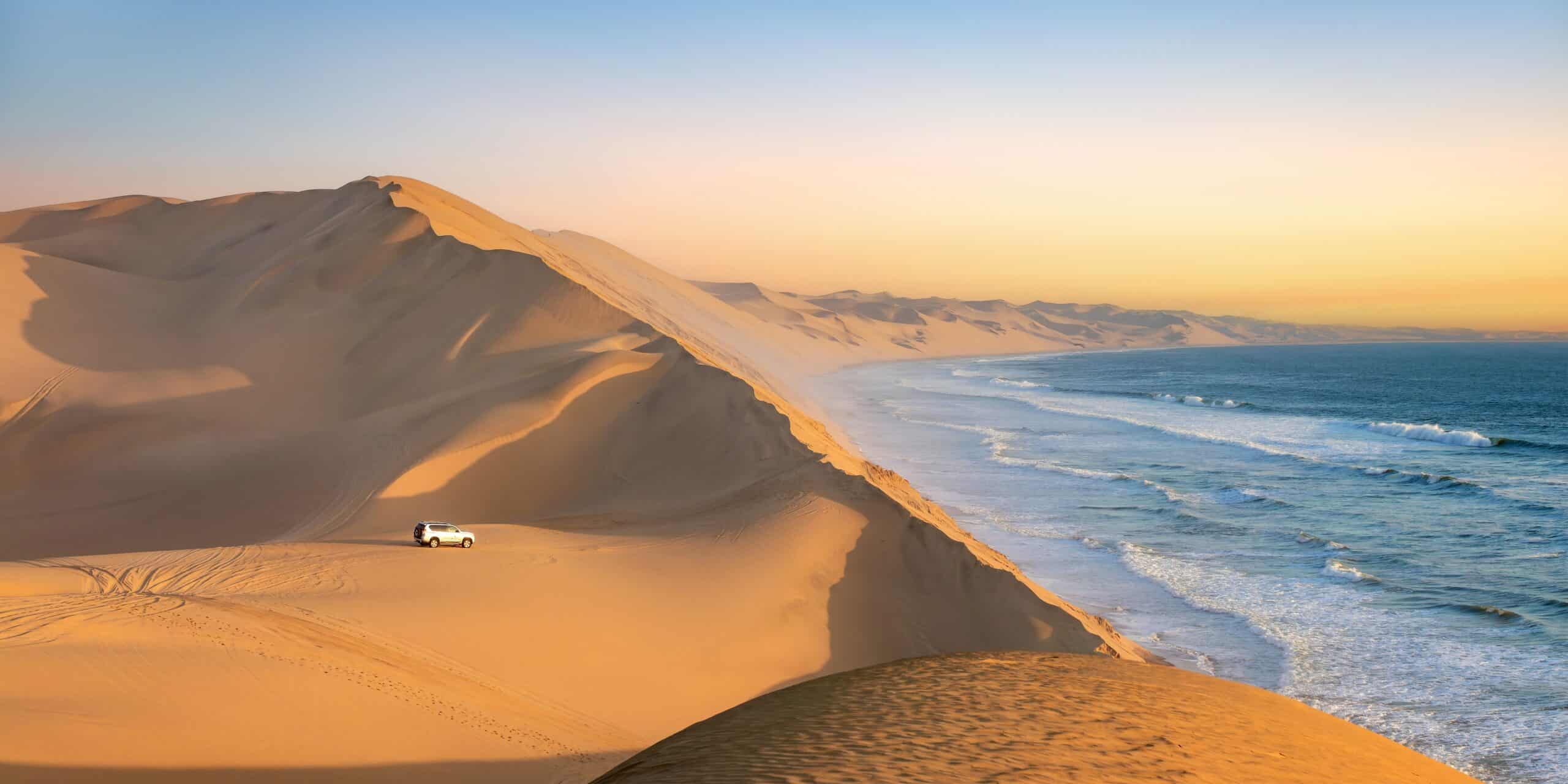
Namibia is a country shaped by vastness, restraint, and elemental power. It is one of the least densely populated nations on Earth, allowing landscapes to remain uninterrupted and profoundly present. Here, silence is not absence but presence, and distance is not emptiness but perspective. Deserts stretch endlessly beneath wide skies, mountains rise from plains untouched by time, and coastlines dissolve into fog and mystery.
This is a land formed by extremes. Ancient geological forces sculpted towering dunes, deep canyons, and mineral-rich plateaus long before recorded history. Survival demanded adaptation rather than domination, creating ecosystems defined by resilience and balance. Wildlife, vegetation, and human life exist in quiet negotiation with the environment, shaped by scarcity and endurance.
Namibia’s cultural identity reflects this relationship with land. Indigenous communities such as the Himba, San, and Herero preserve traditions rooted in oral history, survival knowledge, and ancestral connection. Colonial occupation and the struggle for independence further shaped national consciousness, reinforcing values of dignity, sovereignty, and self-determination.
Time moves differently in Namibia. Roads are long, settlements are sparse, and encounters feel intentional rather than incidental. The absence of congestion encourages attention, allowing travelers to experience place deeply rather than consume it quickly. Stillness becomes a form of engagement, and observation replaces distraction.
19. Sossusvlei: Sculpted by Time and Wind
Sossusvlei lies deep within the Namib Desert, home to some of the tallest sand dunes on Earth. These immense formations rise sharply from pale clay pans, creating a visual contrast that feels otherworldly and ancient. Shaped by wind over millions of years, the dunes appear in constant motion while remaining timeless in form.
Light defines the experience of Sossusvlei. At dawn and dusk, the dunes glow in layered tones of red, copper, and gold, while shadows carve dramatic contours across the landscape. Silence amplifies every movement, reinforcing the scale and age of the environment.
Nearby, the skeletal trees of Deadvlei stand preserved against white earth and deep blue sky. Their presence reflects environmental change and survival through stillness rather than growth. Life here exists through adaptation, not abundance.
Sossusvlei is not merely scenic; it is instructive. It teaches patience, proportion, and humility. Standing among these dunes, one becomes acutely aware of time measured in geological rhythms rather than human urgency.
This landscape represents Namibia’s desert soul—powerful, restrained, and enduring. It reveals beauty stripped to its essentials, where form, light, and silence speak with authority.
18. Swakopmund: Where Desert Meets Ocean
Swakopmund sits along Namibia’s Atlantic coast at the precise meeting point of desert and ocean. Rolling dunes descend abruptly into cold waters, creating a stark and memorable contrast shaped by wind, fog, and salt air.
Founded during the colonial era, the town retains architectural traces of its past, softened by African rhythm and coastal life. Palm-lined streets, cafés, and ocean promenades reflect a balance between order and openness.
Fog frequently drifts inland from the Benguela Current, blurring the boundary between land and sea. This atmospheric presence defines Swakopmund’s identity, lending it a muted, contemplative character.
The surrounding desert offers vast space and adventure, while the ocean shapes daily rhythm through tides and temperature. Activities exist, but never overwhelm the town’s calm pace.
Swakopmund represents Namibia’s meeting of contrasts—past and present, wilderness and settlement. It is a place of transition, where land yields to water without resistance.
17. Etosha National Park: Life Around Water
Etosha National Park is one of Africa’s most distinctive wildlife sanctuaries, defined by a vast salt pan that dominates its landscape. In an otherwise arid environment, water determines survival, shaping movement, interaction, and rhythm.
During dry seasons, animals gather around scattered waterholes, creating remarkable opportunities for observation. Elephants, lions, giraffes, antelope, and countless bird species move with purpose, guided by necessity rather than abundance.
The openness of Etosha allows clear visibility, reinforcing authenticity and restraint. There is no spectacle engineered here—only life responding to environment with precision and patience.
The salt pan itself, visible from space, reflects light dramatically, transforming the landscape into shifting shades of white, silver, and blue. It serves as both barrier and gathering ground, depending on seasonal conditions.
Etosha teaches attentiveness. It rewards waiting, observation, and respect for natural rhythm. This is wildlife experienced on its own terms.
The park reveals Namibia’s ecological philosophy—balance rather than excess, preservation rather than domination. It stands as a powerful reminder that survival depends not on control, but on understanding.
16. Damaraland: Stone, Memory, and Survival
Damaraland is a region of elemental beauty and deep cultural significance, defined by rocky plains, eroded mountains, and open sky. The landscape feels ancient and uncompromising, shaped by drought, erosion, and time.
This region contains some of Namibia’s most important archaeological sites, including prehistoric rock engravings that preserve early human expression. These markings connect present and past through stone and story.
Desert-adapted elephants and rhinos roam freely across vast distances, embodying resilience shaped by scarcity. Life here survives through movement, memory, and balance rather than abundance.
Local communities maintain traditions closely tied to land and ancestry, reinforcing continuity rather than disruption. Culture and environment exist as one system, each shaping the other.
Damaraland offers perspective. It reveals Namibia as a place where survival, culture, and landscape remain inseparable—etched not in monument, but in stone, movement, and memory.
15. Skeleton Coast: Edge of the Unforgiving
The Skeleton Coast stretches along Namibia’s northern Atlantic shoreline as one of the most haunting and uncompromising landscapes in the world. Where desert dunes collapse into cold ocean waters, fog, wind, and isolation define an environment shaped by endurance rather than welcome.
This coastline earned its name from shipwrecks scattered along the shore, remnants of vessels claimed by strong currents and unpredictable weather. Bleached whale bones and rusting hulls stand as silent witnesses to nature’s dominance, reinforcing the sense of raw confrontation between land and sea.
The Benguela Current brings dense fog inland, obscuring vision and sound. This atmospheric veil sustains unique ecosystems while intensifying the coast’s mysterious character. Seals gather in large colonies, thriving amid conditions that repel most forms of life.
Despite its severity, the Skeleton Coast supports remarkable adaptation. Desert-adapted wildlife moves between dune and shoreline, guided by instinct and scarcity. Human presence remains minimal, emphasizing respect over intrusion.
The Skeleton Coast is not meant to comfort. It exists as a boundary—between survival and surrender, movement and stillness. It reveals Namibia’s most uncompromising truth: that beauty can be severe, and that resilience is often born where conditions allow no margin for error.
14. Fish River Canyon: Depth Beyond Measure
Fish River Canyon is the largest canyon in Africa and one of the most impressive geological formations on the planet. Carved over millions of years by erosion and tectonic movement, it cuts deeply through southern Namibia, revealing layers of time exposed in stone.
The canyon’s scale is overwhelming. Sheer cliffs plunge toward a winding river far below, while expansive viewpoints stretch endlessly across barren plateaus. Light shifts dramatically throughout the day, altering color and depth, transforming stone into shadow and flame.
Despite its arid surroundings, life persists here in adapted forms. Vegetation clings to sheltered crevices, and wildlife navigates the harsh terrain with careful precision. The canyon teaches restraint—movement is slow, deliberate, and purposeful.
Hiking routes descend into the canyon, demanding physical endurance and mental focus. This journey is not recreational; it is immersive, offering perspective shaped by effort and exposure.
Fish River Canyon offers scale without embellishment. It strips experience down to proportion and time, reminding visitors of the earth’s capacity to shape itself far beyond human measure.
13. Spitzkoppe: Cathedral of Granite
Spitzkoppe rises abruptly from Namibia’s flat plains, a dramatic granite formation often referred to as the “Matterhorn of Namibia.” Its rounded peaks and exposed rock surfaces create a striking contrast against open desert sky.
Formed over hundreds of millions of years, Spitzkoppe feels monumental yet intimate. Rock arches frame horizons, while smooth granite surfaces reflect shifting light and temperature. The landscape invites exploration through movement and observation rather than distance.
Ancient rock paintings hidden among the boulders reveal early human presence and spiritual connection to place. These artworks link geology with memory, reinforcing continuity between land and expression.
At night, Spitzkoppe becomes a sanctuary of stillness. The absence of light pollution reveals vast star fields, grounding experience in silence and scale.
Spitzkoppe is not imposing—it is contemplative. It stands as a natural monument shaped by patience rather than force, offering Namibia’s most sculptural expression of time.
12. Zambezi Region (Caprivi Strip): Namibia’s Green Corridor
The Zambezi Region, formerly known as the Caprivi Strip, is Namibia’s most unexpected landscape. Stretching eastward between neighboring countries, it contrasts sharply with the nation’s arid identity through lush vegetation, rivers, and wetlands.
Multiple river systems converge here, including the Zambezi, Okavango, and Kwando, creating a life-rich corridor of water and movement. Wildlife flourishes in abundance, supported by fertile floodplains and dense forests.
Communities in the region maintain fishing, farming, and cultural traditions shaped by seasonal rhythms rather than scarcity. Life here follows water, reinforcing Namibia’s diversity beyond desert narrative.
Protected areas support elephants, buffalo, hippos, and birdlife, creating ecosystems more commonly associated with central Africa than the Namib.
The Zambezi Region expands understanding. It reveals Namibia as a country of contrast, where abundance and restraint coexist within the same national identity.
11. Kolmanskop: Echoes of Abandonment
Kolmanskop is a ghost town slowly reclaimed by desert sand, standing as one of Namibia’s most evocative symbols of impermanence. Once a thriving diamond-mining settlement, it was abandoned when resources dwindled and focus shifted elsewhere.
Today, dunes pour through doorways and windows, filling empty rooms with sculptural curves of sand. Furniture, walls, and staircases remain intact, suspended between presence and disappearance.
Kolmanskop confronts ambition directly. It reveals how prosperity built on extraction fades when land reclaims priority. The desert here is not violent—it is patient.
This abandoned town invites reflection rather than nostalgia. It reminds visitors that human dominance is temporary, while landscape endures.
Kolmanskop is memory made visible. It completes Namibia’s narrative by showing not how land is used, but how it ultimately remains.
10. Windhoek: Crossroads of Identity and Direction
Windhoek stands at the center of Namibia not only geographically, but symbolically. Nestled in the central highlands, the capital serves as a bridge between vast rural landscapes and the institutions that guide a young nation forward. It is a city defined less by scale than by purpose.
Architecturally and culturally, Windhoek reflects layers of history. German colonial buildings coexist with modern African design, while public monuments, museums, and civic spaces emphasize independence, memory, and national unity. Rather than erase its past, the city integrates it into a broader narrative of self-definition.
Life in Windhoek moves with intention. Streets are orderly, conversations unhurried, and daily routines shaped by practicality rather than urgency. Markets, cafés, and community spaces reveal a society grounded in dialogue and accessibility. The city feels lived in, not performed.
Windhoek also functions as Namibia’s primary gateway. Roads extend outward in every direction, dissolving quickly into open land and silence. For travelers, the city provides context—historical, cultural, and logistical—before immersion into the country’s immense scale.
More than a capital, Windhoek represents Namibia’s voice. It is where policy meets tradition, where diversity finds common ground, and where national direction is shaped through responsibility rather than excess. In its restraint and clarity, Windhoek mirrors the values of the country it serves.
9. Waterberg Plateau: Elevation as Refuge
The Waterberg Plateau rises suddenly from the surrounding plains, its sheer sandstone cliffs forming a natural stronghold visible from great distance. This elevated landscape feels self-contained, defined by height, isolation, and ecological significance.
Waterberg plays a central role in Namibia’s conservation efforts. Protected reserves on the plateau provide refuge for endangered species, allowing populations to stabilize within an environment shaped by geology rather than artificial barriers. Wildlife thrives here under careful stewardship, emphasizing protection over spectacle.
The plateau’s elevation captures rainfall, sustaining vegetation far denser than the surrounding savannah. Forested paths, open grasslands, and dramatic viewpoints create a varied landscape that rewards slow exploration. From the edge, the plains stretch endlessly below, reinforcing perspective and scale.
Historically, Waterberg carries weight beyond ecology. It is a site of memory and consequence, reminding visitors that land holds human history alongside natural form. The plateau stands as both sanctuary and witness.
Waterberg offers a lesson in restraint. It demonstrates how boundaries, when shaped by nature and responsibility, can create space for renewal. Here, elevation becomes more than physical height—it represents protection, reflection, and the possibility of balance between preservation and progress.
8. Okonjima Nature Reserve: Guardianship in Practice
Okonjima Nature Reserve stands as one of Namibia’s most respected centers for conservation and wildlife research. Located between Windhoek and Etosha, it serves as a vital link between protection, education, and ethical tourism.
The reserve is internationally recognized for its work with large predators, particularly leopards and cheetahs. Long-term monitoring, scientific research, and rehabilitation programs operate transparently, emphasizing coexistence rather than control. Animals are not displayed; they are understood.
The landscape itself is expansive and understated. Rolling plains, rocky hills, and acacia woodland create space for movement and natural behavior. Wildlife roams freely, supported by management strategies rooted in knowledge and restraint.
What defines Okonjima is intention. Visitors engage not only with animals, but with the systems that protect them. Conservation here is explained, questioned, and refined, fostering awareness rather than consumption.
Okonjima reflects Namibia’s broader environmental philosophy: guardianship over ownership, responsibility over dominance. It demonstrates that preservation is not passive, but active work shaped by patience, research, and long-term commitment. In this reserve, conservation becomes not an attraction, but a shared obligation.
7. Brandberg Mountain: Memory in Stone
Brandberg Mountain rises from the desert of northwestern Namibia as the country’s highest peak, its granite mass glowing in shifting hues of red, copper, and gold. More than a physical landmark, Brandberg is a place of cultural depth and spiritual resonance.
The mountain shelters thousands of ancient rock paintings scattered across its slopes and valleys. Among them, the famed “White Lady” stands as a symbol of early human expression, ritual, and movement. These images transform the mountain into a living archive of belief and observation.
The terrain is demanding. Heat, stone, and distance define movement, while water remains scarce. Exploration requires respect for environment and limits, reinforcing humility in the face of scale and age.
Brandberg’s silence feels deliberate. It invites contemplation rather than conquest, encouraging awareness of time measured in millennia rather than moments. Here, landscape and memory are inseparable.
Brandberg reminds visitors that land can carry meaning beyond explanation. It stands not as a challenge to overcome, but as a presence to acknowledge—one shaped by endurance, reverence, and the quiet persistence of human story.
6. Twyfelfontein: Humanity’s Earliest Language
Twyfelfontein is one of Africa’s most significant concentrations of rock engravings, preserving thousands of carvings etched into sandstone over thousands of years. Set within a dry, rocky valley, it offers a rare window into early human understanding.
The engravings depict animals, tracks, and symbolic forms, reflecting close observation of environment and movement. Rather than decoration, these images functioned as knowledge—maps, stories, and memory encoded in stone.
The surrounding landscape reinforces continuity between art and place. Heat, silence, and stone remain largely unchanged, allowing direct connection across time. Each carving feels grounded in necessity rather than expression alone.
Twyfelfontein reveals communication before writing, belief before monument. It shows how early societies understood their world through pattern, repetition, and shared meaning.
This site is not defined by scale, but by significance. Twyfelfontein speaks quietly, yet powerfully, of humanity’s earliest efforts to record experience, understand nature, and leave trace without dominance. It completes Namibia’s narrative by grounding it in origin.
5. Fish River Canyon: Silence Carved Into Stone
Fish River Canyon dominates southern Namibia as one of the largest canyons on Earth, stretching vast distances through an otherwise stark and arid landscape. Its immense scale is not immediately grasped; it unfolds gradually, revealing depth, distance, and geological history layered in stone.
Formed over hundreds of millions of years through tectonic movement and erosion, the canyon exposes ancient rock formations shaped by time rather than force. Sheer cliffs descend dramatically toward the river below, while plateaus stretch outward in quiet expanse. Light transforms the canyon constantly, shifting from cool shadow to burning brilliance as the sun moves across the sky.
Despite its harshness, life persists. Hardy vegetation clings to sheltered ledges, while adapted wildlife navigates the canyon’s extremes with caution and precision. Movement here is deliberate, dictated by terrain and climate rather than convenience.
Hiking routes into the canyon demand endurance and self-awareness. This is not a casual journey, but an immersion that strips experience down to essentials: water, footing, direction, and resolve. The environment allows no shortcuts.
Fish River Canyon offers perspective through exposure. It reminds visitors of geological time, of landscapes shaped without urgency, and of humanity’s smallness within the planet’s greater narrative. It is a place where silence feels earned, and scale commands humility.
4. Skeleton Coast National Park: Where Survival Draws the Line
Skeleton Coast National Park extends along Namibia’s northern Atlantic shoreline as one of the most unforgiving environments on the continent. Here, towering dunes collapse directly into cold ocean waters, forming a boundary where desert and sea exist in constant tension.
The coast’s name reflects its history. Shipwrecks lie scattered along the shore, remnants of vessels claimed by strong currents, dense fog, and unpredictable weather. Bleached whale bones and rusting metal punctuate the landscape, reinforcing the sense of isolation and severity.
The Benguela Current shapes the region’s climate, pulling fog inland and sustaining fragile ecosystems amid extreme conditions. Seal colonies thrive along the coast, while desert-adapted wildlife moves cautiously between land and shoreline.
Human presence is minimal, emphasizing restraint and respect. Roads are scarce, distances vast, and assistance far away. Survival here depends entirely on preparation and awareness.
Skeleton Coast does not offer comfort. It offers truth. It reveals beauty shaped by endurance, where life persists not through abundance, but through precision and adaptation. The park stands as Namibia’s most uncompromising reminder that nature defines its own limits.
3. Caprivi (Zambezi) Region: Namibia’s Living Waterway
The Caprivi Region, officially known as the Zambezi Region, challenges every assumption about Namibia’s landscape. Stretching eastward between neighboring countries, it introduces rivers, wetlands, and dense vegetation into a nation defined by aridity.
Multiple river systems converge here, including the Zambezi, Okavango, and Kwando, creating fertile floodplains that support abundant wildlife. Elephants, buffalo, hippos, crocodiles, and countless bird species thrive within ecosystems shaped by seasonal rhythm.
Communities in the region live in close relationship with water. Fishing, farming, and cultural practices follow cycles of flooding and retreat, reinforcing continuity between environment and livelihood. Life here is guided by flow rather than scarcity.
Protected areas and transboundary conservation initiatives emphasize coexistence across borders, expanding Namibia’s environmental vision beyond national limits.
The Caprivi Region broadens Namibia’s identity. It reveals a country capable of both restraint and abundance, silence and movement. Here, water reshapes narrative, reminding travelers that Namibia is not one landscape, but many.
2. Okahandja: Heart of Herero Heritage
Okahandja holds a unique place in Namibia’s cultural landscape as the spiritual heart of the Herero people. Situated north of Windhoek, the town carries significance far beyond its size.
The Herero Heroes’ Acre and annual commemorations draw communities together in remembrance of leaders and ancestors lost during colonial conflict. These gatherings reinforce continuity, identity, and collective memory.
Markets, especially the renowned woodcarving stalls, reflect craftsmanship passed through generations. Objects here are not souvenirs, but expressions of heritage, skill, and storytelling.
Okahandja moves quietly, grounded in tradition rather than expansion. Its importance lies not in spectacle, but in preservation.
This town reveals Namibia’s cultural depth, reminding visitors that national identity is built not only through landscapes, but through people, memory, and resilience.
1. Omaruru: Creativity in a Desert Setting
Omaruru sits at the edge of central Namibia’s dry landscapes as a town shaped by creativity and community. Surrounded by rolling hills and open plains, it has become a gathering place for artists, writers, and craftspeople.
Galleries, workshops, and cultural spaces reflect a commitment to expression rooted in place. Creativity here is not detached from environment; it responds to light, space, and silence.
The town’s colonial-era buildings and tree-lined streets create a sense of calm continuity. Life moves slowly, allowing conversation, observation, and collaboration.
Omaruru demonstrates how culture can flourish even in sparse settings. It offers balance—between solitude and exchange, environment and imagination.
In Omaruru, Namibia’s quieter voice becomes visible, showing how art and landscape can shape one another with mutual respect.