
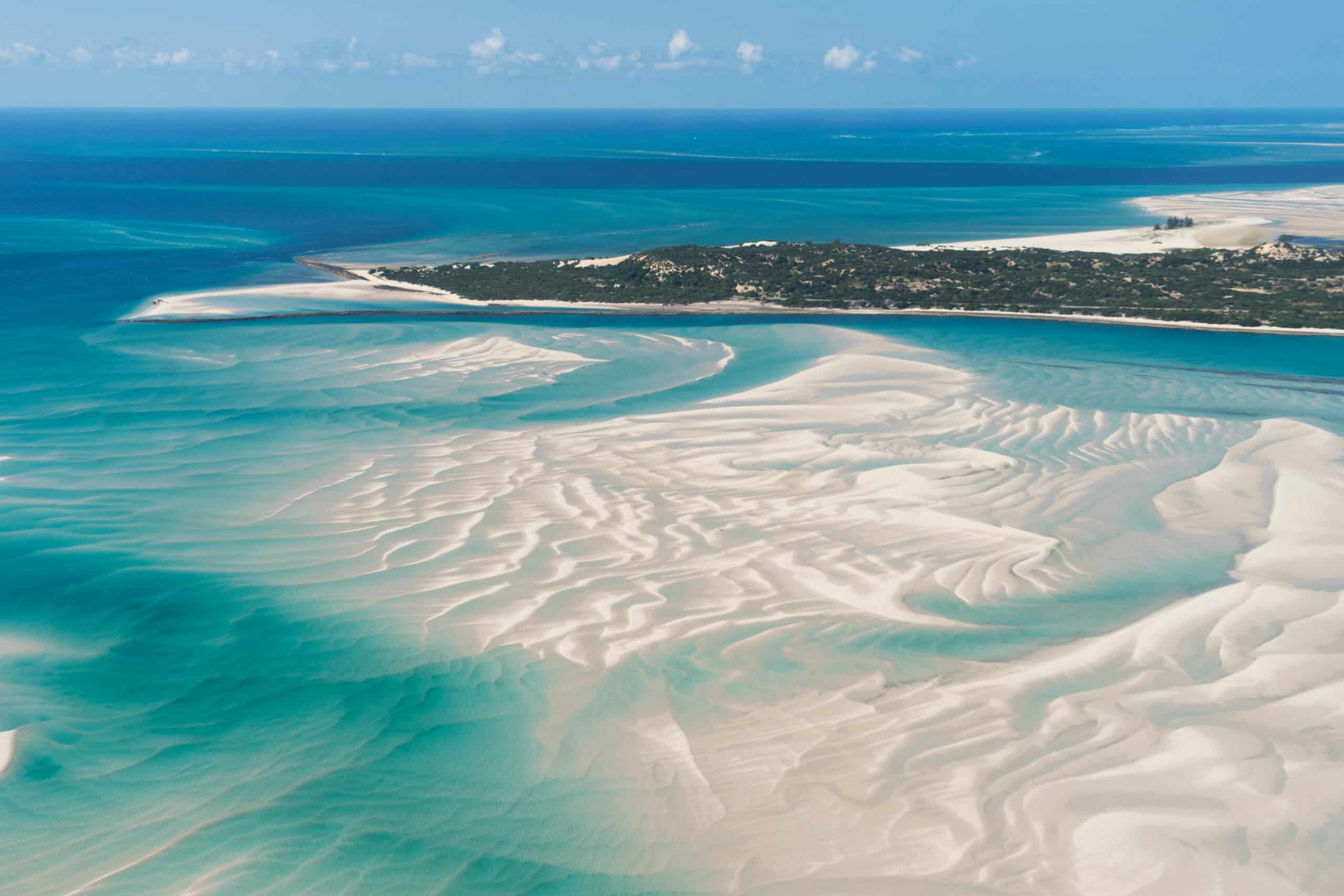
Mozambique is a country shaped by movement—of ocean tides, cultural exchange, and historical passage. Stretching along the warm waters of the Indian Ocean, it carries an identity forged through trade routes, migration, and centuries of interaction between Africa, Arabia, and Europe. Here, rhythm defines life, whether through music, language, or the steady pulse of the sea.
The landscape of Mozambique is diverse and expansive. Palm-lined beaches give way to coral reefs, inland plains stretch toward distant mountains, and major rivers carve fertile corridors through the land. Water plays a central role, not only as geography but as livelihood, memory, and connection. The ocean feeds communities, shapes cuisine, and anchors the country’s outward-looking spirit.
Mozambique’s cultural richness is inseparable from its history. Ancient Swahili trading towns, Portuguese colonial influence, and indigenous traditions coexist within a complex national narrative. Decades of struggle for independence and recovery have forged resilience and pride, expressed through art, storytelling, and communal life.
Time in Mozambique feels generous. Life unfolds through shared meals, conversation, and celebration rather than urgency. Music and dance act as collective language, carrying memory and joy across generations. Even in cities, the pace remains grounded, shaped by climate and custom rather than speed.
In our article we explore Mozambique’s most compelling destinations—places where natural beauty, cultural depth, and historical layers converge. From island archipelagos to inland reserves, each chapter reveals a different expression of the country’s character. To travel through Mozambique is to encounter a nation defined not by excess, but by warmth, continuity, and the enduring dialogue between land, sea, and people.
11. Ilha de Moçambique: Stone, Sea, and Memory
Ilha de Moçambique stands as one of the most historically significant places in the country, a small coral island that once served as a major trading hub along the Indian Ocean. Long before colonial arrival, Arab and Swahili merchants connected this island to global networks of exchange, shaping its cosmopolitan identity.
Stone Town, built from coral rock and lime, reflects centuries of layered influence. Fortresses, churches, mosques, and merchant houses stand close together, forming an architectural dialogue between cultures rather than a single narrative. Narrow streets echo with memory, shaped by footsteps of traders, sailors, and local communities.
The island’s divide between the historic Stone Town and the more modest wooden town reveals contrasts shaped by history and economy. Yet daily life bridges these spaces through shared rhythm, fishing traditions, and communal bonds.
The surrounding sea remains central. Dhows glide across turquoise waters, coral reefs protect the shoreline, and the ocean continues to define sustenance and identity. Life here follows tides rather than clocks.
Ilha de Moçambique is not preserved as a relic; it is lived in. Its significance lies in continuity, where history remains visible but not frozen. The island offers insight into Mozambique’s origins as a meeting point of worlds, shaped by exchange, endurance, and the quiet persistence of place.
10. Bazaruto Archipelago: Mozambique’s Ocean Sanctuary
The Bazaruto Archipelago rises from the Indian Ocean as a chain of pristine islands defined by clarity, color, and ecological balance. Protected as a national park, this region represents Mozambique’s most refined expression of coastal beauty.
White sand dunes roll gently toward turquoise waters, while coral reefs shelter diverse marine life. Dugongs, dolphins, sea turtles, and vibrant fish species thrive here, supported by conservation efforts that prioritize preservation over exploitation.
Life on the islands remains closely tied to the sea. Fishing communities maintain traditional practices, navigating waters with knowledge passed down through generations. Simplicity defines daily rhythm, shaped by wind, tide, and weather rather than demand.
The islands offer stillness rather than spectacle. Movement is slow, horizons uninterrupted, and nights illuminated by stars rather than artificial light. The absence of excess allows attention to settle on detail—color shifts in water, wind across dunes, the quiet of open space.
Bazaruto reflects Mozambique’s relationship with the ocean at its most harmonious. It is a place where protection and livelihood coexist, and where beauty is sustained through restraint. The archipelago reveals a nation capable of preserving its natural wealth without surrendering its soul.
9. Gorongosa National Park: Renewal and Resilience
Gorongosa National Park stands as one of Africa’s most powerful stories of ecological recovery. Once devastated by conflict and environmental collapse, it has emerged as a symbol of resilience through long-term restoration and community partnership.
Located where the Great Rift Valley meets Mozambique’s central plains, Gorongosa contains remarkable ecological diversity. Floodplains, savannah, forests, and limestone gorges create interconnected habitats that support a wide range of wildlife.
Restoration efforts focus not only on animals, but on systems. Rewilding, scientific research, and local collaboration work together to rebuild balance rather than recreate spectacle. Wildlife populations are returning gradually, guided by patience and planning.
Communities surrounding the park play a central role in its future. Education, healthcare, and sustainable livelihoods are integrated into conservation, reinforcing mutual benefit rather than exclusion.
Gorongosa represents Mozambique’s forward-looking vision. It demonstrates how healing—ecological and human—can occur through commitment and cooperation. The park is not just a destination; it is a living model of renewal shaped by responsibility and hope.
8. Maputo: Coastal Capital of Contrast and Culture
Maputo is a capital shaped by rhythm, resilience, and layered identity. Set along a broad bay on the Indian Ocean, it carries the imprint of centuries of trade, colonial rule, and post-independence reinvention. Rather than overwhelm, the city invites observation, revealing itself through texture and movement.
Architecturally, Maputo is a dialogue between eras. Colonial buildings stand beside modern structures and informal markets, forming an urban landscape that reflects continuity rather than uniformity. Iron balconies, wide avenues, and shaded plazas coexist with street vendors, music, and open-air cafés.
Cultural life pulses throughout the city. Music, poetry, and visual arts serve as expressions of memory and renewal, often addressing themes of struggle, identity, and hope. Museums and cultural centers preserve national narratives while encouraging contemporary voices.
Daily life unfolds at an unhurried pace shaped by climate and custom. Meals are social, evenings stretch long, and the ocean breeze softens the city’s edges. The coastline remains central, grounding urban life in maritime tradition.
Maputo is not polished, nor does it attempt to be. Its strength lies in authenticity and openness. As Mozambique’s gateway, it offers insight into a nation shaped by survival, creativity, and connection. The city stands as a living reflection of Mozambique’s capacity to absorb history without losing its pulse.
7. Tofo and Inhambane: Where Ocean and Community Converge
The coastal towns of Tofo and Inhambane represent Mozambique’s enduring relationship with the sea. Located along the southern coastline, they balance marine richness with community-driven rhythm, offering a sense of continuity shaped by water and wind.
Inhambane is one of the country’s oldest settlements, defined by colonial-era architecture, palm-lined streets, and a deeply rooted fishing culture. Its historic mosques, markets, and harbor reveal centuries of maritime exchange and cultural layering.
Nearby Tofo has developed as a center for marine exploration while retaining its relaxed, local character. Offshore waters are home to whale sharks, manta rays, and seasonal humpback whales, drawing global attention without overwhelming the town’s scale.
Fishing boats line the beaches at dawn, reinforcing livelihood as ritual. Life here follows tides rather than schedules, with days shaped by weather, catch, and community exchange.
The strength of Tofo and Inhambane lies in balance. Tourism exists alongside tradition, not in place of it. Conservation efforts support marine ecosystems while sustaining local knowledge.
Together, these towns reflect Mozambique’s coastal identity at its most human. They reveal how ocean, culture, and economy can coexist through respect and shared stewardship rather than acceleration.
6. Quirimbas Archipelago: History Beneath Turquoise Water
The Quirimbas Archipelago stretches along Mozambique’s northern coast as a chain of coral islands shaped by history, isolation, and ecological richness. Less developed than southern archipelagos, it retains a sense of quiet continuity rooted in tradition.
Many islands were once part of Swahili trade networks, linking Africa with Arabia and Asia. Stone ruins, mosques, and forts remain scattered across select islands, bearing witness to centuries of maritime exchange and cultural fusion.
The surrounding waters are among the most biodiverse in the region. Coral reefs support abundant marine life, while mangroves protect coastlines and sustain fisheries. Conservation initiatives focus on protection without displacement.
Island communities maintain fishing and boat-building traditions passed down through generations. Life here is defined by cooperation, seasonal rhythm, and adaptation rather than growth.
The Quirimbas offer stillness rather than spectacle. Movement is slow, silence generous, and space uninterrupted. These islands reveal Mozambique’s northern soul—deeply connected to water, memory, and restraint.
5. Limpopo National Park: Borderlands of Renewal
Limpopo National Park occupies Mozambique’s southwestern frontier, forming part of the Greater Limpopo Transfrontier Conservation Area shared with neighboring countries. This vast landscape emphasizes ecological connection beyond political boundaries.
Savannahs, rivers, and woodlands create corridors for wildlife movement, supporting elephants, antelope, predators, and birdlife. Restoration here prioritizes natural migration and long-term balance rather than density.
Communities living within and around the park participate in conservation through shared management and sustainable livelihoods. This approach reflects Mozambique’s evolving environmental vision—one rooted in inclusion rather than exclusion.
Limpopo is not dramatic in isolation; its power lies in scale and intention. It represents cooperation across borders and commitment to ecological continuity.
The park reveals Mozambique’s forward-looking relationship with land—one that values connectivity, patience, and shared responsibility over immediate return.
4. Ponta do Ouro: Edge of the Indian Ocean
Ponta do Ouro sits at Mozambique’s southernmost edge, where the country meets South Africa and the Indian Ocean stretches endlessly eastward. Defined by wide beaches, shifting dunes, and warm currents, it carries a sense of openness shaped by movement rather than settlement.
The ocean is central to life here. Dolphins swim close to shore, and seasonal migrations bring whales along the coastline. Coral reefs just offshore support vibrant marine ecosystems, reinforcing the area’s reputation as one of the region’s most accessible marine sanctuaries.
Unlike heavily developed beach destinations, Ponta do Ouro maintains a relaxed, informal character. Roads remain sandy, structures modest, and daily life oriented toward tide, weather, and shared rhythm. Fishing, diving, and community interaction coexist without competition.
Conservation plays an increasingly important role. Marine protection initiatives work alongside local livelihoods, emphasizing sustainability rather than restriction. The goal is continuity, not transformation.
Ponta do Ouro offers simplicity with depth. It reveals Mozambique’s coastal identity at its most natural—where land ends gently, ocean begins patiently, and life follows cycles older than borders.
3. Lake Niassa: Inland Sea of Stillness
Lake Niassa, also known as Lake Malawi, forms Mozambique’s vast northern frontier, stretching like an inland sea between nations. Its scale is immediate and calming, with clear waters meeting distant hills and quiet shores.
The lake supports remarkable biodiversity, particularly endemic fish species that thrive in its depths. Fishing communities depend on this resource, practicing techniques shaped by generations of observation and respect.
Villages along the Mozambican shore remain largely untouched by modern infrastructure. Life unfolds slowly, defined by water collection, fishing cycles, and communal exchange. Evenings bring stillness broken only by sound carried across open water.
The lake’s remoteness reinforces reflection. There is little urgency here, only continuity. Movement is deliberate, and presence feels intentional.
Lake Niassa reveals Mozambique beyond coastline and savannah. It introduces a freshwater identity grounded in patience, sustenance, and quiet endurance, offering a deeply grounding experience shaped by elemental calm.
2. Mount Namuli: Sacred Highlands of the North
Mount Namuli rises above northern Mozambique as a massif wrapped in mist, forest, and cultural reverence. These highlands form one of the country’s most ecologically important and least explored regions.
Dense forests shelter rare plant species and birdlife, remnants of ancient ecosystems preserved through elevation and isolation. The climate here contrasts sharply with surrounding lowlands, offering cooler air and fertile slopes.
For local communities, Namuli is sacred. Belief systems, rituals, and oral histories tie identity directly to the mountain, reinforcing stewardship rather than exploitation. Agriculture follows sustainable patterns shaped by terrain and tradition.
Access remains limited, preserving both ecological integrity and cultural continuity. Exploration requires effort, respect, and time.
Mount Namuli represents Mozambique’s spiritual geography. It reveals how landscape can hold meaning beyond utility, existing as source, sanctuary, and symbol.
1. Chimoio and the Manica Highlands: Fertile Crossroads
Chimoio lies within the Manica Highlands near Mozambique’s western border, a region defined by fertile land, rolling hills, and agricultural productivity. This landscape offers contrast to coastal narratives, emphasizing cultivation and connection.
The highlands benefit from cooler temperatures and reliable rainfall, supporting farming communities that form the backbone of local economy. Markets here reflect abundance shaped by labor rather than extraction.
Historically, the region served as a crossroads for movement between inland southern Africa and the coast. This legacy remains visible in cultural diversity and trade patterns.
Chimoio itself is functional rather than ornate, grounded in daily life and regional exchange. Its value lies in what it sustains rather than what it displays.
The Manica Highlands complete Mozambique’s portrait. They show a nation rooted not only in ocean and history, but in soil, continuity, and shared effort.