
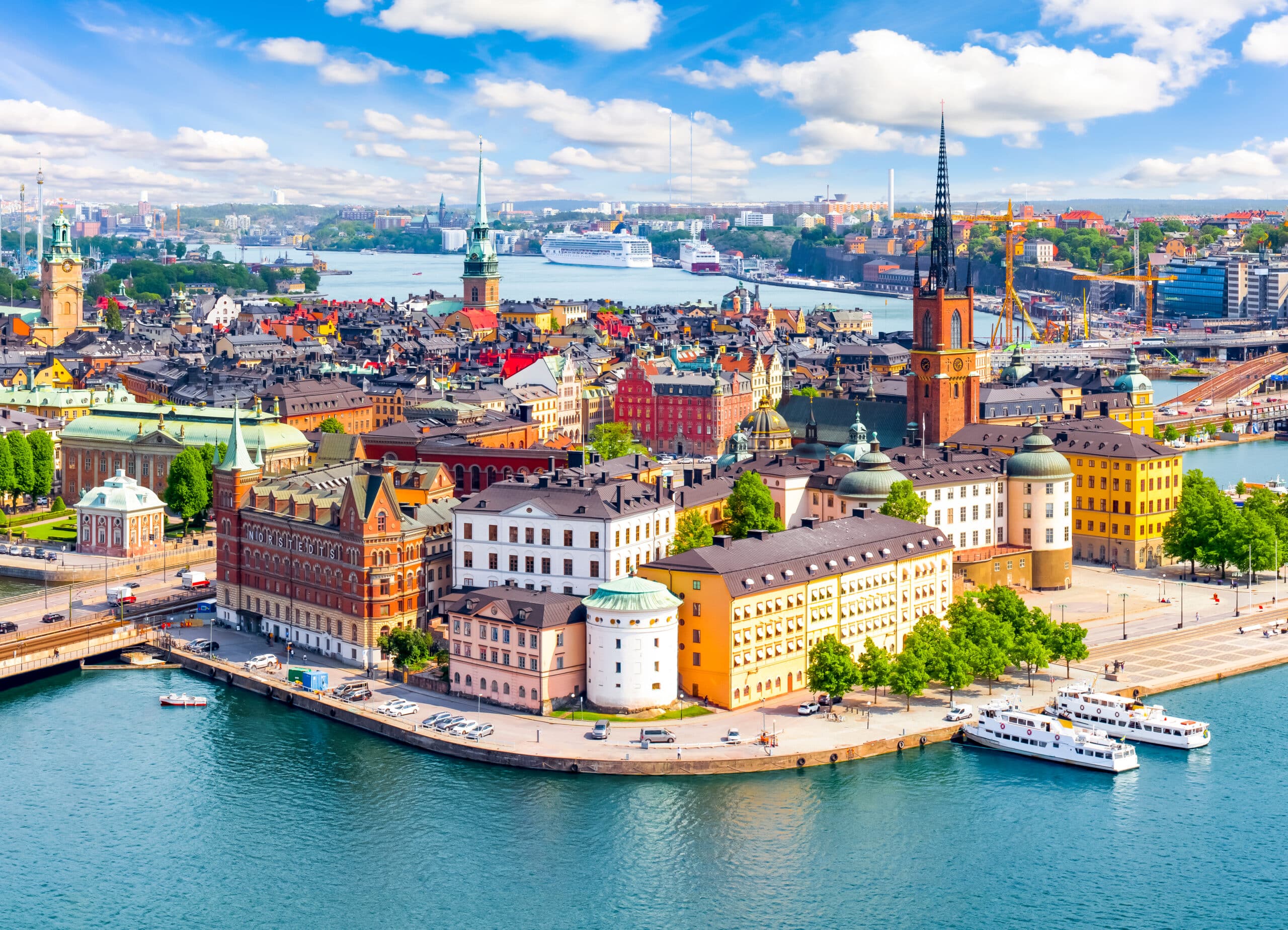
Sweden is the largest country in Scandinavia, occupying the eastern portion of the Scandinavian Peninsula in Northern Europe. Bordered by Norway to the west and Finland to the northeast, and connected to Denmark via the Øresund Bridge, Sweden combines vast natural landscapes with highly developed urban centers. Its geography stretches from fertile southern plains to Arctic tundra in the north, creating significant regional diversity in climate, economy, and culture.
Historically, Sweden evolved from Viking-era kingdoms into a powerful Baltic state during the 17th century. In the modern era, it transitioned from a largely agrarian society into one of the world’s most industrialized and innovation-driven economies. Neutrality in both World Wars helped preserve infrastructure and supported postwar economic expansion. Today, Sweden operates as a constitutional monarchy with a parliamentary democracy, maintaining high levels of political stability and public trust.
The country is internationally recognized for its welfare model, emphasis on equality, and commitment to sustainability. Environmental policy, renewable energy development, and urban planning reflect long-term strategic priorities. Major cities such as Stockholm, Gothenburg, and Malmö function as economic engines, while smaller regional centers contribute through industry, education, and resource management.
Sweden’s economy is export-oriented, built on advanced manufacturing, automotive engineering, telecommunications, pharmaceuticals, forestry, and mining. At the same time, research universities and technology startups reinforce its global competitiveness.
Culturally, Sweden balances deep-rooted traditions—such as midsummer celebrations and regional folk heritage—with contemporary design, music, and digital innovation. The country’s integration of natural landscapes, social policy, and technological advancement defines its distinctive national character.
30. Stockholm
Stockholm, the capital of Sweden, is situated on fourteen islands where Lake Mälaren flows into the Baltic Sea. Founded in the mid-13th century, the city initially functioned as a fortified trading settlement designed to control access between inland waterways and maritime routes. Its strategic location allowed Stockholm to develop into Sweden’s political and economic center during the era of the Swedish Empire in the 17th century.
Gamla Stan, the Old Town, preserves medieval street patterns, narrow alleys, and historic structures including the Royal Palace and Stockholm Cathedral. Expansion during the industrial period brought new districts, rail connections, and port facilities, strengthening its role in trade and governance.
Today, Stockholm is home to the Riksdag parliament, government ministries, and the official residence of the monarch. The metropolitan economy is driven by finance, information technology, life sciences, and creative industries. The city is widely recognized as one of Europe’s leading innovation hubs, with a strong startup ecosystem and global technology firms.
Urban planning emphasizes environmental sustainability. Extensive public transportation, green parks, and waterfront promenades integrate nature into daily life. Cultural institutions, museums, and universities further reinforce Stockholm’s national significance.
Stockholm harmonizes medieval heritage, maritime geography, and advanced knowledge-based industries. Its island setting and forward-looking economy symbolize Sweden’s balance between tradition and innovation.
29. Gothenburg
Gothenburg is located on Sweden’s western coast at the mouth of the Göta River, providing direct access to the North Sea. Founded in 1621 by King Gustavus Adolphus, the city was strategically planned with Dutch-inspired canals and defensive fortifications to secure Sweden’s western trade routes.
Maritime commerce quickly became central to Gothenburg’s identity. During the 18th century, the Swedish East India Company operated from the city, strengthening international connections. Later, shipbuilding and heavy industry transformed Gothenburg into one of Scandinavia’s foremost industrial centers. The Port of Gothenburg remains the largest in the Nordic region, handling a substantial share of Sweden’s foreign trade.
The 20th century saw diversification into automotive manufacturing, engineering, and logistics. Major corporations maintain headquarters or research facilities in the region, contributing to economic stability. Universities and research institutes support technological development and workforce training.
Urban renewal initiatives have reshaped former docklands into residential and commercial districts, integrating sustainability goals and waterfront accessibility. Cultural life includes theaters, museums, and music festivals that enhance the city’s social fabric.
Gothenburg harmonizes maritime legacy, industrial resilience, and modern urban planning. Its coastal position continues to define its economic orientation and international outlook.
28. Malmö
Malmö is situated in southern Sweden in the province of Skåne, directly facing Denmark across the Øresund strait. Originally founded in the 13th century under Danish rule, Malmö became part of Sweden in 1658 following the Treaty of Roskilde. Its geographic position has long made it a crossroads of Scandinavian trade and cultural exchange.
Industrialization in the 19th and 20th centuries established Malmö as a major shipbuilding and manufacturing center. The Kockums shipyard became one of the city’s largest employers before industrial restructuring led to economic transition in the late 20th century.
The opening of the Øresund Bridge in 2000 significantly reshaped Malmö’s development. The fixed link to Copenhagen created a transnational metropolitan region characterized by cross-border commuting, shared labor markets, and economic integration.
Urban regeneration projects have transformed former industrial harbor areas into sustainable neighborhoods featuring modern architecture, including the Turning Torso skyscraper. Malmö’s population reflects significant international migration, contributing to its multicultural character.
Today, education, technology, and services drive the local economy. Malmö University plays a central role in research and innovation. Environmental initiatives emphasize renewable energy and climate-conscious urban design.
Malmö harmonizes historical cross-border ties, industrial adaptation, and contemporary sustainability strategies. Its position at the gateway between Scandinavia and continental Europe continues to shape its dynamic development.
27. Uppsala
Uppsala is located north of Stockholm and is one of Sweden’s oldest cities. Its origins date back to pre-Christian times, when the nearby site of Old Uppsala served as a religious and political center during the Viking Age. Burial mounds in the area reflect its early importance in Scandinavian history.
During the Middle Ages, Uppsala became the ecclesiastical heart of Sweden. Uppsala Cathedral, completed in the 15th century, remains the largest church building in Scandinavia and serves as the seat of the Archbishop of Sweden. The city’s religious authority significantly influenced national development.
Founded in 1477, Uppsala University is the oldest university in Scandinavia. It has played a central role in Sweden’s intellectual life, contributing to advancements in science, medicine, and the humanities. The presence of students and researchers continues to shape the city’s demographic and economic profile.
Uppsala’s economy is strongly connected to education, biotechnology, and research institutions. Pharmaceutical and life science industries have expanded in collaboration with the university.
Urban design integrates historical buildings, parks, and the Fyris River, which runs through the city center. Residential neighborhoods balance academic facilities with green spaces.
Uppsala harmonizes ancient heritage, ecclesiastical tradition, and modern scientific innovation. Its continuity as a religious, educational, and research center underscores its enduring national significance.
26. Västerås
Västerås lies on the northern shore of Lake Mälaren, west of Stockholm. Its strategic location along inland waterways fostered early settlement, and the city became an important trading center during the Middle Ages.
In the 16th century, Västerås gained national prominence during the Swedish Reformation, when key political decisions reshaped the relationship between church and state. Västerås Cathedral remains a central historical landmark.
Industrialization in the late 19th century transformed Västerås into a major manufacturing hub. The establishment of electrical engineering industries positioned the city at the forefront of Sweden’s industrial modernization. Energy technology and automation continue to drive the regional economy.
Today, Västerås is recognized for innovation in power systems and sustainable energy solutions. Industrial firms collaborate with research institutions to develop advanced technologies for global markets.
The city also emphasizes environmental sustainability and waterfront redevelopment. Parks, marinas, and recreational paths along Lake Mälaren enhance urban livability.
Västerås harmonizes medieval political significance, industrial heritage, and technological advancement. Its development reflects Sweden’s broader transition from traditional trade to high-tech industry.
25. Örebro
Örebro is situated in central Sweden along the Svartån River, near Lake Hjälmaren. The city emerged during the medieval period as a fortified settlement, with Örebro Castle playing a central defensive and administrative role.
The castle, strategically positioned on a small island in the river, became an important site for national assemblies and political negotiations. Its preserved structure remains a defining symbol of the city.
During the 19th and 20th centuries, Örebro developed as a center for shoe manufacturing and light industry. Although traditional industries have declined, diversification into logistics, education, and public services has sustained economic stability.
Örebro University contributes to research and workforce development, strengthening the city’s role as a regional education center. Transportation infrastructure, including rail and highway networks, enhances connectivity across central Sweden.
Urban planning integrates historical landmarks with modern commercial districts and residential neighborhoods. Green areas and lakeside recreation support quality of life.
Örebro harmonizes medieval fortification, industrial transition, and educational growth. Its central geographic location reinforces its function as a logistical and administrative hub within Sweden.
24. Linköping
Linköping is located in Östergötland county in southern Sweden and has historically functioned as both a religious and administrative center. During the medieval period, it became the seat of a bishopric, and Linköping Cathedral remains one of Sweden’s most significant ecclesiastical buildings. The cathedral’s Gothic architecture reflects centuries of religious influence.
The city expanded gradually through trade and agriculture before entering a new phase of development in the 20th century. Industrialization, particularly in aviation and defense manufacturing, transformed Linköping into a high-technology hub. Aerospace production and advanced engineering remain central to the local economy.
Linköping University, founded in the 20th century, has played a key role in research and innovation. The institution emphasizes interdisciplinary studies and maintains strong partnerships with regional industries, particularly in technology and life sciences.
Urban planning integrates residential districts, research parks, and green corridors. The nearby Göta Canal enhances tourism and recreational activity, linking inland Sweden to the Baltic Sea.
Cultural institutions, museums, and science parks contribute to a dynamic civic environment. The city’s population includes students, researchers, and professionals drawn by employment opportunities in advanced industries.
Linköping harmonizes medieval religious heritage with modern aerospace innovation. Its development reflects Sweden’s capacity to combine historical foundations with technological advancement and academic growth.
23. Helsingborg
Helsingborg is situated in Skåne on Sweden’s southwestern coast, facing Denmark across the narrowest part of the Øresund strait. Its strategic location has shaped its history as a fortified town and trading port since medieval times.
The city’s Kärnan tower remains from a 14th-century fortress that once controlled maritime traffic between Sweden and Denmark. Frequent territorial conflicts between the two kingdoms influenced Helsingborg’s political significance.
During the 19th and early 20th centuries, industrialization strengthened the local economy through shipping, manufacturing, and trade. Ferry connections to Denmark continue to reinforce cross-border movement and economic exchange.
Modern Helsingborg emphasizes services, logistics, and innovation. Its port remains active, supporting regional commerce. Urban redevelopment has transformed former industrial areas into residential and business districts.
Parks, beaches, and waterfront promenades enhance quality of life. Cultural venues and educational institutions contribute to the city’s social vitality.
Helsingborg harmonizes medieval strategic importance, industrial expansion, and contemporary cross-border integration. Its coastal position continues to define its economic orientation and regional influence.
22. Jönköping
Jönköping lies at the southern end of Lake Vättern, one of Sweden’s largest lakes. Its location along key inland trade routes contributed to its early development as a commercial center during the Middle Ages.
The city historically served as a military stronghold due to its central position between Sweden’s major regions. Fortifications once protected trade and administrative functions.
In the 19th century, Jönköping became known for match manufacturing, earning international recognition in export markets. Industrial growth stimulated population expansion and infrastructure development.
Today, the economy is diversified, including logistics, education, and service industries. Jönköping University plays an important role in research and entrepreneurship, particularly in business and engineering fields.
The lakeside setting supports tourism, water sports, and outdoor recreation. Urban planning integrates waterfront access with residential and commercial zones.
Jönköping harmonizes historical trade significance, industrial heritage, and modern educational initiatives. Its central geographic position continues to support economic connectivity within southern Sweden.
21. Lund
Lund is located in Skåne in southern Sweden and is one of the country’s oldest cities. Founded in the late 10th century when the region belonged to Denmark, Lund quickly developed into a major ecclesiastical center in Scandinavia. During the Middle Ages, it served as the seat of the Archbishop for the Nordic countries.
Lund Cathedral, consecrated in 1145, remains a prominent Romanesque structure and a defining landmark of the city. Its historical significance reflects Lund’s early religious and cultural importance in the region.
The establishment of Lund University in 1666 marked a turning point in the city’s development. Today, it is one of Scandinavia’s leading research institutions, attracting students and scholars from around the world. Academic research in science, engineering, medicine, and humanities significantly shapes the local economy.
Modern Lund is closely associated with innovation and high-technology industries. Research facilities and science parks have developed in collaboration with the university, fostering advancements in materials science and biotechnology.
Despite its academic orientation, Lund retains a compact medieval street layout, parks, and historic buildings that contribute to its distinct character.
Lund harmonizes medieval religious heritage with contemporary scientific research. Its long-standing role as an intellectual center underscores Sweden’s emphasis on education and innovation.
20. Umeå
Umeå is situated in northern Sweden along the Ume River near the Gulf of Bothnia. Founded in the 17th century, it initially developed as a trading post supporting regional agriculture and forestry.
A major fire in 1888 destroyed much of the town, after which it was rebuilt with wider streets and extensive birch tree plantings to prevent future fire spread. This reconstruction gave Umeå its reputation as the “City of Birches.”
During the 20th century, Umeå evolved into a regional center for education and healthcare. Umeå University, established in 1965, significantly influenced demographic growth and economic diversification. Research in medicine, life sciences, and environmental studies plays an important role in the city’s profile.
Cultural life is vibrant, with museums, music festivals, and contemporary art institutions contributing to northern Sweden’s creative landscape. Umeå was designated a European Capital of Culture in 2014, highlighting its cultural vitality.
Forestry, renewable energy, and public administration remain key economic sectors. The surrounding forests and coastal areas support outdoor recreation throughout the year.
Umeå harmonizes northern resilience, academic development, and cultural dynamism. Its growth reflects Sweden’s commitment to regional balance and educational expansion.
19. Karlstad
Karlstad is located in Värmland county at the northern shore of Lake Vänern, Sweden’s largest lake. Founded in the late 16th century, it developed as a market town serving agricultural and forested hinterlands.
Timber floating along the Klarälven River contributed to Karlstad’s economic importance during the 19th century. Forestry and paper production became central industries, supported by access to waterways for transport.
Karlstad is also historically associated with diplomatic negotiations; the Karlstad Convention of 1905 helped formalize the peaceful dissolution of the union between Sweden and Norway.
Today, Karlstad University supports regional education and research, strengthening the local knowledge economy. Public services, manufacturing, and trade contribute to economic stability.
The lakeside setting defines urban life, with marinas, beaches, and parks integrated into city planning. Recreational boating and tourism enhance seasonal economic activity.
Karlstad harmonizes forestry heritage, diplomatic history, and waterfront environment. Its strategic location along major waterways continues to influence its economic and cultural development.
18. Sundsvall
Sundsvall is located on Sweden’s eastern coast along the Gulf of Bothnia in Västernorrland county. The city emerged as a significant industrial center during the 19th century, particularly through the expansion of the timber and sawmill industries. Abundant forest resources in northern Sweden and access to maritime shipping routes enabled rapid economic growth.
A devastating fire in 1888 destroyed much of the wooden town. Reconstruction efforts resulted in a distinctive stone-built city center, giving Sundsvall the nickname “Stenstaden,” or the Stone City. This architectural transformation reflected both economic confidence and new building regulations designed to prevent future disasters.
The timber and pulp industries continued to dominate well into the 20th century, shaping labor markets and regional infrastructure. Today, Sundsvall’s economy includes energy production, information technology services, and public administration, while forestry-related industries remain influential.
Mid Sweden University contributes to research and workforce development, supporting diversification into digital services and sustainable technologies. Transportation networks connect Sundsvall to northern inland regions and southern metropolitan areas.
The surrounding landscape features forests, coastline, and nearby mountain terrain, encouraging outdoor recreation and tourism. Cultural festivals and historical preservation efforts strengthen civic identity.
Sundsvall harmonizes industrial timber heritage, architectural resilience, and modern service-sector adaptation. Its development illustrates the transformation of northern Sweden from resource extraction toward diversified regional economies.
17. Växjö
Växjö is situated in Småland in southern Sweden, surrounded by forests and lakes. Founded in the Middle Ages, it developed as a religious and trading center, with Växjö Cathedral serving as a central landmark.
The city’s historical economy relied on agriculture, glassmaking, and forestry, reflecting Småland’s rural character. Over time, Växjö transitioned toward education and public administration as primary economic drivers.
Linnaeus University, named after the Swedish botanist Carl Linnaeus, plays a key role in academic research and student life. The institution supports studies in environmental science, business, and technology, contributing to regional innovation.
Växjö has gained international recognition for environmental policies and sustainability initiatives. Investments in renewable energy, waste management, and climate-conscious urban planning have positioned the city as a model for green development.
Residential neighborhoods integrate lakes, cycling paths, and green corridors, reinforcing environmental priorities. Cultural venues and museums reflect local history and artistic expression.
Växjö harmonizes rural heritage, academic advancement, and environmental leadership. Its evolution demonstrates Sweden’s commitment to sustainable growth within smaller urban centers.
16. Luleå
Luleå is located in Norrbotten county in northern Sweden, near the Gulf of Bothnia. Established in the 17th century, it developed as a trading and church center serving inland Sami and Swedish communities.
Industrialization in the late 19th century transformed Luleå into a major steel production hub, supported by iron ore transported from Kiruna and Malmberget via rail. Access to an ice-free harbor during summer months strengthened export capacity.
Today, steel manufacturing remains significant, but diversification has expanded into energy production and digital infrastructure. Luleå has attracted data centers due to its cool climate and renewable energy resources.
Luleå University of Technology contributes research in mining, metallurgy, and sustainable engineering. Collaboration between academia and industry reinforces regional competitiveness.
Winter conditions shape daily life, with frozen sea ice forming seasonal roads and recreational areas. Cultural institutions and local festivals highlight northern traditions and Sami heritage.
Luleå harmonizes Arctic environment, heavy industry, and technological modernization. Its strategic northern location underscores Sweden’s integration of natural resources and innovation-driven development.
15. Visby
Visby is located on the island of Gotland in the Baltic Sea and is one of Scandinavia’s best-preserved medieval towns. During the 12th and 13th centuries, Visby became a prominent trading center within the Hanseatic League, linking Scandinavia with German and Baltic ports. Its wealth during this period financed the construction of numerous churches and defensive structures.
The medieval city wall, largely intact, encircles the historic core and remains a defining feature. Cobblestone streets and merchant houses reflect Visby’s commercial prosperity during the height of Baltic trade. However, competition and political shifts reduced its influence in later centuries.
Today, Visby’s economy relies heavily on tourism, heritage preservation, and regional services. The town is recognized as a UNESCO World Heritage Site, attracting visitors interested in medieval architecture and maritime history.
Gotland’s limestone landscapes, beaches, and agricultural surroundings support seasonal tourism and local food production. Cultural events, including historical festivals and political forums, contribute to the city’s national visibility.
Visby harmonizes medieval mercantile heritage, island geography, and modern cultural activity. Its preserved urban fabric provides insight into Sweden’s role in Baltic trade networks.
14. Kiruna
Kiruna lies in Sweden’s far north within the Arctic Circle and is one of the country’s most distinctive industrial towns. Founded in the late 19th century, Kiruna developed around rich iron ore deposits that became central to Sweden’s mining economy.
The LKAB mining company established infrastructure, housing, and transport links, including the railway connecting Kiruna to the ice-free Norwegian port of Narvik. Iron ore exports continue to play a major role in Sweden’s economy.
Ongoing mining operations have caused ground subsidence, leading to a large-scale urban relocation project. Significant buildings, including the wooden Kiruna Church, have been moved to a newly planned city center, demonstrating innovative urban adaptation.
The Arctic environment shapes daily life, with polar nights in winter and midnight sun in summer. Tourism focused on northern lights observation and wilderness experiences supplements mining activities.
Kiruna harmonizes resource extraction, Arctic conditions, and urban transformation. Its development illustrates Sweden’s balancing of industrial necessity with environmental and community considerations.
13. Kalmar
Kalmar is located on Sweden’s southeastern coast along the Baltic Sea. During the Middle Ages, it gained strategic importance due to its position near maritime trade routes and the Danish border.
Kalmar Castle, originally constructed in the 12th century and later expanded during the Renaissance, became a key defensive and administrative structure. The Kalmar Union of 1397, uniting Denmark, Norway, and Sweden under a single monarch, was negotiated here.
Trade, shipbuilding, and agriculture supported the regional economy for centuries. Though its military significance declined, Kalmar remained an administrative and commercial center.
Modern Kalmar emphasizes education, public services, and tourism. Its coastal setting and proximity to the island of Öland encourage seasonal travel and recreational boating.
Urban planning integrates historical districts with contemporary residential areas and waterfront development. Cultural institutions preserve maritime and union-era heritage.
Kalmar harmonizes medieval diplomacy, coastal defense history, and present-day regional governance. Its strategic Baltic location continues to shape its identity within southeastern Sweden.
12. Falun
Falun is located in Dalarna county in central Sweden and is historically associated with copper mining. The Great Copper Mountain, known as Falun Mine, was one of Europe’s most important mining sites from the Middle Ages through the 17th century. At its peak, the mine supplied a significant share of the world’s copper, contributing substantially to Sweden’s economic strength.
Revenue generated from copper exports supported Sweden’s military expansion during the era of the Swedish Empire. The mining landscape, including open pits and red-painted wooden buildings, reflects centuries of industrial activity. The distinctive red pigment known as “Falun Red,” derived from mining byproducts, became widely used on Swedish rural houses.
Mining operations gradually declined, and the site closed in the late 20th century. Today, the preserved industrial landscape is recognized as a UNESCO World Heritage Site, emphasizing its global historical significance.
Falun’s modern economy includes public administration, small-scale manufacturing, and tourism centered on cultural heritage. Educational institutions and regional services sustain local employment.
The surrounding lakes and forests support outdoor recreation, reinforcing Dalarna’s reputation as a region of traditional Swedish culture. Folk music and midsummer celebrations contribute to Falun’s identity.
Falun harmonizes mining heritage, cultural tradition, and heritage-based tourism. Its preserved industrial landscape illustrates the economic foundations of early modern Sweden.
11. Ystad
Ystad is located on Sweden’s southern coast in Skåne, facing the Baltic Sea. Established in the Middle Ages, it developed as a merchant town engaged in trade across the Baltic region. Well-preserved half-timbered houses and cobblestone streets characterize its historic center.
The city maintained commercial importance through shipping and agriculture. In later centuries, ferry connections strengthened links with continental Europe, reinforcing Ystad’s coastal trading identity.
Ystad gained international recognition through literature as the setting of detective novels featuring Inspector Kurt Wallander. This association has supported cultural tourism and media production.
Modern economic activity includes tourism, maritime services, and local commerce. The port continues to handle passenger and freight traffic, linking Sweden with Poland and Denmark.
Surrounding beaches, rolling farmland, and nature reserves contribute to seasonal tourism. Cultural institutions and festivals highlight regional heritage.
Ystad harmonizes medieval merchant traditions, maritime connectivity, and contemporary cultural tourism. Its southern coastal position sustains both historical continuity and international orientation.
10. Östersund
Östersund is situated in central Sweden on the shores of Lake Storsjön in Jämtland county. Founded in the late 18th century, it developed as an administrative and trading center serving inland agricultural communities.
The arrival of the railway in the late 19th century strengthened Östersund’s regional importance, connecting it with coastal and southern markets. Military presence also contributed to economic stability during the 20th century.
Today, Östersund functions as a regional government and service center. Mid Sweden University has a campus in the city, supporting education and research.
The surrounding mountains and lakes make Östersund a hub for winter sports and outdoor tourism. It has hosted international biathlon competitions, reinforcing its profile in winter athletics.
Agriculture, tourism, and public administration remain key economic sectors. Urban planning emphasizes accessibility to nature and lakeside recreation.
Östersund harmonizes administrative development, rail-era expansion, and outdoor tourism. Its inland location and mountain proximity shape both its economy and cultural identity within central Sweden.
9. Halmstad
Halmstad is located on Sweden’s southwestern coast in Halland county, along the Kattegat Sea. Founded in the 13th century when the region belonged to Denmark, the town developed as a trading and defensive settlement. Its strategic coastal position influenced centuries of Danish-Swedish rivalry before Halland became Swedish territory in the 17th century.
Agriculture, fishing, and maritime trade shaped Halmstad’s early economy. During the 19th and early 20th centuries, industrial growth expanded employment through textile manufacturing and engineering industries. Rail connections strengthened links with Gothenburg and Malmö, integrating the city into national markets.
Today, Halmstad’s economy includes services, education, light industry, and tourism. Halmstad University supports regional research and workforce development, particularly in technology and health sciences.
The city is known for its beaches, golf courses, and summer tourism. Tylösand Beach attracts visitors seasonally, reinforcing Halmstad’s identity as a coastal leisure destination. Public parks and waterfront promenades enhance residential quality of life.
Urban development integrates historical landmarks such as Halmstad Castle with modern housing and commercial districts. Environmental planning emphasizes coastal preservation and recreational access.
Halmstad harmonizes medieval coastal heritage, industrial transition, and contemporary tourism. Its seaside location continues to define both its economy and cultural character within southwestern Sweden.
8. Norrköping
Norrköping lies in Östergötland county along the Motala River near the Baltic Sea. Established in the Middle Ages, the city expanded significantly during the 17th century as Sweden promoted industrial development.
Textile manufacturing became central to Norrköping’s growth, earning it the nickname “Manchester of Sweden.” Water power from the Motala River supported factories, mills, and workshops, shaping the urban landscape.
Industrial restructuring in the 20th century led to economic decline, but extensive regeneration transformed former factories into cultural institutions, offices, and university facilities. This adaptive reuse preserved industrial heritage while supporting modern services.
Today, the economy includes logistics, information technology, and public administration. Linköping University maintains a campus in the city, reinforcing educational activity.
The preserved industrial district along the river is now a focal point for museums, theaters, and cultural venues. Urban design integrates waterways with pedestrian zones and residential developments.
Norrköping harmonizes industrial legacy, cultural revitalization, and economic diversification. Its evolution demonstrates Sweden’s broader transition from manufacturing toward knowledge-based industries.
7. Borlänge
Borlänge is located in Dalarna county in central Sweden. It developed rapidly during the late 19th century with the expansion of railways and steel production. Proximity to iron ore resources and transportation infrastructure positioned Borlänge as a key industrial center.
The establishment of Domnarvet steelworks significantly shaped the city’s economic structure. Manufacturing and metal processing provided employment for much of the population throughout the 20th century.
Modern Borlänge remains closely tied to the steel industry while also diversifying into trade, services, and public administration. Transportation networks continue to make it a regional logistics hub.
Dalarna University has a campus in Borlänge, supporting education and research in technology and social sciences. Collaboration between academia and industry promotes innovation.
The surrounding forests and rivers contribute to outdoor recreation and regional tourism. Cultural traditions associated with Dalarna strengthen local identity.
Borlänge harmonizes industrial steel heritage, transport connectivity, and regional education. Its development reflects Sweden’s integration of heavy industry with contemporary service sectors.
6. Skellefteå
Skellefteå is situated in northern Sweden along the Gulf of Bothnia. Founded in the 19th century, it developed as a center for timber, mining, and river-based trade. Forestry and sawmills shaped early economic growth.
Mining activities in surrounding regions supported industrial expansion, while hydroelectric power from nearby rivers facilitated energy production. Skellefteå became an important regional service center in Västerbotten county.
In recent decades, investment in renewable energy and battery manufacturing has strengthened economic diversification. Sustainable industry and green technology initiatives play a growing role in local development.
The city integrates modern architecture with wooden construction traditions, reflecting both innovation and heritage. Cultural institutions and community events contribute to civic engagement.
Proximity to forests, rivers, and coastal areas encourages outdoor activities throughout the year. Infrastructure improvements enhance connections with other northern cities.
Skellefteå harmonizes resource-based origins, renewable energy innovation, and northern resilience. Its continued development reflects Sweden’s focus on sustainable industrial transformation.
5. Trollhättan
Trollhättan is located in Västra Götaland county along the Göta River, connecting Lake Vänern to the Kattegat Sea. The city developed around waterfalls and river locks that historically facilitated inland shipping. During the 19th century, canal construction improved navigation and strengthened trade between Sweden’s interior and western coast.
Industrialization transformed Trollhättan into a center for engineering and manufacturing. Hydroelectric power generation from the river supported heavy industry and technological innovation. The establishment of automotive production in the 20th century further expanded employment and international recognition.
Although industrial restructuring affected manufacturing output, Trollhättan diversified into technology, film production, and education. The city earned the nickname “Trollywood” due to its film studios and media sector activity.
Infrastructure, including rail and highway links, connects Trollhättan efficiently with Gothenburg and other regional centers. Waterfront redevelopment has enhanced residential and recreational areas near the historic locks.
Natural surroundings, including forests and river landscapes, contribute to outdoor tourism and quality of life. Cultural institutions preserve the city’s industrial and engineering heritage.
Trollhättan harmonizes hydropower innovation, manufacturing tradition, and modern creative industries. Its strategic river location continues to influence its economic and environmental planning.
4. Varberg
Varberg is a coastal town in Halland county along the Kattegat Sea. Historically a fishing and trading settlement, it gained prominence due to its fortress, Varberg Fortress, which dates back to medieval times and reflects centuries of regional conflict.
The town became known in the 19th century as a spa destination, attracting visitors seeking sea bathing and health treatments. Tourism and wellness have remained central to Varberg’s identity.
Agriculture and small-scale industry supported local employment, while port facilities enabled maritime commerce. Rail connections strengthened integration with Gothenburg and southern Sweden.
Modern Varberg continues to emphasize tourism, renewable energy initiatives, and sustainable coastal development. Offshore wind projects and environmental planning highlight commitment to green transition.
Beaches, cliffs, and cycling paths define the landscape. Cultural festivals and local markets reinforce community engagement and seasonal economic activity.
Varberg harmonizes fortress heritage, spa traditions, and contemporary sustainability. Its coastal character continues to shape both its economy and cultural atmosphere.
3. Gävle
Gävle is located on Sweden’s east coast along the Gulf of Bothnia. Founded in the 15th century, it developed as a merchant town engaged in fishing, shipping, and iron export.
The city expanded significantly during the 19th century with industrial growth in forestry, pulp, and paper production. Port facilities supported exports from inland regions.
Today, Gävle’s economy includes logistics, manufacturing, and public services. The University of Gävle contributes to research in environmental science and sustainable urban development.
Urban renewal has modernized former industrial areas while preserving historical districts. Cultural landmarks and annual traditions strengthen civic identity.
Gävle harmonizes maritime trade heritage, industrial forestry, and contemporary sustainability initiatives. Its coastal position remains central to regional commerce.
2. Uddevalla
Uddevalla lies on Sweden’s west coast along the Byfjord near the Norwegian border. Established as a trading town in the 15th century, it experienced periods of Danish and Swedish rule before permanently becoming part of Sweden in the 17th century.
Fishing, shipbuilding, and maritime trade historically shaped Uddevalla’s economy. During the 20th century, industrial expansion included automotive assembly and manufacturing facilities.
Industrial decline prompted economic restructuring toward services, retail, and regional administration. Port operations and logistics remain active components of the local economy.
The surrounding Bohuslän archipelago enhances tourism, with boating, seafood traditions, and coastal recreation attracting visitors. Cultural institutions highlight maritime heritage.
Urban planning integrates waterfront redevelopment and residential expansion while maintaining environmental protections.
Uddevalla harmonizes maritime history, industrial adaptation, and coastal tourism. Its proximity to Norway strengthens cross-border economic interaction.
1. Södertälje
Södertälje is located south of Stockholm, connecting Lake Mälaren with the Baltic Sea through a canal system. Its strategic waterway has historically supported trade and transportation.
Industrial growth in the 20th century established Södertälje as a center for automotive and pharmaceutical production. Major manufacturing facilities continue to provide significant employment.
The city has a diverse population, shaped by international migration and industrial labor demand. Economic activity includes logistics, research, and regional services.
Canal locks and waterfront areas remain central features of urban life. Transportation infrastructure links Södertälje closely with Stockholm’s metropolitan region.
Educational institutions and innovation centers support research in life sciences and engineering. Urban development balances industry with residential neighborhoods and green spaces.
Södertälje harmonizes industrial manufacturing, strategic waterways, and metropolitan connectivity. Its evolution reflects Sweden’s broader economic modernization and demographic diversity.