
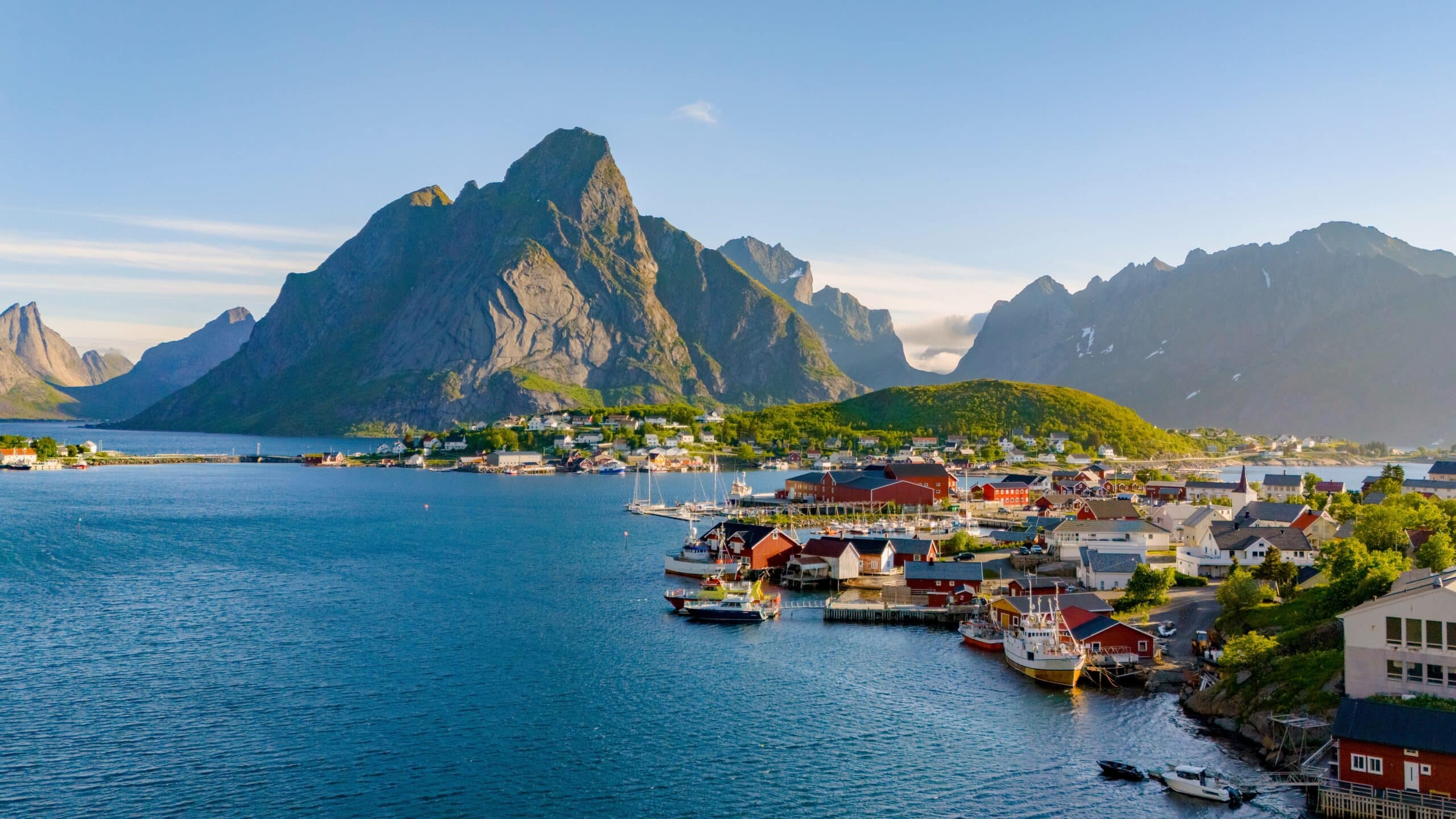
Norway occupies the western portion of the Scandinavian Peninsula in Northern Europe. Characterized by dramatic coastlines, deep fjords, mountain plateaus, and Arctic territories, the country stretches from the Skagerrak strait in the south to the Barents Sea in the far north. Its geography has profoundly shaped settlement, economy, and culture.
The capital, Oslo, lies at the head of the Oslofjord and functions as the nation’s political, economic, and cultural center. Despite its modern skyline and growing population, Oslo remains closely connected to surrounding forests and waterways, reflecting Norway’s strong relationship with nature.
Norway’s coastline, extending over 25,000 kilometers including fjords and islands, is among the most intricate in the world. Glacial activity during the Ice Age carved steep valleys later filled by seawater, forming iconic fjords such as Sognefjord and Geirangerfjord. Inland, mountain ranges and high plateaus dominate, while the Arctic archipelago of Svalbard extends Norwegian territory far north of the mainland.
Historically, Norway emerged from Viking seafaring societies that explored and traded across Europe and the North Atlantic. Later centuries saw unions with Denmark and Sweden before full independence in 1905. In the 20th century, offshore oil and gas discoveries transformed Norway into one of the world’s wealthiest nations.
Modern Norway combines advanced social welfare systems, maritime industries, renewable energy development, and strong environmental policies. Cultural traditions—including folk music, stave churches, and Sami heritage—remain central to national identity.
This edition explores Norway’s cities, fjords, Arctic settlements, and historic towns, presenting a country where natural grandeur and modern prosperity coexist within a distinctive Scandinavian framework.
30. Oslo
Oslo, Norway’s capital, lies at the northern end of the Oslofjord and is surrounded by forested hills known as Marka. Founded around 1040 and established as a capital in the 13th century, the city has evolved from a medieval trading settlement into a modern Scandinavian metropolis.
The Royal Palace, completed in the 19th century, symbolizes Norway’s constitutional monarchy. Nearby, the Storting building houses the national parliament. The revitalized waterfront district of Bjørvika features contemporary architecture, including the Oslo Opera House, whose sloping marble roof invites public access.
Oslo’s economy centers on maritime industries, energy, technology, and finance. Though oil and gas revenues shape the broader national economy, the capital increasingly emphasizes sustainability and green urban development.
Cultural institutions such as the Munch Museum and the National Museum highlight Norway’s artistic heritage. Parks, islands, and ski trails remain easily accessible, reinforcing Oslo’s integration of urban life with nature.
Public transport networks, cycling infrastructure, and environmental initiatives support a high standard of living. Oslo consistently ranks among cities with strong social welfare and environmental performance.
Oslo harmonizes political authority, cultural innovation, and natural surroundings. Its fjord setting and forested backdrop define a capital uniquely shaped by geography.
29. Bergen
Bergen, located on Norway’s southwestern coast, served as the country’s capital during the Middle Ages and became a central trading port within the Hanseatic League. Surrounded by seven mountains and opening onto the North Sea, Bergen’s maritime character remains evident.
The historic Bryggen wharf, with its colorful wooden warehouses, stands as a UNESCO-listed reminder of Hanseatic commerce. These structures once stored dried fish exported across Europe.
Fishing, shipping, and offshore energy industries continue to influence Bergen’s economy. The city also functions as a gateway to Norway’s most famous fjords, including Sognefjord and Hardangerfjord.
Frequent rainfall shapes the local climate, contributing to lush vegetation. The Fløibanen funicular carries visitors to Mount Fløyen for panoramic views of the harbor and surrounding islands.
Bergen maintains strong cultural traditions, hosting music festivals and serving as the birthplace of composer Edvard Grieg. The University of Bergen strengthens its academic profile.
Bergen harmonizes medieval trade heritage, maritime industry, and dramatic landscapes. Its harbor remains central to both history and contemporary life.
28. Trondheim
Trondheim lies along the Trondheim Fjord in central Norway. Founded in 997 by Viking King Olaf Tryggvason, it became an early political and religious center.
Nidaros Cathedral, built over the burial site of Saint Olaf, remains Norway’s most significant medieval church and a traditional coronation site for monarchs. The cathedral’s Gothic architecture reflects centuries of construction and restoration.
Trondheim developed as a trade hub connecting northern fisheries with southern markets. Timber houses along the Nidelva River illustrate its mercantile past.
Today, Trondheim is a major academic center, home to the Norwegian University of Science and Technology. Research, technology, and innovation contribute significantly to the local economy.
The city balances historical architecture with modern infrastructure. Cycling routes and public spaces enhance livability, while nearby forests and fjords offer recreation.
Trondheim harmonizes Viking origins, religious heritage, and technological advancement. Its central location strengthens connections between northern and southern Norway.
27. Stavanger
Stavanger is located on Norway’s southwestern coast and has evolved from a medieval ecclesiastical center into the country’s oil and energy capital. Founded in the 12th century, the city’s early development revolved around Stavanger Cathedral, one of Norway’s oldest preserved churches.
For centuries, fishing and fish canning defined the local economy. However, the discovery of offshore oil in the North Sea in the late 1960s transformed Stavanger into a global energy hub. Petroleum-related industries, engineering firms, and research institutions now dominate its economic landscape.
Despite rapid modernization, Stavanger preserves historical character in the Old Town (Gamle Stavanger), where white wooden houses line narrow streets. Museums dedicated to petroleum and maritime history reflect the city’s industrial evolution.
Stavanger also serves as a gateway to dramatic natural attractions, including Lysefjord and the iconic Preikestolen cliff. Outdoor tourism complements its business profile.
The city emphasizes sustainability and innovation, investing in renewable energy research and urban environmental initiatives. Cultural life thrives through festivals, galleries, and a dynamic culinary scene.
Stavanger harmonizes medieval heritage, industrial transformation, and coastal scenery. Its transition from fishing port to energy capital illustrates Norway’s broader economic shift in the 20th century.
26. Tromsø
Tromsø lies above the Arctic Circle in northern Norway and serves as a major cultural and scientific center of the Arctic region. Despite its high latitude, the city benefits from a relatively mild climate due to the Gulf Stream.
Historically a fishing and trading settlement, Tromsø gained importance during Arctic exploration in the 19th and early 20th centuries. Expeditions departing from its harbor earned it the nickname “Gateway to the Arctic.”
The Arctic Cathedral, completed in 1965, stands as a modern architectural landmark overlooking the Tromsø Sound. The city also hosts the University of Tromsø, strengthening research in Arctic science and climate studies.
Seasonal extremes define life in Tromsø. The Midnight Sun illuminates summer months, while winter brings polar night and opportunities to observe the Northern Lights. Tourism related to these natural phenomena plays a growing economic role.
Fishing, aquaculture, and marine research remain essential industries. Cultural festivals, including film and music events, reinforce Tromsø’s vibrant identity despite its remote location.
Tromsø harmonizes Arctic exploration heritage, academic research, and natural spectacle. Its position far north highlights Norway’s extensive territorial reach and maritime tradition.
25. Ålesund
Ålesund is situated on Norway’s western coast across several islands extending into the Atlantic Ocean. The city is renowned for its distinctive Art Nouveau architecture, largely the result of reconstruction after a devastating fire in 1904.
International assistance, particularly from Germany, influenced the rebuilding process, giving Ålesund its cohesive Jugendstil character. Ornamental façades, towers, and decorative motifs distinguish its urban landscape.
Fishing and maritime industries have long shaped Ålesund’s economy. The city remains one of Norway’s most important centers for seafood export and marine technology.
Its coastal setting provides direct access to fjords and islands, making Ålesund a popular stop for cruise ships and travelers exploring western Norway. The viewpoint atop Mount Aksla offers panoramic vistas of the harbor and surrounding archipelago.
Cultural institutions and aquariums emphasize maritime heritage, while educational programs support marine sciences. Urban planning integrates waterfront spaces and pedestrian-friendly areas.
Ålesund harmonizes architectural uniqueness, maritime enterprise, and island geography. Its rebuilt cityscape stands as a testament to resilience and international cooperation.
24. Kristiansand
Kristiansand lies at Norway’s southern tip along the Skagerrak strait. Founded in 1641 by King Christian IV of Denmark-Norway, the city was designed according to a Renaissance grid plan that still shapes its central layout. Its strategic coastal position made it an important trading and naval center.
Shipping, timber export, and maritime services historically drove Kristiansand’s economy. In modern times, offshore energy services, shipbuilding, and technology firms contribute to regional employment. The harbor remains active with commercial shipping and ferry connections to Denmark.
Kristiansand is known for its beaches and relatively mild summer climate compared to other Norwegian regions. The city has developed a strong tourism sector, supported by cultural festivals and family attractions. The Posebyen district preserves wooden houses that reflect 18th- and 19th-century architecture.
Educational institutions and cultural venues, including theaters and museums, support community life. Urban development projects have revitalized waterfront areas, integrating residential, commercial, and recreational spaces.
Kristiansand harmonizes Renaissance planning, maritime industry, and coastal leisure culture. Its southern location connects Norway closely with continental Europe while maintaining a distinctly Scandinavian character.
23. Bodø
Bodø is situated north of the Arctic Circle along Norway’s rugged northern coastline. Despite heavy destruction during World War II, the city was rebuilt and has grown into a key administrative and transportation hub for northern Norway.
Fishing and aquaculture dominate Bodø’s economy, supported by access to rich Arctic waters. The nearby Saltstraumen maelstrom, one of the world’s strongest tidal currents, highlights the region’s dramatic natural forces.
Bodø also functions as a gateway to the Lofoten Islands and other Arctic destinations. Its airport and port facilities enhance connectivity in a region characterized by vast distances and challenging terrain.
The city has invested in cultural infrastructure and urban development, aiming to diversify beyond fisheries and public administration. Educational institutions and research centers focus on marine biology and Arctic studies.
Bodø experiences pronounced seasonal light variation, including Midnight Sun in summer and polar night in winter. These conditions shape daily life and tourism patterns.
Bodø harmonizes postwar reconstruction, Arctic maritime economy, and northern geography. Its resilience and strategic location underscore Norway’s presence in the High North.
22. Drammen
Drammen lies southwest of Oslo along the Drammenselva River and Drammensfjord. Historically associated with timber trade and river transport, the city prospered during the 18th and 19th centuries as wood products were exported to Europe.
Industrialization introduced paper mills and manufacturing facilities, which shaped Drammen’s economic profile. Environmental degradation in the mid-20th century prompted urban renewal initiatives that later transformed the riverfront.
Today, Drammen is recognized for successful regeneration projects. Riverbanks have been redeveloped into promenades, parks, and residential areas, significantly improving quality of life. Transportation infrastructure connects the city closely to Oslo, making it an important commuter hub.
The surrounding hills and forests provide recreational opportunities, reinforcing Norway’s close relationship between urban settlement and natural environment. Cultural institutions, schools, and sports facilities contribute to civic engagement.
Drammen’s economy now emphasizes services, logistics, and regional commerce, reflecting broader national economic diversification beyond heavy industry.
Drammen harmonizes industrial heritage, environmental restoration, and suburban connectivity. Its transformation illustrates how Norwegian cities have adapted to changing economic and ecological priorities.
21. Haugesund
Haugesund is located on Norway’s southwestern coast between Bergen and Stavanger. Though relatively small in population, it holds considerable historical significance due to its association with Viking heritage and early Norwegian monarchy.
Nearby Avaldsnes is traditionally regarded as one of the oldest royal seats in Norway, linked to Viking King Harald Fairhair, who is said to have unified the country in the 9th century. This legacy has shaped Haugesund’s cultural identity, reinforced by annual Viking festivals and historical commemorations.
During the 19th century, herring fisheries drove rapid economic expansion. Processing plants and maritime trade turned Haugesund into one of Norway’s most important fishing ports. Although the herring industry declined in the 20th century, maritime services and offshore energy support the local economy today.
The city’s waterfront remains central to civic life, hosting cultural events and serving as a hub for shipping activity. The Norwegian International Film Festival, held annually, contributes to its cultural profile.
Haugesund harmonizes Viking-era symbolism, maritime enterprise, and coastal resilience. Its development reflects Norway’s enduring relationship with the sea and its historical roots in seafaring traditions.
20. Lillehammer
Lillehammer is situated in southeastern Norway along Lake Mjøsa, the country’s largest lake. Though historically a modest market town, it gained international recognition as host of the 1994 Winter Olympics.
The Olympic Games transformed Lillehammer’s infrastructure, introducing world-class sports facilities and modern transportation networks. Many venues remain in use for international competitions and recreational activities.
Tourism plays a central role in the local economy, particularly winter sports such as skiing and snowboarding. The surrounding Gudbrandsdalen valley provides natural terrain ideal for alpine and cross-country skiing.
Lillehammer also emphasizes cultural heritage. The Maihaugen open-air museum preserves traditional Norwegian buildings, illustrating rural life across centuries. Literary connections to author Sigrid Undset, who lived in the town, enhance its cultural standing.
Educational institutions and cultural festivals contribute to year-round vitality. Environmental sustainability and preservation of wooden architecture are priorities in urban planning.
Lillehammer harmonizes Olympic legacy, mountain recreation, and historical preservation. Its transformation from regional town to international winter sports destination highlights Norway’s global sporting presence.
19. Molde
Molde lies along the Romsdal Fjord in western Norway and is often referred to as the “City of Roses” due to its mild climate and horticultural traditions. Surrounded by mountain peaks, the town offers panoramic views across fjord landscapes.
Historically dependent on fishing and trade, Molde developed into an administrative and cultural center for the Romsdal region. Much of the town was destroyed during World War II, leading to postwar reconstruction with modern planning principles.
The Molde International Jazz Festival, established in 1961, is one of Europe’s oldest jazz festivals and contributes significantly to the city’s cultural reputation. Music and arts remain central to civic identity.
Marine industries, shipping, and regional services support the economy. The town also functions as a gateway to scenic attractions such as the Atlantic Ocean Road and Trollstigen mountain pass.
Molde’s waterfront promenades and cultural institutions enhance quality of life, while nearby hiking trails and fjord excursions draw visitors.
Molde harmonizes cultural vibrancy, reconstructed urban form, and dramatic natural surroundings. Its position within the fjord region underscores Norway’s balance between artistic expression and maritime tradition.
18. Harstad
Harstad is located in northern Norway on the island of Hinnøya, the country’s largest island. Positioned between the Lofoten archipelago and the mainland, the city serves as a regional hub for maritime industries and public administration in the High North.
Historically, Harstad developed around fisheries and coastal trade. Its harbor provided safe anchorage for vessels navigating Arctic waters, and fishing remains a significant contributor to the local economy. In the 20th century, oil and gas service industries expanded into the region, strengthening Harstad’s economic base.
The city played a strategic role during World War II due to its northern position and harbor facilities. Postwar reconstruction and modernization shaped much of its present-day urban landscape.
Cultural life in Harstad is marked by festivals, including arts and music events that attract participants from across northern Norway. The surrounding landscape of fjords, mountains, and islands supports outdoor recreation such as hiking, skiing, and boating.
Educational institutions and regional administrative offices enhance Harstad’s status as a service center. Infrastructure improvements, including bridges and ferry links, strengthen connectivity despite geographic challenges.
Harstad harmonizes Arctic maritime tradition, regional governance, and island geography. Its northern location underscores Norway’s strategic and economic engagement in the High North.
17. Hamar
Hamar lies along the eastern shore of Lake Mjøsa, Norway’s largest lake. Established as a medieval bishopric in the 12th century, the town became an important religious center before experiencing decline during the Reformation.
The ruins of Hamar Cathedral, protected today by a modern glass structure, represent one of Norway’s most distinctive historical sites. This combination of medieval stone and contemporary architecture illustrates the country’s approach to heritage preservation.
Agriculture dominates the surrounding Hedmark region, with grain cultivation and livestock farming supporting local prosperity. Hamar functions as a regional service center, with commerce, education, and administration contributing to the economy.
The city gained international attention as a venue during the 1994 Winter Olympics, hosting ice-skating events in the distinctive Viking Ship arena. This structure remains an important sports facility.
Waterfront development has enhanced public access to Lake Mjøsa, promoting recreation and tourism. Parks, museums, and cultural festivals contribute to community life.
Hamar harmonizes medieval ecclesiastical heritage, agricultural productivity, and modern sporting infrastructure. Its lakeside setting reinforces the integration of history and landscape in Norwegian urban identity.
16. Voss
Voss is located in western Norway between Bergen and the fjord regions, surrounded by mountains, lakes, and rivers. Historically a rural agricultural community, Voss developed into a transportation junction following the construction of railway lines in the 19th century.
Today, Voss is widely recognized as an adventure tourism destination. Winter sports, particularly alpine and freestyle skiing, attract domestic and international visitors. During summer, rafting, hiking, and paragliding utilize the area’s varied terrain.
Agriculture continues to play a role in the local economy, with dairy farming and traditional food production reflecting rural heritage. The town also hosts cultural events, including music festivals that celebrate Norwegian folk traditions.
The Vangskyrkja stone church, dating to the 13th century, highlights Voss’s medieval past. Though much of the town was damaged during World War II, reconstruction maintained its function as a regional center.
Transportation links, including rail and highway connections to Bergen and Oslo, strengthen Voss’s accessibility. Tourism infrastructure has expanded while preserving natural surroundings.
Voss harmonizes rural tradition, outdoor sport culture, and mountain landscapes. Its transformation into an adventure hub demonstrates Norway’s ability to combine heritage with modern recreation.
15. Alta
Alta is located in Finnmark county in northern Norway, well above the Arctic Circle. The town is internationally recognized for its prehistoric rock carvings, which document human presence in the region for thousands of years. These carvings depict hunting scenes, animals, and ritual activities, providing insight into early Arctic societies.
Historically, Alta’s economy relied on fishing, small-scale agriculture, and trade with indigenous Sámi communities. The region also became known for slate quarrying, and Alta slate was exported for construction purposes across Norway and beyond.
During World War II, Alta Fjord gained strategic importance when the German battleship Tirpitz was stationed nearby. The area later returned to civilian development, emphasizing fisheries and regional administration.
Today, Alta functions as a service and transportation center for western Finnmark. Tourism plays a growing role, particularly related to Northern Lights observation during winter and Midnight Sun experiences in summer. The Alta Museum preserves archaeological and cultural heritage.
Infrastructure projects, including hydroelectric power development along the Alta River, have shaped modern growth while sparking national debates over environmental protection and indigenous rights.
Alta harmonizes prehistoric heritage, Arctic environment, and contemporary regional governance. Its location highlights Norway’s northern identity and the enduring relationship between people and Arctic landscapes.
14. Narvik
Narvik lies along the Ofotfjord in northern Norway and is distinguished by its ice-free harbor, which remains operational year-round despite its high latitude. This natural advantage established Narvik as a critical export port for Swedish iron ore transported via rail from Kiruna.
The Ofoten Railway, completed in the early 20th century, transformed Narvik into an industrial hub. Its strategic importance made the city a focal point during World War II, when Allied and German forces fought for control of the port.
Postwar reconstruction modernized Narvik’s infrastructure. The economy continues to depend on mineral exports, maritime services, and transportation logistics. Port facilities remain among the most important in northern Scandinavia.
Narvik’s mountainous surroundings provide opportunities for alpine skiing and hiking. The Narvikfjellet ski area attracts visitors seeking winter sports combined with Arctic scenery.
Educational institutions and military presence contribute to local employment. Urban development has emphasized waterfront access and cultural facilities.
Narvik harmonizes industrial logistics, wartime history, and dramatic fjord landscapes. Its strategic harbor underscores Norway’s role in Arctic trade networks and international transport corridors.
13. Sandefjord
Sandefjord is located along the southeastern coast of Norway, facing the Skagerrak strait. Historically, the town gained prominence through whaling activities during the 19th and early 20th centuries. Sandefjord became one of the world’s leading centers for modern whaling expeditions.
Profits from maritime industries supported urban growth, civic institutions, and international connections. The Whaling Museum preserves artifacts and documents this period of economic expansion, while also addressing changing global attitudes toward marine conservation.
As whaling declined, Sandefjord diversified into shipping, aviation services, and commerce. The nearby Torp airport enhances regional accessibility and supports tourism.
The town’s coastal setting includes beaches, marinas, and small islands that attract recreational boating and summer visitors. Residential development has expanded while maintaining maritime character.
Cultural festivals and museums strengthen civic identity. Local businesses and service industries now form the backbone of the economy, replacing earlier reliance on whaling.
Sandefjord harmonizes maritime legacy, economic adaptation, and coastal leisure culture. Its evolution reflects broader transformations in Norway’s relationship with marine resources and international trade.
12. Arendal
Arendal is situated along Norway’s southeastern coast in Agder county, facing the Skagerrak strait. Established as a trading port in the 16th century, the town flourished during the age of sail when timber exports and shipbuilding drove economic growth. By the 19th century, Arendal had become one of Norway’s leading maritime centers.
The prosperity of this era is reflected in historic wooden houses and merchant residences that still characterize parts of the town. However, economic downturns and shifts in global shipping patterns led to periods of decline, prompting diversification in the 20th century.
Today, Arendal functions as a regional administrative center with a mixed economy based on services, maritime industries, and tourism. The harbor remains active, while nearby islands and sheltered waterways attract recreational boaters during summer.
Cultural institutions and annual festivals strengthen community life, and educational facilities contribute to regional development. Urban planning emphasizes preservation of historic districts alongside modern waterfront redevelopment.
Arendal harmonizes maritime heritage, coastal trade history, and contemporary regional services. Its sheltered archipelago setting reflects Norway’s long-standing relationship with seafaring and coastal settlement.
11. Hammerfest
Hammerfest lies in Finnmark county and is often described as one of the world’s northernmost towns. Located on the island of Kvaløya, it faces the Barents Sea and experiences extreme seasonal light variation.
Historically, Hammerfest developed as a fishing port and Arctic trading post. In the 19th century, it became one of the first towns in northern Europe to receive electric street lighting, reflecting early modernization efforts.
World War II caused extensive destruction, and the town was largely rebuilt in the postwar period. In recent decades, offshore gas development in the Barents Sea has revitalized the local economy. The nearby liquefied natural gas facility has positioned Hammerfest as a key center for Arctic energy production.
Fishing and aquaculture remain significant industries, complemented by maritime services and tourism focused on Arctic experiences. Museums and cultural centers highlight polar exploration and regional history.
Hammerfest harmonizes Arctic industry, postwar resilience, and northern maritime tradition. Its remote yet strategically important location underscores Norway’s economic engagement in the High North.
10. Florø
Florø is located on Norway’s western coast in Vestland county and is considered the westernmost town on the Norwegian mainland. Founded in the 19th century, Florø developed around fishing, shipping, and coastal trade.
The town’s harbor provides direct access to North Sea fisheries, and seafood processing remains central to its economy. Offshore energy services have also expanded, linking Florø to Norway’s broader petroleum industry.
Island landscapes and rugged coastline define the surrounding region. Boat transport connects nearby communities, reinforcing maritime connectivity.
Florø hosts cultural festivals and maintains museums dedicated to coastal life. Educational institutions and municipal services support the town’s administrative role in the region.
Although relatively small in population, Florø benefits from modern infrastructure, including an airport and ferry connections. Economic diversification continues through marine technology and renewable energy initiatives.
Florø harmonizes fishing heritage, offshore industry, and Atlantic coastal geography. Its exposed yet resilient position illustrates Norway’s adaptation to maritime conditions along the North Sea.
9. Svolvær
Svolvær is located in the Lofoten archipelago in northern Norway and serves as the administrative center of Vågan municipality. Surrounded by steep mountains rising directly from the sea, the town embodies the dramatic landscape for which Lofoten is internationally recognized.
Fishing has shaped Svolvær’s development for centuries, particularly the seasonal cod fisheries that attract boats from across northern Norway. Traditional rorbuer, or fishermen’s cabins, remain part of the harbor environment and now often accommodate visitors.
Tourism has become increasingly important, with activities including hiking, kayaking, climbing, and winter Northern Lights excursions. The nearby Svolværgeita rock formation attracts climbers seeking panoramic views of the surrounding fjords.
Cultural institutions and galleries reflect the region’s artistic traditions, inspired by Arctic light and rugged scenery. Maritime services, aquaculture, and hospitality businesses contribute to the local economy.
Svolvær harmonizes traditional fisheries, tourism growth, and island geography. Its position within Lofoten highlights Norway’s coastal identity and Arctic maritime culture.
8. Røros
Røros lies in central Norway near the Swedish border and is distinguished by its well-preserved wooden mining town. Founded in the 17th century following copper discoveries, Røros developed into one of Norway’s most important mining centers.
The harsh inland climate and remote location shaped a tightly knit community centered around the copper works. Wooden houses, smelting facilities, and narrow streets remain largely intact, reflecting centuries of industrial activity. The town is recognized for its cultural and architectural preservation.
Mining operations ceased in the late 20th century, but Røros transitioned toward heritage tourism, handicrafts, and regional food production. Traditional craftsmanship, including wool textiles and local cuisine, supports economic diversification.
The surrounding highland landscape offers opportunities for hiking and winter sports. Seasonal markets and festivals reinforce community traditions.
Røros harmonizes industrial heritage, preservation efforts, and rural mountain setting. Its transformation from mining hub to cultural destination illustrates Norway’s commitment to safeguarding historical environments.
7. Skien
Skien is situated in Telemark county along the Skienselva River. With origins tracing back to the Middle Ages, it developed as a trading center for timber and agricultural goods transported via river networks.
The city is closely associated with playwright Henrik Ibsen, who was born in Skien in 1828. His legacy contributes significantly to the city’s cultural identity, supported by museums and theaters dedicated to his work.
Industrialization brought paper mills and manufacturing facilities, strengthening Skien’s economic base. Modern industries now include services, regional administration, and light manufacturing.
Waterways continue to shape urban life, with canals and rivers integrated into recreational and transport infrastructure. Skien also serves as a gateway to the Telemark Canal, an engineering achievement linking inland waterways to the coast.
Skien harmonizes literary heritage, river trade history, and industrial adaptation. Its development reflects Norway’s inland commercial networks and cultural contributions.
6. Kongsberg
Kongsberg is located southwest of Oslo and was founded in the 17th century following the discovery of silver deposits. The establishment of silver mines transformed the town into one of Norway’s most important industrial centers of the early modern period.
The Kongsberg Silver Mines operated for over three centuries, shaping settlement patterns and technological innovation. Mining heritage remains visible through preserved tunnels and museums that document industrial history.
In the 20th century, Kongsberg diversified into advanced engineering and defense technology. High-tech industries now form the backbone of the local economy, making the town a center for aerospace and maritime systems development.
Cultural life includes annual jazz festivals and preservation of baroque-era buildings from the mining period. The surrounding forests and mountains provide opportunities for outdoor recreation.
Kongsberg harmonizes early industrial mining heritage with modern technological innovation. Its evolution demonstrates Norway’s capacity to transition from resource extraction to knowledge-based industries.
5. Grimstad
Grimstad is a coastal town in Agder county along Norway’s southern shoreline. Historically a small sailing port, it developed during the 18th and 19th centuries through shipbuilding and maritime trade. Its sheltered harbor supported timber exports and coastal commerce.
The town is closely associated with playwright Henrik Ibsen, who worked here as an apprentice pharmacist before achieving literary prominence. Cultural institutions preserve this connection and contribute to Grimstad’s identity.
Fishing, boatbuilding, and maritime services shaped early prosperity. In modern times, education, tourism, and small-scale industry support the economy. The University of Agder maintains a campus in Grimstad, strengthening research and regional development.
The archipelago just offshore attracts summer visitors, offering boating, swimming, and coastal hiking. White wooden houses line narrow streets, reflecting southern Norway’s architectural traditions.
Grimstad harmonizes maritime heritage, literary associations, and coastal leisure culture. Its combination of academic presence and historic charm sustains its role as a regional cultural center.
4. Mosjøen
Mosjøen lies along the Vefsnfjord in Nordland county, positioned between coastal waterways and inland mountain landscapes. Founded in the 19th century, it grew around trade, forestry, and river transport.
Timber processing and sawmills historically dominated the local economy, supported by access to forest resources in surrounding valleys. Later industrial diversification included aluminum production and manufacturing.
The Sjøgata district preserves wooden merchant houses from the 1800s, reflecting Mosjøen’s commercial past. Cultural festivals and community events animate these historic streets throughout the year.
Modern Mosjøen functions as a regional service hub, with healthcare, education, and retail contributing to employment. The nearby mountains and rivers support outdoor recreation such as hiking, fishing, and skiing.
Transportation routes linking northern and southern Norway enhance strategic importance. Despite its modest size, Mosjøen maintains strong local identity rooted in industry and landscape.
Mosjøen harmonizes timber heritage, industrial development, and fjord geography. Its preserved architecture and mountain surroundings reinforce Norway’s blend of commerce and nature.
3. Elverum
Elverum is located in Innlandet county along the Glomma River, Norway’s longest river. Historically, forestry and agriculture shaped the town’s development, with timber floated downstream for processing and export.
The region played a notable role during World War II when Norwegian authorities temporarily relocated government functions to Elverum during the German invasion. This event remains central to local historical memory.
Forestry continues to influence the economy, alongside education and public administration. Elverum hosts institutions specializing in teacher training and health sciences, supporting regional services.
Museums and cultural centers highlight rural traditions and wartime history. River landscapes provide opportunities for fishing, boating, and outdoor recreation.
Infrastructure improvements have strengthened connections to larger urban centers, while preserving small-town character. Residential neighborhoods integrate green spaces and river access.
Elverum harmonizes forestry tradition, national history, and inland river environment. Its strategic location along the Glomma underscores the importance of waterways in Norway’s economic development.
2. Steinkjer
Steinkjer is situated at the innermost part of the Trondheimsfjord in central Norway. Established as a trading post, it became an administrative and agricultural center for the Trøndelag region.
The surrounding fertile farmland supports dairy and grain production, making agriculture a key economic pillar. Forestry and small-scale industry complement rural enterprise.
Steinkjer experienced significant destruction during World War II and was rebuilt with modernist architectural influences. Government offices and regional institutions now anchor its economy.
Cultural life includes festivals celebrating Trøndelag traditions, music, and food. The fjord and nearby forests provide recreational opportunities for residents and visitors.
Educational institutions and public services reinforce Steinkjer’s administrative role. Urban planning emphasizes accessibility and integration with surrounding farmland.
Steinkjer harmonizes agricultural productivity, postwar reconstruction, and fjord landscape. Its central position within Trøndelag highlights Norway’s regional governance and rural vitality.
1. Odda
Odda is located at the southern end of the Sørfjord, a branch of the Hardangerfjord in western Norway. Surrounded by steep mountains and waterfalls, the town developed as both an industrial center and a gateway to dramatic natural scenery.
In the early 20th century, hydroelectric power attracted energy-intensive industries, particularly smelting and chemical production. Industrial facilities shaped the town’s economy and physical landscape for decades.
As heavy industry declined, Odda increasingly focused on tourism. It serves as an access point to hiking destinations such as Trolltunga, which draws visitors seeking panoramic views above the fjord.
Waterfalls including Låtefossen enhance the region’s scenic appeal. Modern development balances industrial heritage with environmental restoration and visitor infrastructure.
Community initiatives emphasize preservation of cultural memory while adapting to new economic realities. Local services and hospitality businesses now support growth in adventure tourism.
Odda harmonizes hydroelectric industrial legacy, mountain wilderness, and fjord geography. Its transformation reflects Norway’s broader transition from resource-based industry toward sustainable tourism and outdoor recreation.