
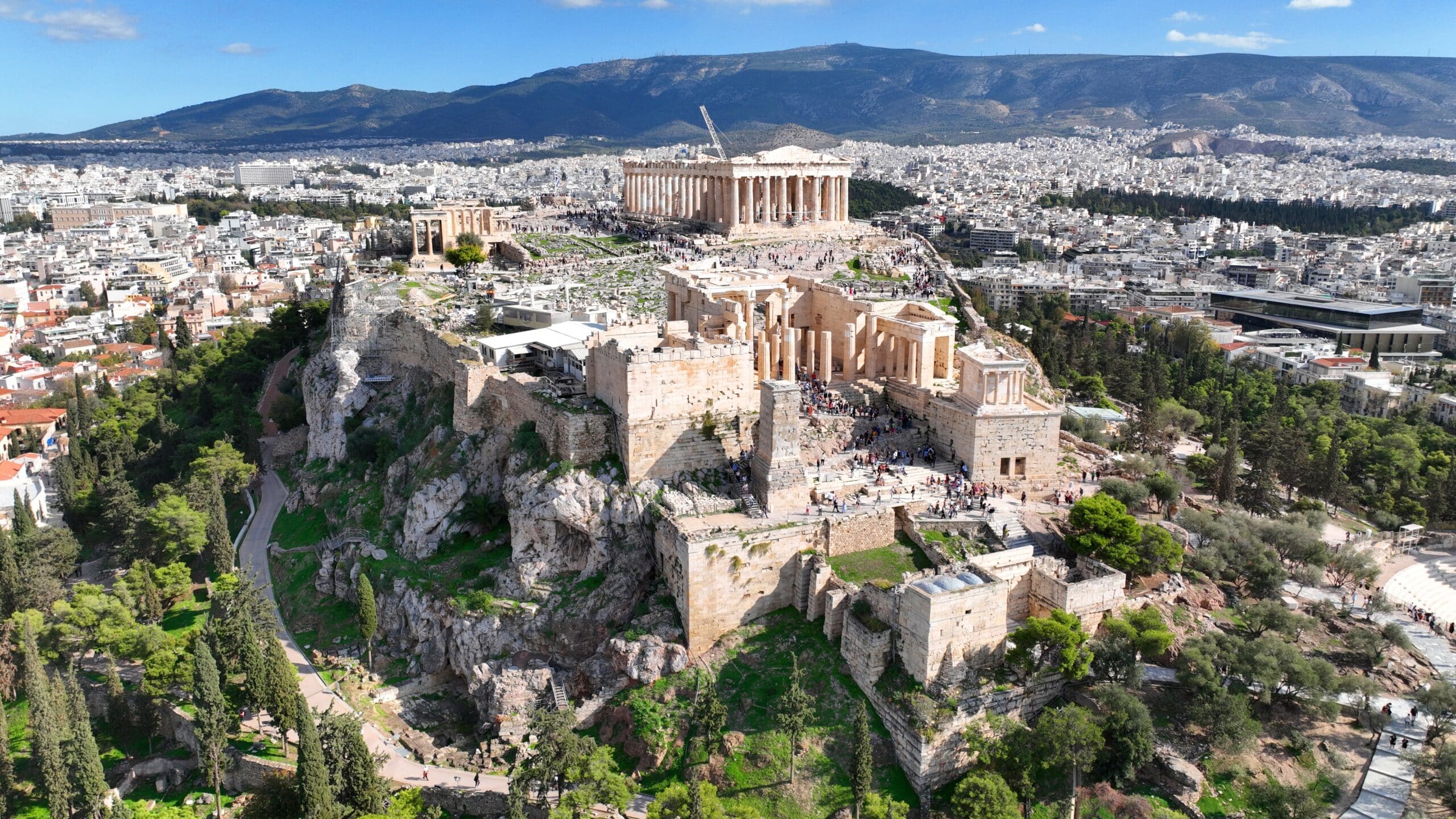
Greece is located in southeastern Europe at the crossroads of Europe, Asia, and Africa. Its geography consists of a mountainous mainland and more than 6,000 islands and islets scattered across the Aegean and Ionian Seas. This fragmented landscape has historically shaped regional identities, maritime trade networks, and economic development.
Ancient Greece laid foundational principles for Western philosophy, political theory, mathematics, and architecture. City-states such as Athens and Sparta influenced governance models that continue to resonate globally. Later integration into the Roman and Byzantine Empires, followed by centuries of Ottoman rule, produced a layered cultural heritage. Modern Greece achieved independence in the 19th century and gradually developed into a parliamentary republic.
The contemporary Greek economy combines tourism, shipping, agriculture, and services. The country possesses one of the world’s largest merchant fleets, reinforcing its maritime tradition. Tourism represents a primary economic pillar, supported by archaeological heritage, Mediterranean climate, and extensive coastline.
Agricultural production includes olive oil, citrus fruits, wine, and dairy products. Manufacturing exists but plays a secondary role compared to services. Following economic challenges in the early 21st century, structural reforms have aimed at fiscal stabilization and economic modernization.
Greece’s cultural landscape integrates ancient ruins, Byzantine monasteries, Ottoman architecture, and neoclassical urban planning. Environmental diversity ranges from alpine mountains in the north to volcanic islands in the south.
Greece harmonizes classical heritage, maritime tradition, and Mediterranean geography. Its strategic location and historical depth continue to define its national identity and economic orientation.
30. Athens
Athens, the capital of Greece, is one of the world’s oldest continuously inhabited cities. Located in the Attica region near the Aegean Sea, it has served as a political, cultural, and economic center for millennia. In antiquity, Athens became synonymous with democracy, philosophy, and classical art. Thinkers such as Socrates and Plato shaped intellectual traditions that continue to influence Western thought.
The Acropolis, crowned by the Parthenon, remains the most recognizable symbol of ancient Greek civilization. Roman, Byzantine, and Ottoman layers later enriched the city’s architectural and cultural landscape. Modern Athens emerged as the capital of the independent Greek state in the 19th century, expanding through neoclassical planning and later urbanization.
Today, Athens anchors the national economy. Services, finance, tourism, shipping administration, and government institutions concentrate in the metropolitan area. The Port of Piraeus functions as a major maritime gateway, reinforcing Greece’s global shipping presence.
Tourism remains a dominant sector, driven by archaeological heritage, museums, and Mediterranean climate. Infrastructure improvements, including metro expansion and airport modernization, have enhanced connectivity.
Athens harmonizes ancient legacy, administrative centrality, and metropolitan complexity. Its continuous historical evolution defines Greece’s political and cultural core.
29. Thessaloniki
Thessaloniki is Greece’s second-largest city and the principal urban center of northern Greece. Situated along the Thermaic Gulf, it has historically functioned as a strategic port linking the Balkans with the Aegean Sea.
Founded in the Hellenistic period, Thessaloniki flourished under Roman and Byzantine rule. Numerous early Christian monuments remain, reflecting its significance within the Byzantine Empire. Ottoman governance introduced additional architectural influences, including mosques and marketplaces.
In the modern era, Thessaloniki developed as a commercial and industrial hub. Its port supports trade with southeastern Europe, while manufacturing, logistics, and services contribute to economic activity. The presence of major universities strengthens research and education sectors.
Culturally, Thessaloniki is known for festivals, gastronomy, and diverse historical influences. Urban redevelopment projects have revitalized waterfront areas and improved transport infrastructure.
Thessaloniki harmonizes maritime trade, Byzantine heritage, and academic vitality. Its northern position reinforces Greece’s regional economic integration within the Balkans.
28. Crete
Crete is Greece’s largest island, located in the southern Aegean Sea. Its size and geographic diversity support a semi-autonomous economic and cultural profile within the country.
In antiquity, Crete was home to the Minoan civilization, one of Europe’s earliest advanced societies. Archaeological sites such as Knossos testify to its Bronze Age significance. Later Roman, Byzantine, Venetian, and Ottoman periods layered additional historical influences.
Agriculture remains central to Crete’s economy. Olive oil production, wine cultivation, and horticulture contribute significantly to exports. Tourism is equally important, supported by extensive beaches, mountain ranges, and archaeological heritage.
Regional cities such as Heraklion and Chania function as administrative and commercial centers. Ports and airports facilitate domestic and international connectivity.
Crete harmonizes ancient civilization, agricultural productivity, and large-scale tourism. Its geographic scale and economic diversity make it a foundational component of Greece’s national structure.
27. Rhodes
Rhodes is the largest island of the Dodecanese group in the southeastern Aegean Sea, located near the Turkish coast. Its strategic maritime position made it a significant commercial and military center throughout antiquity and the medieval period.
In ancient times, Rhodes was renowned for maritime trade and naval power. The Colossus of Rhodes, one of the Seven Wonders of the Ancient World, symbolized its prosperity. During the medieval era, the Knights of St. John fortified the island, leaving behind extensive defensive walls and the Palace of the Grand Master in Rhodes Town. Ottoman rule followed before integration into modern Greece in the 20th century.
Today, tourism dominates the local economy. The preserved medieval Old Town, a UNESCO World Heritage Site, attracts substantial international visitors. Coastal resorts, archaeological sites, and favorable climate extend the tourist season beyond summer months.
Agriculture, particularly olive oil and wine production, supports rural communities. Port facilities facilitate ferry connections with mainland Greece and nearby islands.
Rhodes harmonizes classical antiquity, medieval fortification, and contemporary tourism infrastructure. Its layered historical legacy and strategic geographic position continue to define its regional importance.
26. Corfu
Corfu lies in the Ionian Sea off Greece’s northwestern coast, closer to Albania than to Athens. Unlike many Aegean islands, Corfu experienced prolonged Venetian rule, which strongly influenced its architecture and cultural orientation.
The island’s Old Town reflects Italianate urban planning, with arcaded squares and fortified structures. French and British administrations later contributed to institutional and infrastructural development. These diverse influences distinguish Corfu culturally within Greece.
Agriculture historically centered on olive cultivation, which remains visible in the extensive olive groves covering much of the island. Today, tourism constitutes the primary economic sector. Coastal resorts, historic monuments, and natural landscapes attract visitors throughout the summer season.
The island’s port and airport provide international accessibility. Cultural festivals and musical traditions reflect Venetian and Ionian heritage.
Corfu harmonizes Mediterranean agriculture, European architectural influence, and service-based tourism. Its western orientation and cosmopolitan history differentiate it from eastern Aegean destinations.
25. Santorini
is a volcanic island in the southern Aegean Sea, formed by a massive eruption during the Bronze Age. The island’s caldera landscape, steep cliffs, and whitewashed settlements create one of the Mediterranean’s most recognizable environments.
Historically linked to the Minoan civilization, Santorini preserves archaeological remains at Akrotiri, often associated with advanced prehistoric urban planning. Subsequent Byzantine, Venetian, and Ottoman periods shaped settlement patterns.
Modern Santorini relies almost entirely on tourism. Luxury hospitality, cruise ship arrivals, and seasonal services dominate economic activity. The island’s limited land area intensifies development pressures and environmental management challenges.
Viticulture persists despite volcanic soil conditions, producing distinctive local wines. Infrastructure expansion, including port and airport improvements, supports high visitor volumes.
Santorini harmonizes geological uniqueness, archaeological significance, and high-end tourism specialization. Its volcanic origin and architectural uniformity distinguish it within Greece’s island landscape.
24. Mykonos
Mykonos is a Cycladic island in the central Aegean Sea, internationally recognized for its tourism-driven economy and cosmopolitan character. Historically, Mykonos was a modest maritime and agricultural community, closely linked to the nearby sacred island of Delos, an important religious center in antiquity.
For centuries, local residents relied on fishing, small-scale farming, and maritime trade. Whitewashed cubic houses and narrow streets were designed to withstand strong Aegean winds while providing defensive protection against piracy.
During the late 20th century, Mykonos transformed into one of Greece’s most prominent tourism destinations. Hospitality, nightlife, luxury accommodations, and cruise tourism now dominate the economy. Seasonal employment patterns strongly influence demographic and economic cycles.
The island’s iconic windmills and waterfront district of Little Venice symbolize its architectural identity. Strict building regulations preserve Cycladic design aesthetics despite ongoing development pressures.
Environmental sustainability remains a key challenge due to water scarcity, waste management demands, and high visitor numbers. Infrastructure modernization seeks to balance economic growth with resource limitations.
Mykonos harmonizes traditional Cycladic architecture, maritime heritage, and global tourism prominence. Its evolution from fishing community to international leisure hub illustrates Greece’s broader shift toward service-based island economies.
23. Delphi
Delphi is located on the slopes of Mount Parnassus in central Greece and was considered the spiritual center of the ancient Greek world. In antiquity, the Sanctuary of Apollo at Delphi housed the famous oracle, where political leaders and city-states sought prophetic guidance.
The site flourished between the 6th and 4th centuries BCE, becoming a major religious and cultural institution. Treasuries, temples, and a theater were constructed along the sacred way, reflecting contributions from various Greek city-states. The Pythian Games, second in importance only to the Olympic Games, were held here.
Following Roman and later Byzantine influence, Delphi gradually declined. Rediscovered in the 19th century, systematic archaeological excavation revealed extensive remains that now attract international visitors.
Tourism centered on archaeological heritage constitutes the primary economic activity in the area. The surrounding mountainous landscape supports small-scale agriculture and seasonal hospitality services.
Delphi harmonizes religious symbolism, archaeological preservation, and cultural tourism. Its historical status as a pan-Hellenic sanctuary continues to shape its global recognition.
22. Meteora
Meteora is located in central Greece near the town of Kalambaka and is renowned for its dramatic sandstone rock pillars crowned by Eastern Orthodox monasteries. The monastic community began forming in the 14th century when hermits sought isolation and spiritual retreat atop the near-inaccessible cliffs.
Monks constructed monasteries using rope systems and removable ladders to ensure protection from invasion. At its peak, more than twenty monasteries operated; today, six remain active. The site reflects both natural geological formation and human architectural adaptation.
Meteora’s monasteries preserve religious art, manuscripts, and Byzantine iconography. The site holds UNESCO World Heritage status due to its combined cultural and natural significance.
Tourism plays a central role in the regional economy. Visitors are drawn by both religious heritage and striking landscapes. Infrastructure improvements have enhanced access while raising concerns about preservation and visitor impact.
Agriculture and small-scale commerce supplement local income in nearby communities.
Meteora harmonizes geological uniqueness, monastic tradition, and heritage tourism. Its vertical landscape and spiritual legacy distinguish it among Greece’s inland cultural landmarks.
21. Nafplio
Nafplio is located in the northeastern Peloponnese along the Argolic Gulf and is widely regarded as one of Greece’s most picturesque historic towns. It served as the first capital of the modern Greek state following independence in the early 19th century.
The town’s strategic coastal position made it significant during Venetian and Ottoman periods. Fortifications such as Palamidi Fortress and Bourtzi Castle reflect centuries of military importance. Neoclassical buildings and narrow streets characterize the old town, illustrating early state formation and European architectural influence.
Today, tourism forms the core of Nafplio’s economy. Visitors are drawn by its preserved historic center, seaside promenades, and proximity to archaeological sites such as Mycenae and Epidaurus. Hospitality services, small retail businesses, and cultural tourism generate local employment.
Agriculture in the surrounding Argolis region supports citrus production and olive cultivation. Nafplio benefits from road connections to Athens and other Peloponnesian cities, enhancing accessibility.
Urban preservation efforts aim to maintain architectural integrity while accommodating modern tourism demand. Seasonal visitor flows shape economic activity.
Nafplio harmonizes early modern Greek statehood, Venetian fortifications, and coastal tourism. Its administrative legacy and preserved urban character distinguish it within the Peloponnese.
20. Olympia
Olympia is situated in the western Peloponnese and is globally recognized as the birthplace of the ancient Olympic Games. In antiquity, it functioned as a major religious sanctuary dedicated to Zeus.
The Olympic Games were first recorded in 776 BCE and became a pan-Hellenic institution, fostering political and cultural unity among Greek city-states. Monumental structures, including the Temple of Zeus and the ancient stadium, highlight the site’s architectural and symbolic importance.
Following Roman rule and eventual decline, Olympia was rediscovered through archaeological excavation in the 19th century. Today, the site and its museum form a central component of Greece’s cultural heritage tourism.
The modern town supports visitors through hospitality services and cultural infrastructure. Agriculture in the surrounding region includes olive oil production and small-scale farming.
Olympia continues to hold symbolic international relevance. The Olympic flame ceremony for the contemporary Olympic Games is conducted here before each edition.
Olympia harmonizes athletic heritage, religious tradition, and archaeological preservation. Its enduring global symbolism strengthens Greece’s cultural identity and international presence.
19. Zakynthos
Zakynthos, also known as Zante, lies in the Ionian Sea west of the Peloponnese. The island’s fertile plains and rugged coastline have shaped both its agricultural and tourism-based economy.
Venetian rule significantly influenced Zakynthos’ cultural development, evident in music, architecture, and administrative traditions. Earthquakes in the 20th century damaged much of the historic urban fabric, leading to reconstruction efforts.
Today, tourism is the island’s dominant economic sector. Notable natural attractions such as Navagio Beach and the Blue Caves draw international visitors. Seasonal tourism generates employment in hospitality, transport, and recreation services.
Agriculture remains important, particularly olive cultivation and wine production. Environmental conservation efforts focus on protecting marine ecosystems, including habitats of the endangered loggerhead sea turtle.
Zakynthos benefits from ferry links and an international airport that supports high visitor volumes during summer months.
Zakynthos harmonizes Ionian cultural influence, coastal tourism, and agricultural tradition. Its scenic landscape and ecological significance position it prominently within western Greece’s island destinations.
18. Chania
Chania is located on the northwestern coast of Crete and serves as one of the island’s principal urban centers. Its history reflects successive Minoan, Roman, Byzantine, Venetian, and Ottoman influences, resulting in a layered architectural and cultural landscape.
The Venetian harbor remains the city’s most recognizable landmark, surrounded by fortifications, arsenals, and narrow alleys. Ottoman mosques and later neoclassical buildings illustrate the city’s transitional periods. Chania also played a strategic role during the Second World War due to Crete’s geographic position in the eastern Mediterranean.
Today, tourism is central to Chania’s economy. Visitors are attracted by its preserved old town, nearby beaches, and access to natural landmarks such as the Samaria Gorge. Hospitality services, retail trade, and gastronomy dominate employment.
Agriculture in the surrounding region includes olive oil production, citrus cultivation, and wine. The port and airport enhance connectivity with mainland Greece and international markets.
Chania harmonizes Venetian maritime heritage, Cretan agricultural productivity, and modern tourism infrastructure. Its historical continuity and natural environment reinforce its significance within Crete and the broader Greek economy.
17. Patras
Patras is situated in western Greece along the Gulf of Patras and functions as the country’s primary gateway to Italy and Western Europe. Historically important during Roman times, the city developed around trade and maritime commerce.
The presence of Roman ruins and Byzantine churches reflects its long-standing urban status. In the 19th century, Patras expanded as an export center for currants and agricultural goods, strengthening its commercial identity.
Today, Patras remains a major port city, facilitating ferry connections and international trade. Industry, logistics, higher education, and services form the economic base. The University of Patras contributes to research and technological development.
The city is also known for hosting Greece’s largest carnival, reinforcing cultural tourism. Infrastructure improvements, including bridge connections to central Greece, enhance regional integration.
Patras harmonizes maritime commerce, academic presence, and industrial activity. Its strategic western location positions it as a vital transport and economic node within Greece.
16. Hydra
Hydra is a small island in the Saronic Gulf, historically known for its maritime prominence during the Greek War of Independence. Its rocky terrain limited agricultural development, encouraging residents to focus on shipping and trade.
During the 18th and early 19th centuries, Hydra developed a powerful merchant fleet that played a decisive role in the struggle for independence. Wealth generated from maritime commerce financed neoclassical mansions that still dominate the island’s architecture.
Modern Hydra prohibits motor vehicles within its main settlement, preserving a distinctive urban character. Tourism now constitutes the primary economic activity, centered on heritage preservation, art galleries, and boutique accommodations.
The island attracts visitors seeking cultural authenticity rather than mass tourism. Seasonal population changes influence local economic rhythms.
Hydra harmonizes maritime legacy, architectural preservation, and controlled tourism development. Its historical role in Greek independence and its preserved built environment distinguish it within the Saronic islands.
15. Kalamata
Kalamata is located in the southern Peloponnese along the Messinian Gulf. The city developed historically as an agricultural and maritime center, benefiting from fertile plains and access to sea trade routes.
In medieval times, Kalamata was influenced by Byzantine and later Venetian rule. Its strategic position in the Peloponnese gave it defensive importance, visible in the remains of its hilltop castle. The city also played a notable role during the Greek War of Independence in the early 19th century.
Today, Kalamata is internationally associated with olive production. Kalamata olives and olive oil represent significant export products, supporting regional agriculture and food processing industries. The surrounding Messinian plain remains one of Greece’s most productive agricultural zones.
Tourism has expanded in recent decades, supported by beaches, cultural festivals, and improved airport infrastructure. While agriculture remains foundational, services and hospitality increasingly contribute to employment.
Transport links connect Kalamata to Athens and other Peloponnesian cities. Seasonal economic variation reflects tourism cycles.
Kalamata harmonizes agricultural specialization, historical heritage, and moderate tourism development. Its combination of export-oriented food production and coastal attractiveness defines its contemporary role within southern Greece.
14. Naxos
Naxos is the largest island in the Cyclades and lies in the central Aegean Sea. Unlike several neighboring islands that rely almost entirely on tourism, Naxos retains a strong agricultural base.
Historically, Naxos prospered during antiquity due to marble resources and strategic maritime positioning. Venetian influence during the medieval period introduced fortified settlements and administrative structures that shaped the island’s urban layout.
Agriculture remains central to the local economy. The island produces potatoes, citrus fruits, olives, and dairy products. Fertile valleys and relatively abundant water resources distinguish Naxos within the Cycladic region.
Tourism has grown steadily but remains less intensive than on islands such as Mykonos or Santorini. Visitors are attracted by beaches, mountain villages, archaeological sites, and traditional architecture. The Portara, a monumental marble gateway from antiquity, symbolizes the island’s classical past.
Ferry connections and a regional airport facilitate accessibility. Development strategies aim to balance tourism growth with preservation of agricultural identity.
Naxos harmonizes agricultural resilience, historical continuity, and sustainable tourism. Its diversified economy differentiates it within the Cyclades archipelago.
13. Ioannina
Ioannina is situated in northwestern Greece beside Lake Pamvotis and is the administrative center of the Epirus region. Surrounded by mountains, the city historically functioned as a cultural and commercial hub in inland Greece.
During the Ottoman period, Ioannina gained prominence under the rule of Ali Pasha, becoming a regional political and economic center. The lakeside fortress and preserved old quarter reflect this era. Byzantine churches and later urban structures illustrate diverse historical layers.
Today, Ioannina’s economy is driven by education, public administration, small-scale industry, and tourism. The University of Ioannina contributes to academic and research activity. Visitors are drawn to the lakeside setting, museums, and nearby mountainous landscapes.
Agriculture and livestock farming support the surrounding rural region. Improved road networks have enhanced connectivity to Thessaloniki and western Greece.
Ioannina harmonizes Ottoman heritage, academic presence, and mountainous geography. Its inland location and cultural depth distinguish it from Greece’s predominantly coastal urban centers.
12. Skiathos
Skiathos is a small island in the Sporades archipelago in the northwestern Aegean Sea. Despite its limited size, it has developed into a significant tourism destination due to its extensive sandy beaches and accessible location.
Historically, Skiathos maintained a maritime orientation, with shipbuilding and seafaring forming core economic activities. The island also played a role during the Greek War of Independence. Traditional architecture, including whitewashed houses and narrow streets, reflects typical Aegean settlement patterns.
In the late 20th century, Skiathos transitioned toward a service-based economy centered on tourism. Seasonal visitors, especially from northern Europe, contribute substantially to local income. Hospitality services, small-scale retail, and transport form the backbone of economic activity.
The island’s airport enhances international accessibility, while ferry links connect Skiathos to neighboring islands and mainland ports. Environmental management remains essential due to coastal development pressures and seasonal population increases.
Skiathos harmonizes maritime tradition, beach tourism, and compact island infrastructure. Its manageable scale and natural coastline position it as a prominent yet geographically contained tourism economy within the Sporades.
11. Monemvasia
Monemvasia is located on the southeastern coast of the Peloponnese and is built on a rocky islet connected to the mainland by a narrow causeway. Its strategic maritime position made it a fortified settlement of considerable importance during Byzantine and Venetian periods.
The medieval town is enclosed within defensive walls and contains narrow cobbled streets, churches, and preserved stone houses. Monemvasia flourished as a commercial and defensive outpost, controlling maritime routes in the eastern Mediterranean.
Following periods of Ottoman and Venetian rule, the town gradually declined in economic importance. In recent decades, restoration projects have revitalized Monemvasia as a heritage tourism destination.
Tourism now drives the local economy, focusing on historical preservation, boutique accommodations, and cultural heritage. Viticulture in the surrounding region contributes to agricultural production, particularly sweet wines historically associated with the area.
Monemvasia harmonizes medieval fortification, coastal geography, and heritage-based tourism. Its preserved architectural fabric and dramatic setting distinguish it among Greece’s historic settlements.
10. Kavala
Kavala is situated in northern Greece along the Aegean coast and functions as a key port city in the region of Eastern Macedonia. Its amphitheatrical urban layout rises from the harbor toward a historic acropolis.
During antiquity, nearby settlements played roles in trade and military campaigns. Under Ottoman rule, Kavala developed as a commercial center, particularly for tobacco processing and export. Architectural remnants, including aqueducts and warehouses, illustrate its economic past.
Today, Kavala’s economy combines port operations, energy-related activity, fisheries, and tourism. The harbor supports commercial shipping and ferry connections to nearby islands such as Thasos. Industrial and logistical functions remain important to regional development.
Tourism has grown steadily, driven by beaches, historical sites, and proximity to archaeological landmarks such as Philippi. Cultural festivals and coastal recreation enhance the city’s profile.
Kavala harmonizes maritime commerce, industrial legacy, and coastal tourism. Its northern geographic position and diversified economic structure differentiate it from Greece’s island-dominated destinations.
9. Thasos
Thasos is located in the northern Aegean Sea near the coast of Eastern Macedonia. Known for its forested landscape and marble resources, the island has maintained economic activity since antiquity.
Ancient Thasos prospered through gold mining and marble extraction, supporting trade networks across the Aegean. Archaeological remains, including an ancient theater and city walls, reflect its early significance.
In modern times, marble quarrying continues to contribute to local industry, though tourism has become the dominant economic sector. Beaches, mountain villages, and accessible ferry connections attract visitors primarily from mainland Greece and neighboring Balkan countries.
Agriculture remains relevant, with olive oil production forming an important export product. Seasonal tourism influences employment patterns, particularly in hospitality and retail services.
Thasos harmonizes natural resources, classical heritage, and moderate tourism development. Its northern location and diversified economic base distinguish it from more heavily commercialized Aegean islands.
8. Arachova
Arachova is a mountain town located on the slopes of Mount Parnassus in central Greece. Traditionally dependent on pastoralism and textile craftsmanship, it has transformed into a prominent winter tourism destination.
Historically, Arachova supported regional trade through wool production and agriculture adapted to mountainous terrain. Its proximity to Delphi strengthened cultural and economic connections.
Today, winter sports drive the local economy. The nearby Parnassos Ski Center attracts domestic visitors during the colder months, while summer tourism benefits from mountain hiking and cultural excursions.
The town retains traditional stone architecture and local handicrafts, contributing to its distinctive character. Hospitality services, restaurants, and seasonal businesses dominate employment.
Improved road infrastructure links Arachova to Athens, increasing weekend tourism flows. Economic activity fluctuates seasonally, with winter representing peak revenue.
Arachova harmonizes mountain geography, winter recreation, and preserved rural identity. Its transition from agricultural settlement to alpine tourism hub reflects diversification within Greece’s inland regions.
7. Lesbos
Lesbos, located in the northeastern Aegean near the Turkish coast, is one of Greece’s largest islands. Its varied terrain includes fertile plains, volcanic landscapes, and extensive olive groves.
Historically significant in antiquity as the birthplace of the poet Sappho, Lesbos developed as a center of culture and trade. During Ottoman rule, olive oil production expanded, shaping the island’s agricultural economy.
Today, olive cultivation remains central to economic activity. The island also produces ouzo and dairy products. Tourism contributes significantly, though it remains less intensive than on southern islands.
The island has faced migration-related challenges due to its geographic proximity to Asia Minor, influencing infrastructure and public services.
Lesbos harmonizes agricultural tradition, literary heritage, and strategic geographic position. Its diversified landscape and historical depth shape its regional importance.
6. Syros
Syros is located in the central Cyclades and serves as the administrative capital of the South Aegean region. Unlike many Cycladic islands, Syros developed into an industrial and commercial center during the 19th century.
The port town of Ermoupoli became a major shipbuilding and trade hub following Greek independence. Neoclassical mansions, theaters, and public buildings reflect this period of economic prosperity.
Shipyards and maritime services continue to contribute to the local economy, alongside tourism and administrative functions. Cultural events and preserved architecture attract visitors interested in heritage rather than mass beach tourism.
Syros maintains ferry connectivity with numerous Aegean islands, reinforcing its logistical role. Small-scale manufacturing and services complement port operations.
Syros harmonizes industrial heritage, administrative importance, and cultural tourism. Its historical urban development distinguishes it within the Cyclades.
5. Chios
Chios is located in the northeastern Aegean Sea near the coast of Asia Minor. Historically significant for maritime trade and agricultural production, the island has maintained a distinct regional identity shaped by both Greek and Ottoman influences.
In antiquity, Chios was known for commerce and cultural development. During the medieval period, it gained prominence through the cultivation of mastic, a resin derived from local trees that remains a protected and economically valuable product. The unique production of mastic continues to differentiate Chios within Greece’s agricultural sector.
The island’s medieval villages, particularly those characterized by fortified architecture, reflect historical security concerns and Genoese influence. Chios also played a notable role in the Greek War of Independence, an event that significantly affected its demographic and economic structure.
Today, the economy combines agriculture, shipping, and moderate tourism. Olive oil, citrus fruits, and mastic contribute to exports, while ferry connections support trade and travel. Tourism remains less intensive compared to other Aegean islands, attracting visitors interested in heritage and traditional village life.
Chios harmonizes maritime tradition, specialized agriculture, and historical resilience. Its economic identity remains closely linked to mastic cultivation and seafaring expertise.
4. Paros
Paros lies in the central Cyclades and has long been recognized for its high-quality marble, widely used in ancient Greek sculpture. Its strategic location facilitated trade across the Aegean Sea.
Historically, Paros prospered through quarrying and maritime activity. The island’s marble contributed to major classical monuments, reinforcing its economic and cultural influence in antiquity.
Modern Paros relies primarily on tourism, supported by sandy beaches, whitewashed settlements, and ferry connectivity. Hospitality, retail, and recreational services dominate employment. Seasonal tourism significantly shapes economic cycles.
Agriculture remains present, including wine production and olive cultivation. Infrastructure development, including port facilities and a regional airport, has strengthened accessibility.
Paros harmonizes classical resource heritage, Cycladic architecture, and modern tourism expansion. Its balanced development distinguishes it within the Cyclades region.
3. Volos
Volos is a coastal city in central Greece situated along the Pagasetic Gulf. It serves as a major port and industrial center connecting mainland Greece with the Sporades islands.
Historically linked to ancient Iolcos and mythological traditions associated with Jason and the Argonauts, Volos expanded significantly in the 19th century as a commercial and manufacturing hub. Tobacco processing, textiles, and food production supported industrial growth.
Today, the port remains central to economic activity, handling cargo and ferry services. Manufacturing, agriculture from the surrounding Thessalian plain, and educational institutions contribute to employment.
Volos also functions as a gateway to Mount Pelion, supporting tourism focused on mountain villages and coastal resorts. Urban infrastructure integrates port operations with residential and commercial zones.
Volos harmonizes industrial capacity, maritime logistics, and regional tourism. Its diversified economic base reinforces its strategic importance in central Greece.
2. Tinos
Tinos is located in the northern Cyclades and is widely recognized as a major religious pilgrimage destination in Greece. The Church of Panagia Evangelistria attracts visitors annually, reinforcing the island’s spiritual significance.
Historically, Tinos developed distinctive marble craftsmanship traditions. Artisan villages and sculptural heritage remain integral to local identity. Agriculture, including pigeon houses used historically for fertilizer production, reflects adaptive rural practices.
Tourism combines pilgrimage activity with beach visitation and cultural exploration. Unlike some neighboring islands, Tinos maintains a quieter profile with emphasis on tradition and craftsmanship.
Ferry connections support steady visitor flow, particularly during religious festivals. Seasonal economic patterns align with pilgrimage cycles.
Tinos harmonizes religious heritage, marble artistry, and moderate tourism development. Its spiritual and artisanal character differentiates it within the Cyclades.
1. Halkidiki
Halkidiki is a three-pronged peninsula in northern Greece extending into the Aegean Sea. Known for its diverse coastline and forested interior, it has developed into a major tourism region.
Historically agricultural and maritime, Halkidiki includes settlements influenced by Byzantine and later Ottoman rule. The region is also home to Mount Athos, an autonomous monastic community of global Orthodox significance.
Tourism constitutes the primary economic sector, particularly along the peninsulas of Kassandra and Sithonia. Resorts, holiday homes, and seasonal services generate employment. Agriculture, including olive production and honey cultivation, supplements income.
Proximity to Thessaloniki enhances accessibility, encouraging domestic and international tourism. Infrastructure development supports large visitor volumes during summer months.
Halkidiki harmonizes coastal tourism, monastic tradition, and agricultural productivity. Its geographic diversity and proximity to northern urban centers reinforce its economic prominence within Greece.