
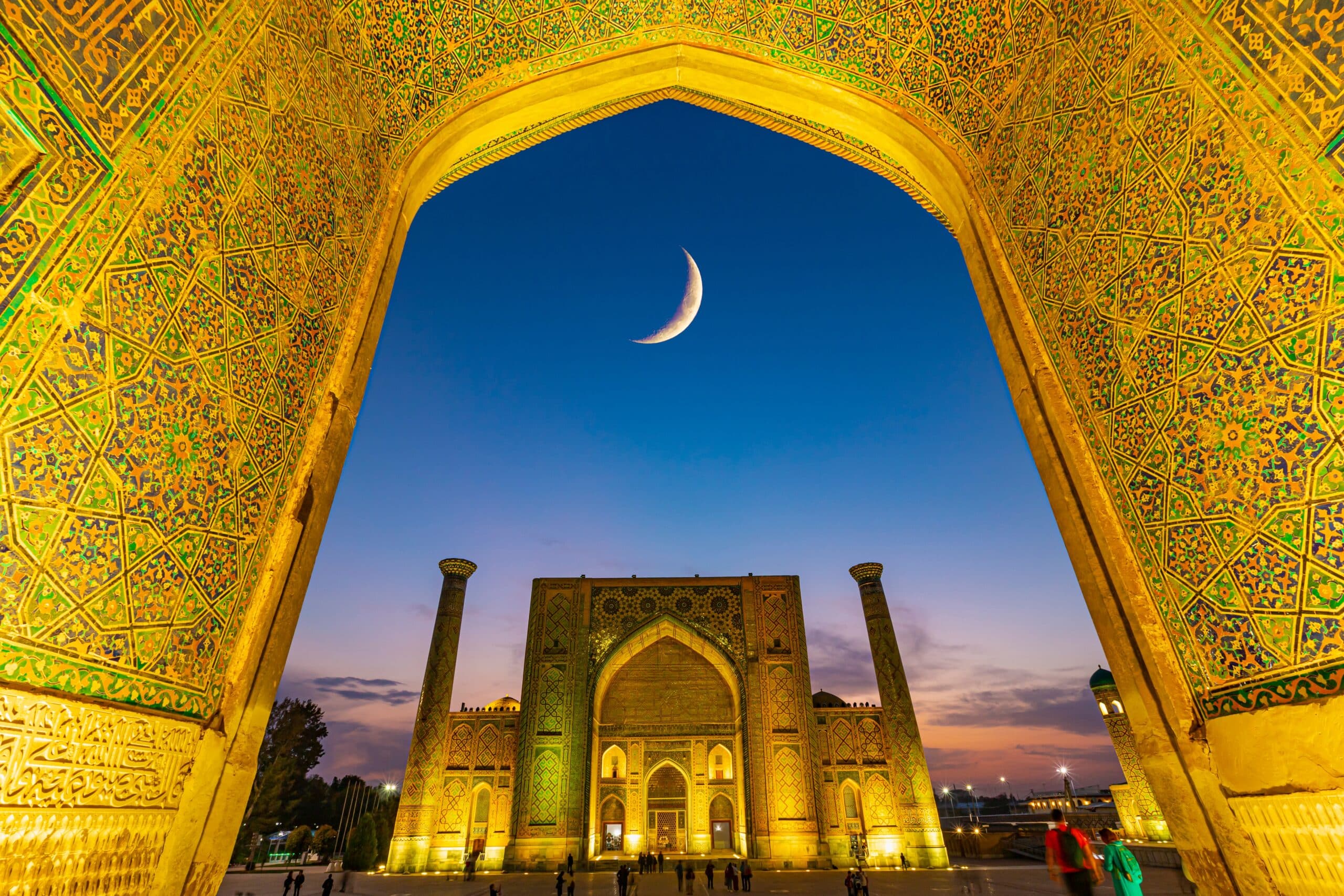
Uzbekistan sits at the heart of Central Asia, where deserts, river valleys, and ancient cities form a landscape shaped as much by movement as by settlement. Geography here is connective rather than confining. The land opens outward across plains and basins, inviting passage, exchange, and continuity. Unlike the vertical drama of its mountain neighbors, Uzbekistan’s terrain emphasizes horizontality, distance, and flow.
Two great rivers, the Amu Darya and the Syr Darya, anchor the country’s geography. Their valleys carve life into otherwise arid land, shaping agriculture, cities, and memory. Settlement gathers along water, reinforcing a long-standing relationship between movement and sustenance. Geography does not isolate; it links. Routes emerge naturally across open terrain, reinforcing Uzbekistan’s historic role as a crossroads.
Deserts define much of the country, but they are not empty. Geography here teaches endurance through scale and exposure. Life adapts by clustering around oases, rivers, and cultivated corridors. The land encourages planning, foresight, and long-term alignment with climate and distance rather than immediate abundance.
Uzbekistan’s inspiration lies in continuity. The geography supports cities that endure through centuries by remaining rooted in trade routes and water systems. Movement across the land feels expansive rather than restrictive, shaped by horizons instead of barriers. Travel becomes an experience of rhythm, where distance unfolds gradually and memory accumulates through repetition.
This is a country where geography supports permanence through openness. Endurance emerges not from resisting the land, but from understanding its breadth and limits. Uzbekistan invites reflection on how resilience can grow across wide spaces, sustained by rivers, routes, and the quiet discipline of living where land rewards patience, connection, and continuity over time.
21. Samarkand
Samarkand lies in eastern Uzbekistan where the Zeravshan River spreads fertility across otherwise arid land. Geography here is foundational. Water transforms plain into permanence, allowing settlement to anchor itself across centuries of movement and exchange.
The city’s position along historic routes reflects the land’s openness. Geography encourages convergence rather than enclosure. Plains stretch outward, inviting passage, while the river offers continuity. Samarkand exists because the land allows both movement and settlement to coexist.
Movement through the city mirrors this balance. Streets extend across gentle terrain, reinforcing openness rather than compression. Geography supports orientation through horizon and distance instead of elevation.
Samarkand inspires through continuity. The land teaches endurance through rootedness, showing how resilience can develop where geography supports long-term habitation. The city’s survival reflects alignment with water, soil, and route rather than resistance to terrain.
Here, endurance is cumulative. Geography allows memory to layer itself through repeated use of space. Samarkand demonstrates how resilience grows not from isolation, but from remaining open while grounded.
The city reflects an Uzbekistan shaped by flow. Geography sustains life through access and repetition, reminding visitors that endurance can emerge where land supports both passage and permanence.
20. Bukhara
Bukhara rises from western Uzbekistan’s desert margins, sustained by ancient irrigation and groundwater. Geography here is restrained but intentional. The surrounding aridity sharpens the importance of water, shaping settlement through careful management rather than abundance.
The city exists because geography allows concentration. Water channels and wells transform desert into habitation. Geography enforces discipline, rewarding foresight and cooperation.
Movement through Bukhara is contained. Streets cluster tightly, reflecting adaptation to climate and exposure. Geography shapes density, reinforcing proximity and continuity.
Bukhara inspires through restraint. The land teaches endurance through conservation, showing how resilience develops where geography demands precision and stewardship.
The city reflects an Uzbekistan where survival depends on attentiveness. Geography does not offer ease; it offers possibility to those who align carefully with its limits.
Here, endurance is deliberate. Geography reminds visitors that resilience often grows strongest where land allows little margin for waste, shaping life through sustained balance between scarcity and continuity.
19. Khiva
Khiva stands near the lower Amu Darya, where desert and river define sharp contrast. Geography here is binary. Fertile corridors exist beside vast aridity, shaping settlement as a deliberate act of preservation.
The river sustains life in an otherwise hostile environment. Geography restricts expansion, encouraging enclosure and density. Walls historically reinforced the land’s limits rather than defying them.
Movement within Khiva reflects containment. Streets fold inward, emphasizing protection from exposure. Geography prioritizes shelter and continuity over outward growth.
Khiva inspires through survival. The land teaches endurance through careful enclosure, showing how resilience emerges when communities consolidate rather than expand.
The city reflects an Uzbekistan shaped by adaptation to extremes. Geography demands constant awareness of water, climate, and boundary.
Here, endurance is architectural and spatial. Geography reminds visitors that resilience can be built through form, density, and respect for land that sustains life only within narrow conditions.
18. Tashkent
Tashkent lies in northeastern Uzbekistan at the meeting point of plains and foothills, where open land begins to rise toward the Tian Shan range. Geography here is transitional. The city occupies a space between steppe and mountain, shaped by access rather than enclosure.
Water and terrain support expansion. Geography allows the city to spread outward, creating broad avenues and open districts. Unlike desert cities shaped by scarcity, Tashkent reflects abundance of space and connection.
Movement through the city feels horizontal. Roads extend across flat ground, reinforcing continuity and ease. Mountains remain visible but distant, shaping climate and orientation without imposing constraint. Geography supports circulation rather than resistance.
Tashkent inspires through adaptability. The land teaches endurance through flexibility, showing how resilience can grow where geography allows rebuilding and reconfiguration. The city’s form reflects repeated adjustment rather than fixed permanence.
Here, endurance is civic rather than monumental. Geography supports renewal by offering space to reorganize after disruption. Tashkent demonstrates how resilience can be expressed through openness and capacity for change.
The city reflects an Uzbekistan where geography enables continuity through reinvention. Visitors encounter a landscape that allows life to reorganize without severing connection to place, reminding that endurance often depends on space to adapt rather than walls to protect.
17. Fergana Valley
The Fergana Valley stretches across eastern Uzbekistan, enclosed by mountains yet expansive within its basin. Geography here is fertile and concentrated. Rivers descend from surrounding ranges, spreading water across broad plains that support dense settlement.
Agriculture defines the valley. Geography offers soil, water, and climate conducive to cultivation, shaping life through productivity and repetition. The land rewards sustained engagement rather than exploration.
Movement through the valley follows agricultural corridors. Roads and towns cluster along watercourses, reinforcing continuity through access. Geography shapes rhythm through seasons rather than elevation.
The Fergana Valley inspires through continuity. The land teaches endurance through cultivation, showing how resilience can grow from long-term stewardship rather than mobility.
Here, density strengthens identity. Geography allows communities to persist closely together, shaping shared reliance on land and water. Endurance is collective, reinforced by proximity and shared resource management.
The valley reflects an Uzbekistan where geography sustains life through abundance tempered by responsibility. Visitors encounter a landscape that emphasizes care, memory, and repetition, reminding that resilience often grows strongest where land invites people to stay rather than pass through.
16. Nuratau Mountains
The Nuratau Mountains rise between desert plains and river valleys in central Uzbekistan, forming a modest but distinct range. Geography here is interruptive. The mountains break the flatness of surrounding land, creating pockets of elevation and refuge.
Slopes support limited agriculture and pasture. Geography restricts scale, encouraging small settlements adapted to terrain. Life here is shaped by moderation rather than extremes.
Movement through Nuratau follows passes and valleys. Roads wind gently, reinforcing awareness of contour and slope. Geography slows travel, turning passage into observation rather than transit.
The Nuratau Mountains inspire through balance. The land teaches endurance through coexistence with limitation, showing how resilience can develop where geography offers neither full openness nor severe confinement.
Here, endurance is quiet. Geography supports persistence through manageable challenge, shaping life through steady adaptation rather than survival pressure.
The range reflects an Uzbekistan where geography introduces variation without domination. Nuratau reminds visitors that resilience does not always arise from harshness; it can also grow from landscapes that encourage attentiveness, restraint, and long-term alignment with land that offers just enough.
15. Shahrisabz
Shahrisabz lies south of Samarkand at the edge of the Gissar foothills, where plains rise gradually toward mountain terrain. Geography here is transitional and grounding. The land provides both openness and protection, shaping settlement through balance.
Water descends from nearby highlands, allowing cultivation across surrounding fields. Geography supports agriculture without excess, encouraging continuity rather than expansion. The city exists because the land sustains repetition over time.
Movement through Shahrisabz reflects this stability. Streets spread across relatively flat ground, while hills frame the horizon. Geography offers orientation without confinement, reinforcing calm progression rather than urgency.
Shahrisabz inspires through rootedness. The land teaches endurance through continuity, showing how resilience can develop where geography supports long-term habitation without dramatic constraint.
Here, endurance is historical and spatial. Geography allows memory to accumulate through use of the same corridors, fields, and routes across generations. The city’s persistence reflects alignment with land that rewards steadiness.
Shahrisabz reflects an Uzbekistan where geography enables permanence without rigidity. Visitors encounter a landscape that encourages staying, remembering, and building endurance through repetition rather than adaptation to extremes.
14. Zarafshan Desert
The Zarafshan Desert stretches west of the Zeravshan River, forming a dry expanse shaped by aridity and distance. Geography here is expansive and sparse. The land offers little shelter, emphasizing exposure and scale.
Life clusters at the margins. Geography restricts habitation to areas where water or movement intersects desert space. The land enforces selectivity, shaping endurance through careful positioning rather than widespread settlement.
Movement across the Zarafshan Desert is directional. Routes follow known paths between water sources and towns. Geography demands planning, making distance a measured commitment rather than casual passage.
The desert inspires through austerity. The land teaches endurance through restraint, showing how resilience emerges where geography permits movement but discourages permanence.
Here, endurance is navigational. Geography reinforces awareness of orientation, timing, and supply. Survival depends on knowledge rather than strength.
The Zarafshan Desert reflects an Uzbekistan where geography emphasizes limits without total exclusion. Visitors encounter a landscape that sharpens perception, reminding that resilience often grows from understanding when and how to cross land that offers little margin for error.
13. Aral Sea Region
The Aral Sea region lies in northwestern Uzbekistan, where water once defined geography and now defines absence. The land is flat and exposed, shaped by former shorelines and retreating water.
Geography here is transitional and revealing. Salt flats, residual channels, and abandoned ports reflect change imposed on landscape and life. The land bears memory through form rather than function.
Movement across the region feels open yet disorienting. Roads traverse wide terrain with few markers. Geography emphasizes scale and emptiness, reshaping perception of distance and purpose.
The Aral region inspires through reflection. The land teaches endurance through adaptation to loss, showing how resilience must respond to altered geography rather than restore the past.
Here, endurance is environmental and communal. Geography forces reconsideration of livelihood, settlement, and movement. Life persists by adjusting to new conditions imposed by the land’s transformation.
The Aral Sea region reflects an Uzbekistan where geography speaks plainly about consequence and persistence. Visitors encounter a landscape that demands reflection, reminding that endurance is not only about surviving terrain, but about continuing within landscapes permanently changed by time and use.
12. Termez
Termez lies in southern Uzbekistan along the Amu Darya, where the river forms both a lifeline and a boundary. Geography here is liminal. The land marks an edge, shaped by water, heat, and historical passage between regions.
The river defines settlement. Geography supports life through flow rather than abundance, sustaining agriculture and movement along its banks. Beyond the river corridor, aridity reasserts itself quickly, reinforcing reliance on this narrow zone.
Movement through Termez follows linear paths parallel to water. Roads and fields align with the river’s direction, reinforcing orientation through flow. Geography emphasizes continuity rather than enclosure.
Termez inspires through transition. The land teaches endurance through adaptability at borders, showing how resilience can grow where geography positions life between systems rather than within a single core.
Here, endurance is relational. Geography shapes identity through connection to routes, crossings, and exchange. The city persists because it remains aligned with movement rather than isolation.
Termez reflects an Uzbekistan where geography defines endurance through position. Visitors encounter a landscape that reinforces awareness of edges and continuity, reminding that resilience often emerges where land supports passage while still sustaining rooted life along its margins.
11. Nukus and Karakalpakstan
Nukus sits within the autonomous region of Karakalpakstan in northwestern Uzbekistan, surrounded by flat plains shaped by desert and former water systems. Geography here is open and exposed. The land stretches outward with little interruption, emphasizing scale and distance.
The region’s geography reflects transformation. Former river channels and dry seabeds mark shifts in water and climate. Geography records change visibly, shaping settlement through adaptation rather than stability.
Movement across Karakalpakstan is expansive. Roads cross wide terrain with minimal elevation change, reinforcing awareness of exposure and horizon. Geography emphasizes endurance through distance and openness.
Nukus inspires through persistence amid change. The land teaches endurance through adjustment, showing how resilience can develop where geography evolves beyond its historical form.
Here, endurance is cultural and spatial. Geography challenges continuity by altering resources, yet communities persist by redefining relationship with land. Identity adapts without abandoning place.
Karakalpakstan reflects an Uzbekistan where geography demands reinterpretation. Visitors encounter a landscape that emphasizes endurance through acceptance of transformation, reminding that resilience often lies not in restoring former conditions, but in continuing meaningfully within altered terrain.
10. Aydar–Arnasay Lake System
The Aydar–Arnasay Lake System lies east of the Kyzylkum Desert, forming a broad expanse of water amid arid land. Geography here is unexpected. Lakes interrupt desert continuity, reshaping perception of scarcity and scale.
Water defines the region. Geography allows life to gather along shorelines where desert would otherwise dominate. The contrast between water and sand sharpens awareness of dependence on geography’s rare allowances.
Movement around the lakes follows open edges. Roads curve along waterlines, reinforcing orientation through reflection and horizon. Geography creates a sense of calm through horizontal openness.
The lake system inspires through contrast. The land teaches endurance through coexistence with anomaly, showing how resilience can emerge where geography defies expectation.
Here, endurance is adaptive. Communities and ecosystems respond to water’s presence without assuming permanence. Geography encourages attentiveness to change rather than certainty.
The Aydar–Arnasay lakes reflect an Uzbekistan where geography reveals its capacity for surprise. Visitors encounter a landscape that reminds them endurance often grows where land introduces variation into otherwise predictable terrain, sustaining life through contrast and careful alignment with water’s shifting boundaries.
9. Andijan
Andijan lies in the eastern Fergana Valley, where fertile plains meet the foothills of surrounding mountains. Geography here is generous. The land offers water, soil, and space in rare combination, shaping settlement through continuity rather than constraint.
Agriculture defines the landscape. Geography supports intensive cultivation, allowing life to root itself deeply into repeated cycles of planting and harvest. The land rewards familiarity and care rather than exploration.
Movement through Andijan reflects openness. Roads extend easily across flat terrain, reinforcing connection between towns and fields. Mountains frame the distance without imposing enclosure. Geography supports flow rather than interruption.
Andijan inspires through productivity. The land teaches endurance through sustained effort, showing how resilience can grow where geography consistently supports life. Strength here is built through repetition and stewardship.
The city reflects an Uzbekistan where geography encourages permanence. Communities endure by remaining closely aligned with land that provides stability across generations.
Andijan reminds visitors that resilience does not always emerge from scarcity. Sometimes it develops where geography quietly supports continuity, allowing life to persist through routine, cultivation, and long-term relationship with fertile land.
8. Kokand
Kokand sits at the western edge of the Fergana Valley, positioned where plains narrow toward mountain passes. Geography here is connective. The land links interior valley space with routes leading outward, shaping settlement through movement and exchange.
Water supports cultivation while routes enable passage. Geography allows Kokand to exist as a hinge between regions, balancing rooted agriculture with mobility. The land neither confines nor disperses entirely.
Movement through Kokand follows established corridors. Roads converge naturally, reinforcing orientation through geography rather than design. The land supports continuity by encouraging interaction rather than isolation.
Kokand inspires through position. Geography teaches endurance through adaptability, showing how resilience can emerge where land supports both stability and transition.
Here, endurance is relational. Geography shapes identity through exchange and passage, allowing the city to persist by remaining relevant within broader movement systems.
Kokand reflects an Uzbekistan where geography rewards connection. Visitors encounter a landscape that emphasizes resilience through positioning, reminding that endurance often depends on remaining aligned with routes, water, and surrounding land rather than retreating from them.
7. Kyzylkum Desert
The Kyzylkum Desert spreads across central Uzbekistan as a vast expanse of sand, scrub, and stone. Geography here is dominant and uncompromising. The land emphasizes exposure, scale, and scarcity.
Life exists at the margins. Geography restricts habitation to wells, rivers, and transit routes. The desert shapes endurance through planning and restraint rather than confrontation.
Movement across the Kyzylkum is purposeful. Routes follow known corridors between resources. Geography enforces awareness of distance, supply, and direction. Travel becomes an exercise in anticipation.
The desert inspires through discipline. The land teaches endurance through limitation, showing how resilience emerges where geography permits movement only through knowledge and preparation.
Here, endurance is mental as much as physical. Geography demands respect, reinforcing survival through understanding rather than force.
The Kyzylkum reflects an Uzbekistan where geography asserts boundaries clearly. Visitors encounter a landscape that strips experience to essentials, reminding that resilience often grows where land allows passage only to those who move thoughtfully, patiently, and in alignment with its scale.
6. Jizzakh
Jizzakh lies in central Uzbekistan between steppe plains and low mountain ridges, occupying a corridor shaped by transition. Geography here is intermediary. The land connects fertile valleys with drier interior zones, shaping settlement through passage rather than isolation.
Water arrives from nearby uplands, allowing agriculture to persist without abundance. Geography supports continuity through moderation, reinforcing careful use of land rather than expansion. Fields and settlements align closely with available flow.
Movement through Jizzakh reflects this role as a hinge. Roads and routes pass through rather than end here, reinforcing orientation through direction and connection. Geography emphasizes movement shaped by terrain rather than destination.
Jizzakh inspires through steadiness. The land teaches endurance through balance, showing how resilience can grow where geography neither shelters completely nor exposes entirely.
Here, endurance is transitional. Geography shapes identity through adaptability, allowing communities to persist by aligning with both openness and constraint. Life continues by reading the land’s subtle signals rather than dramatic boundaries.
Jizzakh reflects an Uzbekistan where geography sustains life through connection. Visitors encounter a landscape that reinforces endurance as a quiet practice, shaped by passage, cultivation, and long-term coexistence with land that mediates between regions.
5. Sarmishsay Gorge
Sarmishsay Gorge lies within the Navoi region, where rocky hills break the monotony of desert plains. Geography here is incised and revealing. The gorge cuts deeply into stone, exposing layers shaped by water and time.
Seasonal streams carve narrow channels through rock, allowing limited vegetation to persist. Geography concentrates life into shaded corridors, reinforcing dependence on microclimates rather than broad landscapes.
Movement through Sarmishsay follows the gorge’s contours. Paths wind between stone walls, slowing pace and sharpening attention. Geography restricts direction, shaping experience through enclosure rather than distance.
Sarmishsay inspires through continuity across time. The land teaches endurance through persistence, showing how resilience can be etched slowly into stone rather than expressed through scale. Geography holds memory visibly.
Here, endurance is geological and human. The gorge reflects long-term interaction between land and presence, where survival depends on understanding shelter, water, and seasonal change.
Sarmishsay reflects an Uzbekistan where geography preserves history through form. Visitors encounter a landscape that emphasizes patience and attentiveness, reminding that endurance often grows where land reveals its past openly and invites careful movement within narrow, enduring bounds.
4. Chimgan Mountains
The Chimgan Mountains rise northeast of Tashkent, forming a compact range where elevation interrupts surrounding plains. Geography here is immediate and vertical. Slopes ascend quickly, shaping climate, vegetation, and perception within short distance.
Snowmelt feeds rivers descending toward the lowlands. Geography supports life downstream while remaining demanding at elevation. The mountains emphasize contrast between exposure and fertility.
Movement through Chimgan follows winding roads and trails. Ascent shapes rhythm, reinforcing awareness of gradient and altitude. Geography demands adjustment rather than speed, making travel experiential.
Chimgan inspires through proximity to challenge. The land teaches endurance through engagement with elevation, showing how resilience can develop where geography compresses effort into short distances.
Here, endurance is physical and perceptual. Geography reshapes orientation, drawing attention upward and outward. Life aligns with slope, weather, and seasonal change rather than expansion.
The Chimgan Mountains reflect an Uzbekistan where geography introduces intensity without isolation. Visitors encounter a landscape that reminds them endurance can grow where land presents challenge close to centers of life, reinforcing resilience through repeated ascent, descent, and sustained presence within changing mountain conditions.
3. Margilan
Margilan lies in the eastern Fergana Valley, where fertile plains stretch beneath surrounding foothills. Geography here is sustaining and intimate. The land provides water, soil, and climate suited to long-term settlement, shaping life through continuity rather than expansion.
Agriculture and craft depend on this stability. Geography supports repeated cycles of production, encouraging deep familiarity with land and season. The valley’s openness allows cultivation to extend gradually, reinforcing connection between field and settlement.
Movement through Margilan is unhurried. Roads and paths weave through cultivated space, reinforcing closeness rather than distance. Geography emphasizes proximity, shaping experience through repetition instead of passage.
Margilan inspires through continuity of practice. The land teaches endurance through sustained relationship, showing how resilience can grow where geography allows skills and traditions to persist across generations.
Here, endurance is embedded in daily rhythm. Geography supports memory by remaining reliable, allowing life to organize itself around known patterns rather than constant adjustment.
Margilan reflects an Uzbekistan where geography nurtures resilience through consistency. Visitors encounter a landscape that reminds them endurance often develops not through hardship, but through long-term alignment with land that quietly supports life’s repetition.
2. Navoi City
Navoi City stands in central Uzbekistan between desert plains and low uplands, shaped by intentional placement rather than organic growth. Geography here is open and deliberate. The land offers space without immediate natural constraint, allowing settlement through planning.
Water and infrastructure define life more than terrain. Geography provides a neutral platform, shaping endurance through management rather than adaptation to extremes. The surrounding plains emphasize scale and exposure.
Movement through Navoi is expansive. Roads stretch outward across flat land, reinforcing openness and visibility. Geography emphasizes distance through breadth rather than difficulty.
Navoi inspires through intention. The land teaches endurance through organization, showing how resilience can be built where geography does not impose strong limits but requires careful stewardship.
Here, endurance is structural. Geography allows human systems to define rhythm and continuity. Persistence depends on coordination rather than confinement.
Navoi reflects an Uzbekistan where geography enables resilience through space. Visitors encounter a landscape that highlights endurance shaped by planning and foresight, reminding that strength can emerge where land offers opportunity without instruction.
1. Surkhan State Nature Reserve
The Surkhan State Nature Reserve lies in southern Uzbekistan near the Gissar range, where foothills rise toward mountains and valleys narrow. Geography here is diverse and layered. Elevation shifts quickly, shaping climate and vegetation within short distances.
Rivers descend from higher ground, sustaining ecosystems across slopes and basins. Geography supports biodiversity by creating variation rather than uniformity. Life adapts to gradient and exposure.
Movement through the reserve is constrained by terrain. Paths follow natural contours, reinforcing attentiveness to slope and habitat. Geography shapes pace through ascent and descent.
The reserve inspires through preservation of complexity. The land teaches endurance through coexistence with variation, showing how resilience develops where geography encourages adaptation rather than dominance.
Here, endurance is ecological. Geography sustains life by allowing multiple systems to persist simultaneously, reinforcing balance rather than specialization.
The Surkhan Reserve reflects an Uzbekistan where geography supports resilience through diversity. Visitors encounter a landscape that reminds them endurance often emerges where land allows many forms of life to align with elevation, water, and seasonal change, sustaining continuity through balance rather than control.