
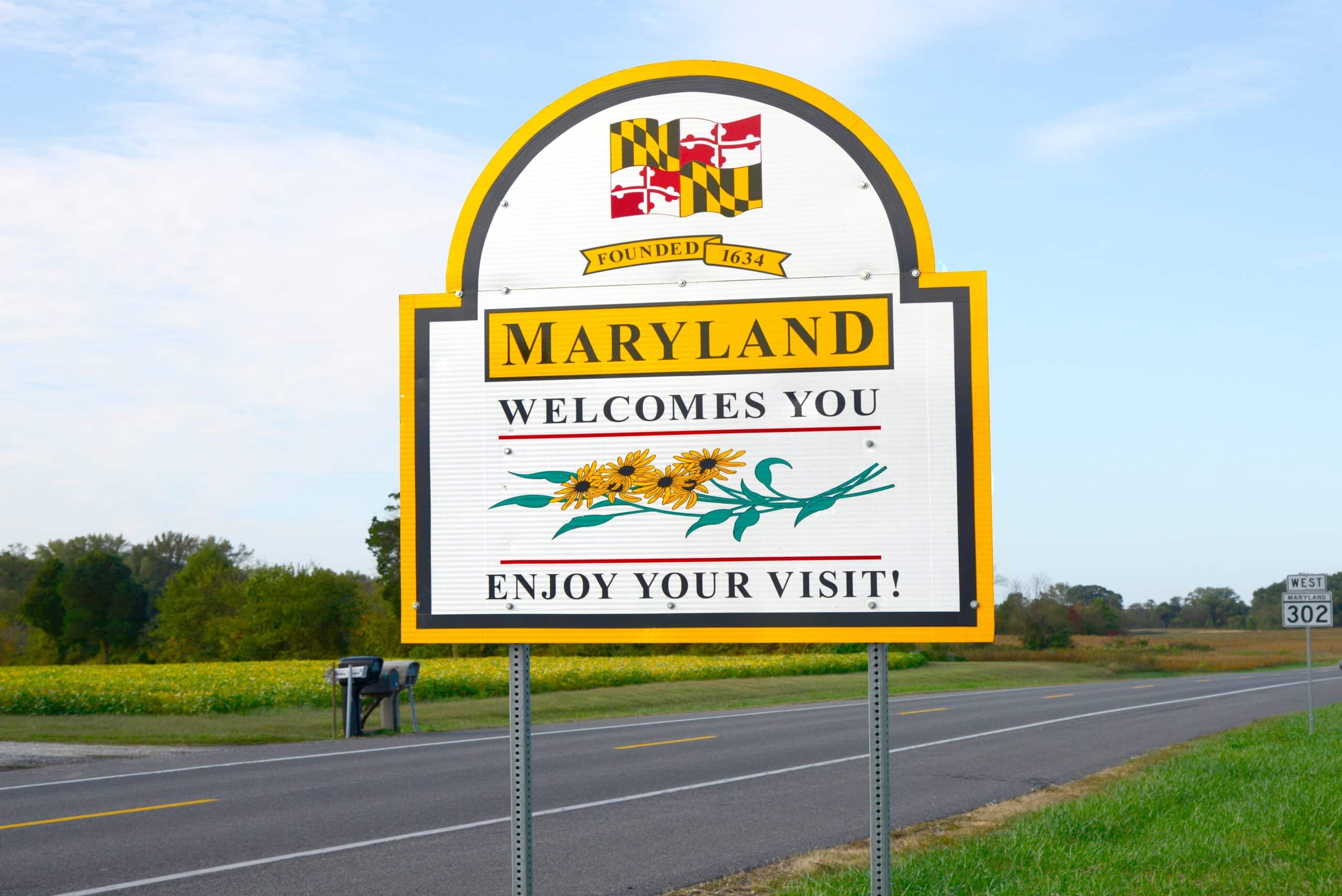
Maryland is a state defined by compression and contrast. Within a short distance, landscapes shift from Appalachian ridges to tidal marsh, from dense urban corridors to quiet agricultural valleys. This closeness produces a state that feels layered rather than expansive, shaped by boundaries, water, and movement.
Water is Maryland’s central organizing force. The Chesapeake Bay reaches deep into the state, fracturing land into peninsulas and shorelines while sustaining one of the most complex estuarine systems in North America. Rivers flow toward the bay from every direction, linking upland forests, farms, and cities into a single ecological network.
Maryland’s history is similarly compressed. Indigenous presence, colonial settlement, industry, and federal governance overlap within tight geography. Towns and cities often carry multiple identities at once—local, regional, and national—without fully separating them.
Urban areas anchor the center of the state, shaped by proximity to Washington, D.C., and long-standing port cities. Rural regions persist alongside them, maintaining agricultural and maritime traditions that resist erasure. Cultural life grows from coexistence rather than dominance.
Maryland rewards attention to transition. Its identity emerges not from singular landmarks, but from the constant negotiation between land and tide, city and field, movement and memory.
20. Chesapeake Bay
The Chesapeake Bay defines Maryland physically, economically, and culturally more than any other feature. As the largest estuary in the United States, it reaches deep into the state through rivers, creeks, and tidal inlets, dissolving the boundary between land and water.
Life around the bay is shaped by rhythm rather than permanence. Tides dictate movement, salinity shifts influence ecology, and weather patterns alter both labor and settlement. Communities along the bay have historically adapted to these conditions, developing livelihoods tied to fishing, shipping, and shoreline agriculture.
The bay fragments Maryland into peninsulas and coves, encouraging local identity while maintaining ecological unity. What appears divided on a map remains deeply interconnected through water flow and habitat.
Ecologically, the bay is complex and fragile. Its health reflects upstream land use, urban development, and climate patterns. Restoration efforts emphasize responsibility rather than control.
The Chesapeake Bay represents Maryland’s central truth: identity shaped by water, interdependence, and long-term adaptation.
19. Appalachian Plateau
Maryland’s western edge rises into the Appalachian Plateau, where ridges, forests, and narrow valleys create a sense of enclosure uncommon in the rest of the state. Elevation introduces distance, shadow, and slower movement.
The landscape is defined by restraint. Roads follow valleys, towns remain small, and forest cover dominates perception. Human presence adapts to terrain rather than reshaping it.
Historically, this region supported extraction and transport, embedding labor into both land and community identity. Remnants of these industries remain integrated into the landscape.
Seasonal change is pronounced. Winters emphasize isolation and structure, while summer restores density and sound.
The Appalachian Plateau anchors Maryland’s interior geography, offering depth, continuity, and a counterpoint to coastal flow.
18. Baltimore
Baltimore is a port city shaped by industry, migration, and resilience. Its relationship with water—through harbor, river, and bay—has defined both opportunity and challenge.
Neighborhoods reflect layered history rather than uniform planning. Rowhouses, industrial corridors, and waterfront infrastructure coexist closely, reinforcing connection between labor and daily life.
The city’s identity resists simplification. Cultural institutions, local networks, and enduring neighborhoods anchor civic life even amid change.
Baltimore’s port history ties it outward to global systems while remaining grounded in local experience.
Baltimore represents Maryland’s urban depth—complex, durable, and shaped by continuity as much as disruption.
17. Eastern Shore
The Eastern Shore stretches along the Chesapeake Bay’s eastern side, defined by flat land, open sky, and proximity to water. Agriculture and maritime tradition coexist closely, shaping daily rhythm.
Towns remain small and dispersed. Roads run straight across fields until interrupted by creeks and inlets, reinforcing the bay’s reach inland.
The landscape emphasizes horizontality. Light and weather dominate perception, and change occurs gradually.
Cultural life here values continuity and restraint. Adaptation happens quietly rather than visibly.
The Eastern Shore reflects Maryland’s enduring relationship between land, water, and patience.
16. Catoctin Mountains
The Catoctin Mountains rise gently in north-central Maryland, forming a wooded ridge that bridges coastal plain and upland interior. Their presence introduces elevation without severity.
Forests dominate the landscape, creating enclosure and quiet. Trails follow historic paths used for travel, labor, and settlement.
The mountains have long served as refuge and boundary. They separate regions while remaining permeable.
Seasonal change reshapes experience through light, foliage, and temperature.
The Catoctin Mountains represent Maryland’s inland balance—where transition feels natural and continuous.
15. Patapsco Valley
The Patapsco Valley cuts a wooded corridor between Baltimore and the Piedmont, offering depth and enclosure within a densely settled region. The river has shaped this landscape through erosion and industry, leaving steep slopes and narrow floodplains.
Historic mills once lined the riverbanks, embedding labor directly into terrain. Ruins and remnants remain integrated into forest and rock, emphasizing continuity rather than abandonment.
Trails follow the river’s curves, moving between shadowed ravines and open clearings. Sound, water, and elevation create immersion uncommon so close to urban centers.
The Patapsco Valley represents Maryland’s layered interior—where nature and industry remain inseparable.
14. Annapolis
Annapolis is defined by its intimate relationship with water. Situated where the Severn River meets the Chesapeake Bay, the city’s physical form, economy, and civic identity all orient toward the harbor.
As Maryland’s capital, Annapolis carries political significance disproportionate to its size. Government buildings, historic institutions, and residential streets coexist within a compact footprint, reinforcing continuity rather than separation.
Maritime presence is constant. The working harbor, sailboats, and the U.S. Naval Academy shape daily rhythm, sound, and movement. Water functions as both boundary and connective tissue.
Streets curve organically toward the shoreline, reflecting early settlement patterns rather than imposed grids. Historic buildings remain active participants in civic life rather than static artifacts.
Annapolis balances formality with intimacy. Governance, tradition, and daily routine intersect visibly.
The city represents Maryland’s civic identity anchored in water—where authority, history, and maritime culture remain inseparable.
13. Antietam National Battlefield
Antietam occupies rolling farmland shaped by ridges, creeks, and stone boundaries. The landscape appears pastoral and orderly, defined by fields and gentle elevation.
History here is embedded rather than monumental. The terrain itself records conflict through layout and contour, allowing memory to remain integrated into working land.
Quiet dominates the experience. Absence of urban intrusion reinforces reflection rather than spectacle.
The battlefield’s preservation maintains agricultural character, preventing separation between past and present use.
Antietam demonstrates how Maryland holds history within everyday landscape—layered, restrained, and enduring.
12. Montgomery County Agricultural Reserve
The Montgomery County Agricultural Reserve preserves thousands of acres of farmland within one of the nation’s most developed metropolitan regions. Fields, barns, and hedgerows persist amid suburban pressure.
The reserve represents deliberate planning. Agriculture remains active, not symbolic, reinforcing continuity of land use.
Open space here is functional rather than scenic. Seasonal work, soil management, and crop cycles define rhythm.
The reserve buffers development, protecting ecological and cultural systems simultaneously.
It reflects Maryland’s capacity for negotiated coexistence between growth and stewardship.
11. Deep Creek Lake
Deep Creek Lake lies in western Maryland’s highlands, surrounded by forested ridges and rolling elevation. The reservoir introduces openness within a region defined by enclosure.
Water anchors seasonal life. Summer emphasizes movement and recreation, while winter reshapes rhythm through snow, ice, and quiet.
Despite its recreational role, the lake remains integrated with surrounding land. Forest, water, and settlement maintain balance.
The landscape emphasizes retreat rather than spectacle.
Deep Creek Lake represents Maryland’s upland interior—where seasonality and space redefine pace.
10. Assateague Island
Assateague Island stretches along Maryland’s Atlantic edge as a narrow barrier between ocean and bay. Its landscape is defined by motion rather than stability, shaped continuously by wind, tide, and shifting sand.
Dunes rise and fall, grasses migrate, and shorelines redraw themselves seasonally. The island absorbs storms rather than resists them, demonstrating resilience through flexibility. Human infrastructure remains minimal and adaptive, acknowledging impermanence rather than denying it.
Wildlife presence is immediate. Birds, marine life, and the island’s well-known wild horses reinforce a sense of shared terrain rather than dominance. Movement across the island feels provisional, guided by weather and light.
The experience emphasizes exposure. Sky and water dominate perception, and sound travels unbroken. Isolation here is spatial rather than emotional, grounded in elemental surroundings.
Assateague Island represents Maryland’s most dynamic boundary—where land survives by yielding to natural force rather than opposing it.
9. Potomac River Gorge
The Potomac River Gorge cuts a compressed and dramatic corridor along Maryland’s southern edge. Here, fast-moving water presses tightly against steep rock and forested slopes, creating enclosure and intensity uncommon so close to urban centers.
Movement through the gorge follows the river’s urgency. Trails cling to cliffs, revealing sudden views and abrupt drops. Sound is constant—water rushing, wind moving through narrow space.
The gorge feels transitional. It marks the shift from upland interior to coastal plain, both geologically and visually. Vegetation changes quickly with slope and exposure.
Despite proximity to development, the gorge maintains wild character. Human presence adapts to terrain rather than reshaping it.
The Potomac Gorge reflects Maryland’s tension between compression and wildness—where natural force persists amid density.
8. Frederick
Frederick is a city shaped by crossroads, agriculture, and measured growth. Located where valleys open toward the Piedmont, it has long served as a point of exchange between regions.
Its downtown reflects layered use rather than singular planning. Historic streets, civic buildings, and modern life coexist closely, reinforcing continuity over reinvention.
Surrounding farmland and nearby ridges remain visible, grounding the city in its agricultural context. Growth has expanded outward without erasing internal coherence.
Cultural life here emphasizes participation and preservation in balance. Change is absorbed gradually.
Frederick represents Maryland’s interior civic stability—adaptive, grounded, and regionally connected.
7. Blackwater National Wildlife Refuge
Blackwater National Wildlife Refuge preserves tidal marsh along the eastern edge of the Chesapeake Bay. The landscape is defined by water, grass, and sky, with little vertical interruption.
Marsh channels shift with tide and season, creating constant variation. The land feels provisional, expanding and retreating as water levels change.
The refuge supports significant wildlife migration, reinforcing the bay’s role as ecological corridor. Human presence remains restrained and observational.
Climate change and erosion are visible realities here, emphasizing vulnerability rather than permanence.
Blackwater reflects Maryland’s fragile coastal systems—valuable precisely because of their exposure and adaptability.
6. St. Michaels
St. Michaels is a small Chesapeake Bay town shaped by maritime trade, fishing, and boatbuilding. Water defines orientation, economy, and daily rhythm.
The town’s scale encourages cohesion. Working waterfront, residential streets, and public spaces remain closely linked. Boats, docks, and tidal movement remain part of everyday life.
Historical continuity is visible but not frozen. Maritime traditions adapt to changing conditions without losing relevance.
The bay functions as workplace as much as backdrop, reinforcing lived relationship rather than abstraction.
St. Michaels represents Maryland’s lived bay culture—intimate, functional, and deeply rooted in water.
5. Calvert Cliffs
Calvert Cliffs rise sharply along the western shore of the Chesapeake Bay, forming one of Maryland’s most striking geological features. Unlike much of the state’s low, horizontal coastline, the cliffs introduce sudden vertical exposure at the water’s edge.
Their pale, layered faces reveal millions of years of sediment, preserving a visible record of prehistoric seas, shifting climates, and long-term erosion. Fossils embedded in the cliffs connect present-day Maryland to ancient marine environments, making deep time tangible rather than abstract.
Erosion is constant and unavoidable. Waves undercut the base of the cliffs, sections collapse, and new material is exposed. This process reinforces impermanence as a defining condition. The landscape here is not preserved in a fixed state; it is actively reshaping itself.
Public access is intentionally limited. Trails and viewing areas emphasize observation rather than extraction, reinforcing respect for fragility and scientific value. The cliffs demand restraint rather than conquest.
The contrast between the calm surface of the bay and the unstable land above heightens awareness of time and scale.
Calvert Cliffs represent Maryland’s geological memory—where water, erosion, and time converge visibly and continuously.
4. Gunpowder Falls State Park
Gunpowder Falls State Park preserves a broad river corridor northeast of Baltimore, protecting forest, wetlands, and flowing water within a heavily developed region. Its size and continuity allow ecological processes to function with minimal interruption.
The Gunpowder River winds through varied terrain, carving floodplains, rocky bends, and shaded pools. Trails follow the river’s movement, reinforcing awareness of slope, water level, and seasonal change.
The park operates as more than recreational space. It serves as wildlife habitat, flood buffer, and green infrastructure for surrounding communities. Its existence reflects long-term planning rather than accident.
Human presence here adapts to the river’s rhythms. High water reshapes access and sound; dry seasons reveal structure beneath flow.
The park demonstrates how natural systems persist through deliberate stewardship rather than isolation.
Gunpowder Falls represents Maryland’s managed landscapes—where preservation is active, negotiated, and ongoing.
3. Ellicott City
Ellicott City is a historic mill town built tightly along the Patapsco River, where steep slopes and narrow valleys dictated settlement form. Stone buildings and narrow streets conform closely to terrain.
The town’s industrial origins remain visible in architecture, bridges, and river alignment. Water once powered mills, embedding labor directly into landscape and daily life.
Recent flooding has reshaped Ellicott City’s identity. Repeated disasters revealed vulnerability while strengthening collective resolve. Responses have emphasized adaptation and mitigation rather than abandonment.
The compact historic core encourages continuity between past and present. Restoration efforts focus on reinforcement rather than replacement.
Ellicott City illustrates Maryland’s ongoing negotiation with risk, memory, and resilience.
2. Kent Island
Kent Island sits at the northern reach of the Chesapeake Bay, marking transition between river systems and open estuary. Its location has long positioned it as a gateway between inland waters and the broader bay.
The island blends residential growth with enduring maritime identity. Fishing, boating, and shoreline activity remain part of everyday life, even as development increases.
Water continues to shape orientation and movement. Views across the bay emphasize openness and exposure, while tidal patterns define shoreline use.
Change here is negotiated rather than resisted. Growth adapts to environmental constraints.
Kent Island represents Maryland’s evolving bay edge—where continuity persists amid transformation.
1. Susquehanna River Mouth
The Susquehanna River enters the Chesapeake Bay at Maryland’s northern boundary, carrying water, sediment, and ecological influence from far beyond the state. Its broad flow represents connection across regions and landscapes.
At its mouth, the river slows and spreads, dispersing energy into tidal waters. This interaction shapes salinity, habitat, and sediment patterns throughout the upper bay.
The scale here is expansive. What appears local is shaped by distant land use, weather, and infrastructure hundreds of miles upstream.
This convergence reinforces Maryland’s role within larger hydrological and ecological systems.
The Susquehanna River Mouth represents integration—where inland systems meet tidal waters and continuity extends beyond borders.