
Bolivia is a country defined by altitude, enclosure, and internal contrast. Lacking direct access to the sea, it compensates with extraordinary geographic diversity compressed into a landlocked frame. From the high Andean plateau to Amazonian lowlands, Bolivia’s landscapes shape settlement, economy, and identity more decisively than political boundaries.
The Andes divide the country into distinct ecological zones. The western highlands host dense urban centers adapted to altitude, while the eastern lowlands stretch outward into sparsely populated plains and forests. This vertical geography creates parallel Bolivias operating under different environmental rules.
Rivers flow outward toward distant oceans, reinforcing Bolivia’s dependence on neighbors for trade routes. Internal transportation reflects this challenge, with mountain passes and long lowland distances limiting integration.
Culturally and historically, Bolivia reflects Indigenous continuity more strongly than most South American nations. Geography preserved languages, land systems, and social structures through isolation and elevation.
Bolivia is best understood not as a single landscape but as a vertical country, stacked rather than spread.
19. La Paz
La Paz is the world’s highest de facto capital, situated at approximately 3,600 meters above sea level within a steep canyon carved into the Andean plateau. Its geography defines nearly every aspect of urban life, from climate and infrastructure to social organization. Unlike cities built on flat terrain, La Paz descends dramatically from the Altiplano into a deep valley, producing a vertical city shaped by slope and elevation.
The city’s upper edges meet the plateau near El Alto, where colder temperatures and flatter land contrast with the denser, warmer neighborhoods below. This vertical arrangement produces distinct microclimates and influences patterns of residence, mobility, and economic activity. Wealthier districts often occupy lower elevations with more stable conditions, while higher areas experience harsher weather and thinner air.
La Paz developed primarily as an administrative and commercial center rather than an industrial hub. Government institutions, financial services, and dense informal markets drive the economy. Street commerce integrates seamlessly into the urban fabric, reflecting adaptation to limited space and steep terrain.
Transportation infrastructure responds creatively to geography. The extensive cable car system functions as mass transit, linking elevation zones efficiently where traditional rail or road systems would struggle. These aerial lines reshape daily movement and reinforce spatial integration.
Despite its constraints, La Paz maintains a strong cultural presence rooted in Indigenous traditions and political history. Festivals, markets, and civic spaces occupy slopes and plazas alike.
La Paz represents Bolivia’s highland intensity: compressed, elevated, and inseparable from its terrain.
18. El Alto
El Alto occupies the flat expanse of the Altiplano directly above La Paz, forming one of Bolivia’s most distinctive urban environments. Sitting at over 4,000 meters above sea level, the city experiences extreme altitude, cold temperatures, and intense sunlight. Its geography contrasts sharply with the canyon city below.
Originally a peripheral settlement, El Alto expanded rapidly through rural migration from highland regions. Growth occurred largely through self-built neighborhoods, producing a city characterized by grid layouts, wide streets, and strong communal organization. The flat terrain allowed horizontal expansion rather than vertical density.
Economic activity in El Alto centers on manufacturing, transport logistics, and trade. Large markets function as regional distribution points connecting rural producers with urban consumers. Informal economies coexist with industrial workshops and warehouses.
The city’s exposed position subjects it to strong winds and colder nights, shaping construction practices and daily routines. Buildings emphasize practicality and insulation over ornament.
Social organization plays a critical role in urban life. Neighborhood councils and trade associations exert influence, reflecting traditions of collective governance.
El Alto represents Bolivia’s plateau urbanism: expansive, resilient, and socially driven by altitude and openness.
17. Lake Titicaca
Lake Titicaca lies along Bolivia’s western frontier at nearly 3,800 meters above sea level, forming the highest navigable lake in the world. Its presence introduces water, moderation, and life to the otherwise austere Altiplano.
The lake’s vast surface tempers temperature extremes, creating microclimates that support agriculture and permanent settlement. Communities along its shores rely on fishing, small-scale farming, and reed-based technologies developed over centuries.
Terraced fields extend from the water’s edge, maximizing arable land while controlling erosion. Traditional crops thrive under conditions shaped by the lake’s thermal influence.
Beyond its ecological role, Lake Titicaca holds deep cultural significance. It occupies a central place in Andean cosmology and Indigenous history, reinforcing continuity across generations.
Transportation across the lake connects dispersed settlements and maintains regional cohesion.
Lake Titicaca anchors Bolivia’s western highlands with water, history, and environmental stability.
16. The Altiplano
The Altiplano is a vast high-elevation plateau spanning western Bolivia, enclosed by Andean mountain ranges. Its elevation averages around 3,800 meters, producing thin air, intense solar radiation, and limited precipitation.
Life on the Altiplano adapts to environmental constraint. Agriculture depends on hardy crops such as quinoa and potatoes, supported by precise seasonal timing. Pastoralism complements farming through llama and alpaca herding.
Settlements are widely spaced, reflecting limited water availability and soil fertility. Villages cluster near lakes, wetlands, and seasonal streams.
The Altiplano forms Bolivia’s demographic and cultural core, sustaining Indigenous languages, traditions, and social systems shaped by long-term isolation.
Despite harsh conditions, the plateau supports continuity rather than abandonment.
The Altiplano defines Bolivia’s highland identity through endurance and adaptation.
15. Salar de Uyuni
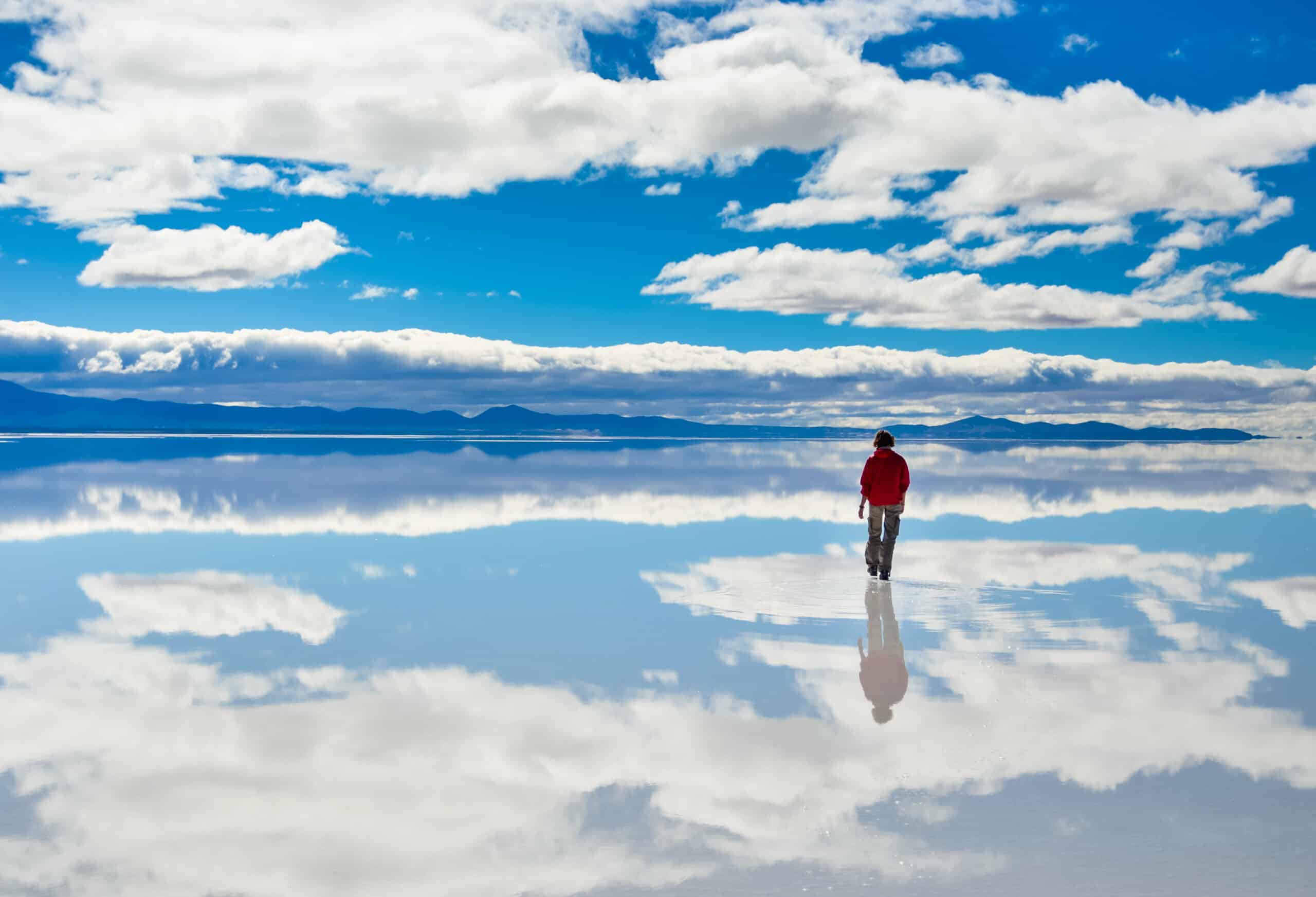
The Salar de Uyuni occupies a vast prehistoric lakebed in southwestern Bolivia, forming the largest salt flat on Earth. Its surface extends uninterrupted for more than 10,000 square kilometers, creating a landscape defined by scale and uniformity.
During the dry season, thick salt crusts fracture into geometric patterns. In the wet season, a thin layer of water transforms the surface into a reflective plane, erasing the horizon.
Beneath the salt lies one of the world’s largest lithium reserves, positioning the Salar within global energy and resource discussions. Extraction potential contrasts sharply with environmental fragility.
The region’s isolation limits permanent settlement. Infrastructure is minimal, and access remains challenging.
The Salar functions as both geological archive and strategic resource.
Salar de Uyuni represents Bolivia’s extreme geography: vast, silent, and globally significant.
14. Cochabamba Valley
The Cochabamba Valley occupies a central position between Bolivia’s highlands and lowland regions, forming a broad, fertile basin surrounded by mountains. Its lower elevation compared to the Altiplano produces a milder climate, making it one of the country’s most agriculturally productive areas.
The valley supports diverse crops, benefiting from relatively stable temperatures and seasonal rainfall. Agriculture has long shaped settlement patterns, with towns and infrastructure concentrated on arable land.
Cochabamba city functions as a regional hub, connecting highland and lowland trade routes. The valley’s geography encourages internal migration and economic exchange.
Water management remains central, as population growth strains traditional systems.
The Cochabamba Valley represents Bolivia’s agricultural middle ground, balancing altitude and productivity.
13. Santa Cruz de la Sierra
Santa Cruz de la Sierra lies in Bolivia’s eastern lowlands, far from the Andean core. Its location within tropical plains marks a sharp geographic and cultural contrast to highland cities.
Flat terrain and warmer climate support agriculture, cattle ranching, and agro-industry. Rapid urban growth transformed Santa Cruz into Bolivia’s largest economic center.
Road networks extend outward, reinforcing regional autonomy and trade connections with neighboring countries.
The city’s expansion reflects lowland opportunity and demographic momentum.
Santa Cruz represents Bolivia’s outward-facing, lowland engine of growth.
12. The Bolivian Amazon
The Bolivian Amazon occupies the northern half of the country, forming part of the greater Amazon Basin and covering vast lowland territories characterized by dense tropical rainforest, meandering rivers, and seasonal wetlands. This region is defined by hot temperatures, high humidity, and heavy rainfall, creating one of Bolivia’s most ecologically rich and least densely populated areas. Elevations are generally low, rarely exceeding 400 meters, allowing rivers to dominate both landscape formation and human activity.
Major river systems such as the Beni, Madre de Dios, and Mamoré shape the region’s hydrology, acting as transportation corridors and sources of food and water. During the rainy season, rivers overflow into floodplains and forests, sustaining fish populations and replenishing soils. These seasonal cycles support remarkable biodiversity, including jaguars, pink river dolphins, macaws, primates, and thousands of plant species.
Indigenous communities such as the Tacana, Tsimané, and Mosetén have inhabited the Bolivian Amazon for centuries, practicing fishing, hunting, and shifting cultivation adapted to forest and river dynamics. Their ecological knowledge plays a crucial role in sustainable land management and conservation. Small-scale agriculture focuses on cassava, plantains, rice, and cacao, while forest products such as Brazil nuts contribute to local economies.
Environmental pressures include deforestation, illegal mining, road expansion, and climate change, which threaten ecosystems and traditional livelihoods. Protected areas and Indigenous territories form the backbone of conservation efforts, helping preserve biodiversity and cultural heritage. The Bolivian Amazon is essential not only to Bolivia’s environmental health but also to global climate regulation, highlighting the importance of balancing development with long-term ecological stewardship.
11. The Beni Floodplains
The Beni Floodplains form one of Bolivia’s most distinctive and ecologically dynamic landscapes, stretching across the department of Beni in the country’s northeast. This vast lowland region is shaped by seasonal flooding from rivers such as the Beni, Mamoré, and Iténez, which transform the plains into extensive wetlands during the rainy season. Water levels can rise dramatically, creating a mosaic of flooded grasslands, lagoons, gallery forests, and river channels.
These flood cycles are central to the region’s productivity. Nutrient-rich sediments deposited during floods sustain natural pastures and wetlands, making the Beni Floodplains ideal for extensive cattle ranching, the dominant economic activity. Ranching practices have traditionally adapted to seasonal rhythms, with livestock moved to higher ground during peak flooding. Fishing also plays a significant role, providing food and income for local communities.
Ecologically, the floodplains support extraordinary biodiversity. Aquatic and semi-aquatic species thrive, including caimans, capybaras, river dolphins, and hundreds of bird species, many of which migrate seasonally. Forest islands, known locally as “islas,” provide refuges for wildlife during floods and support unique plant communities.
Human settlement is sparse and largely rural, concentrated on natural levees and elevated areas. Indigenous groups and mestizo populations coexist with ranching economies, maintaining livelihoods closely tied to water cycles. Environmental challenges include land conversion, altered flood regimes, and climate variability. Conservation initiatives focus on preserving wetlands, maintaining natural hydrological processes, and promoting sustainable ranching. The Beni Floodplains exemplify how seasonal flooding can sustain both biodiversity and human economies when ecological rhythms are respected.
10. Yungas Region
The Yungas form a transitional zone between the Andes and Amazon basin, characterized by steep slopes and humid climate.
Dense vegetation supports coffee, coca, and fruit cultivation.
Roads traverse dramatic terrain, linking highlands to lowlands.
The Yungas illustrate Bolivia’s vertical ecological transition.
9. Sucre
Sucre occupies a unique position in Bolivia as the constitutional capital and a city shaped by elevation, history, and relative calm. Located at approximately 2,800 meters above sea level, it sits lower than La Paz, benefiting from a milder and more stable climate. This geographic moderation has long influenced its role as an administrative and cultural center rather than an economic engine.
The city’s setting within rolling highland terrain allowed for more regular urban planning. White colonial architecture, broad streets, and open plazas reflect Spanish influence adapted to Andean conditions. Unlike canyon-bound La Paz, Sucre expands gently outward, reinforcing a sense of spatial balance.
Sucre’s economy centers on governance, education, and legal institutions. Universities and courts shape daily rhythms, attracting students and professionals from across the country. This institutional presence sustains the city without driving rapid expansion.
Culturally, Sucre preserves strong ties to Bolivia’s colonial and republican history while remaining embedded within Indigenous highland traditions. Surrounding rural areas maintain agricultural practices tied to altitude and seasonal cycles.
Sucre represents Bolivia’s measured center: elevated but accessible, historical yet stable.
8. Potosí
Potosí stands at over 4,000 meters above sea level, making it one of the highest cities of its size in the world. Its extreme elevation defines both its physical challenges and historical importance.
The city developed around Cerro Rico, a mountain once rich in silver deposits that fueled Spanish colonial wealth. Mining shaped urban form, labor systems, and global economic flows.
Steep slopes, cold temperatures, and thin air constrain daily life. Infrastructure adapts to elevation, with compact neighborhoods clustered near historic mining zones.
Although silver production has declined, mining remains symbolically and economically significant. The city’s identity is inseparable from extraction and endurance.
Potosí represents Bolivia’s mineral core: elevated, exhausted, yet historically central.
7. Tarija Valley
The Tarija Valley lies in southern Bolivia near the borders with Argentina and Paraguay. At lower elevation than the Altiplano, it experiences a warmer and more temperate climate.
The valley’s fertile soils support vineyards, orchards, and diversified agriculture uncommon elsewhere in the country. Wine production distinguishes Tarija economically and culturally.
Settlement patterns follow river courses and arable land, producing a dispersed but productive landscape. Urban growth remains modest compared to eastern lowlands.
Cultural influences reflect cross-border exchange, visible in architecture, cuisine, and social rhythms.
Tarija represents Bolivia’s southern moderation: productive, temperate, and outward-looking.
6. Oruro
Oruro occupies the Altiplano between La Paz and Potosí, positioned along historic trade and mining routes. Its high elevation produces cold temperatures and a stark landscape.
The city emerged as a mining and transport center, linking mineral zones to markets. Flat surrounding terrain allowed linear expansion.
Economic activity declined with mining contraction, yet cultural traditions remain strong. Festivals draw national attention and reinforce identity.
Oruro represents continuity on the plateau, sustained by culture despite economic fluctuation.
5. Chiquitania Region
The Chiquitania region lies in eastern Bolivia between the Andes and Amazon basin. Its dry tropical forests and savanna landscapes differ from both rainforest and highland ecosystems.
Jesuit missions established settlements that persist today, blending Indigenous organization with European planning.
Agriculture and cattle ranching shape land use, supported by seasonal rainfall.
The region balances ecological sensitivity with development pressure.
Chiquitania represents Bolivia’s eastern cultural landscape, shaped by forest, mission history, and transition.
4. Madidi National Park
Madidi National Park occupies a vast area of northwestern Bolivia, spanning dramatic elevation changes from high Andean peaks to Amazonian lowlands. This vertical range produces one of the highest levels of biodiversity on Earth.
Steep mountains descend rapidly into humid forest, creating overlapping ecosystems within short distances. Climate shifts sharply with altitude, shaping vegetation, wildlife, and human access.
Settlement inside the park is minimal, limited mainly to Indigenous communities whose livelihoods depend on forest resources and river systems. Transportation relies on waterways and narrow trails rather than roads.
Madidi’s remoteness limits large-scale extraction, allowing ecological processes to function with limited disruption. Conservation efforts focus on balancing protection with Indigenous land rights.
The park illustrates Bolivia’s ecological continuity, linking mountains to rainforest.
Madidi National Park represents the country’s greatest biological concentration, shaped by vertical geography.
3. Apolobamba Range
The Apolobamba Range forms a rugged Andean corridor along Bolivia’s northern border. High peaks, glaciers, and deep valleys define this remote mountain region.
Extreme elevation limits agriculture, favoring pastoralism and seasonal movement. Communities rely on llamas and alpacas, adapting to cold temperatures and steep terrain.
Isolation preserves traditional land-use practices and cultural continuity. Infrastructure remains minimal, reinforcing environmental constraint.
The range also serves as a hydrological source for rivers flowing toward the Amazon basin.
Apolobamba represents Bolivia’s northern highland margin, shaped by altitude and remoteness.
2. Chapare Region
The Chapare region lies between the Andes and Amazon basin, forming a humid lowland corridor marked by dense vegetation and heavy rainfall.
Steep slopes flatten into tropical plains, supporting agriculture that differs sharply from highland systems. Crops include coca, fruits, and staple foods adapted to moisture-rich soils.
Settlement expanded rapidly with migration from the highlands, producing dispersed towns connected by roads vulnerable to weather.
The region’s climate challenges infrastructure while sustaining high biological productivity.
Chapare represents Bolivia’s humid agricultural frontier.
1. Pantanal Fringe
Bolivia’s southeastern Pantanal fringe connects the country to one of the world’s largest wetland systems. Seasonal flooding defines land use and ecology.
Grasslands alternate with shallow water, supporting cattle ranching adapted to inundation cycles. Wildlife thrives under minimal urban pressure.
Human settlement concentrates on higher ground, following flood rhythms rather than resisting them.
The Pantanal fringe highlights Bolivia’s role within continental wetland systems.