
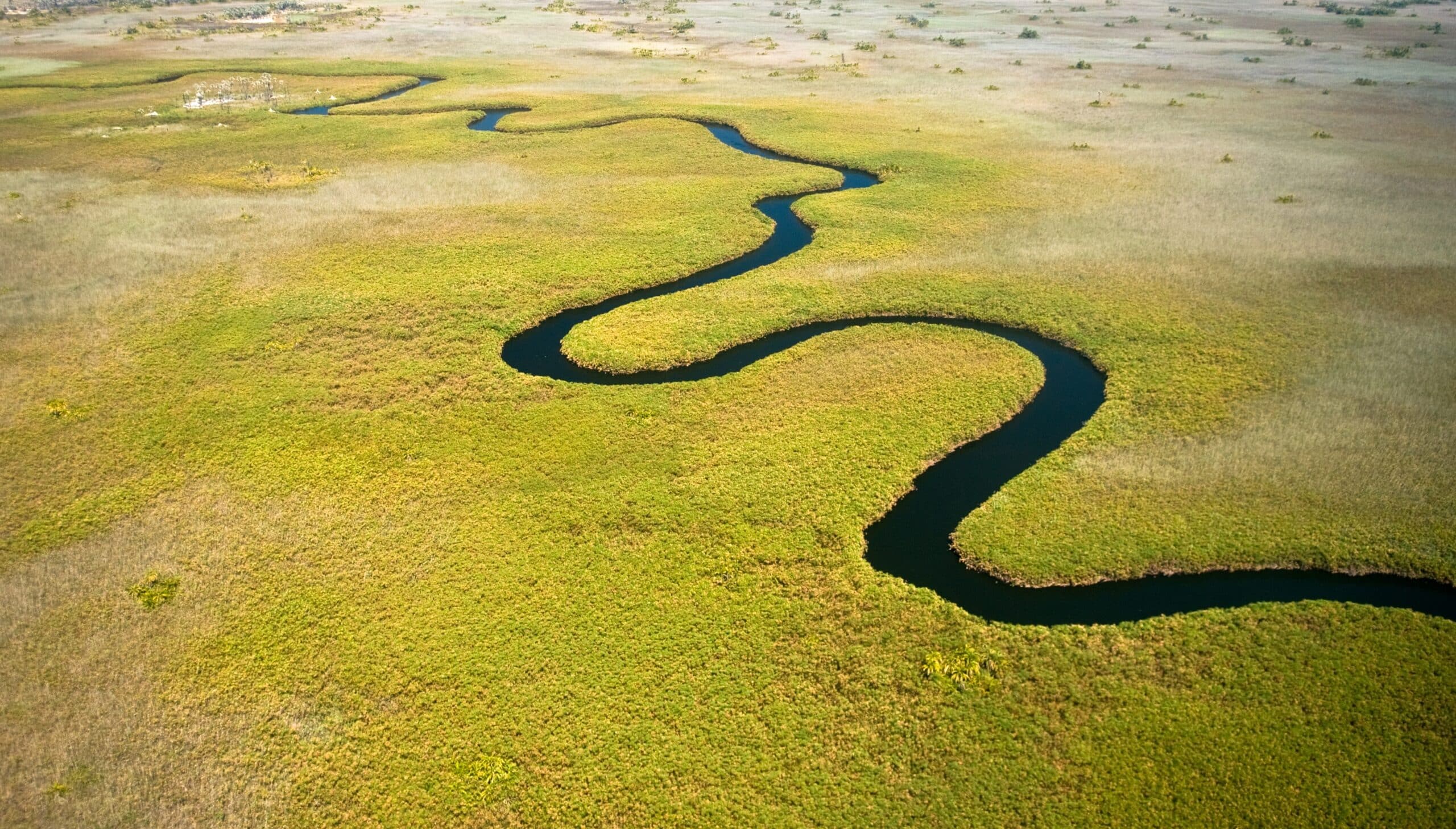
Botswana is a country defined by restraint, patience, and respect for space. Situated at the heart of southern Africa, it is shaped less by density than by deliberate openness. Here, wilderness is not compressed or curated for spectacle; it is protected through distance, silence, and time. Botswana’s landscapes unfold gradually, revealing depth rather than drama.
Much of the country rests within the Kalahari Basin, a vast geological depression that gives rise to deserts, savannahs, and seasonal wetlands. Water is rare and precious, yet where it appears, it transforms everything. Rivers that vanish into sand, floodplains that bloom unpredictably, and deltas that defy gravity define Botswana’s ecological identity. These systems sustain some of Africa’s most intact wildlife populations.
Botswana’s conservation philosophy is central to its character. Low-impact tourism, large protected areas, and strong governance have allowed ecosystems to function with minimal disruption. Animals move freely across immense distances, following ancient routes shaped by instinct and season. Human presence remains measured, reinforcing coexistence rather than dominance.
Culturally, Botswana reflects stability and continuity. Communities are grounded in tradition, consensus, and shared responsibility. The legacy of the Tswana kingdoms, combined with peaceful post-independence development, has shaped a national identity rooted in dialogue and foresight. Modern Botswana balances progress with preservation, embracing education and infrastructure without sacrificing environmental integrity.
To travel through Botswana is to experience Africa in equilibrium. It is a country that trusts natural processes, values silence, and understands that abundance is sustained through care.
10. Okavango Delta: A Miracle of Water and Sand
The Okavango Delta spreads across northern Botswana as one of the world’s most extraordinary ecosystems. Formed by rivers that never reach the sea, it is an inland delta where water disappears into desert, creating life against expectation.
Each year, floodwaters arrive from distant highlands, slowly filling channels, lagoons, and islands. This delayed rhythm governs the delta’s ecology, drawing wildlife into its embrace during the dry season when surrounding lands harden. Elephants, antelope, predators, and birds converge in remarkable density without losing freedom of movement.
The delta is experienced quietly. Traditional mokoro canoes glide through reed-lined waterways, guided by local expertise and deep environmental knowledge. Movement here emphasizes observation rather than intrusion, allowing encounters shaped by trust and proximity.
Islands rise gently from the floodplain, supporting palms, fig trees, and termite mounds that anchor life above water. Each shift in flood level redraws the landscape, reinforcing impermanence as stability.
The Okavango Delta represents Botswana’s philosophy in physical form. It shows how protection, patience, and respect allow complexity to flourish. This is wilderness sustained not by control, but by allowance—an ecosystem alive precisely because it is left to breathe.
9. Chobe National Park: Where Giants Gather
Chobe National Park occupies Botswana’s northeastern corner, anchored by the Chobe River and renowned for one of the largest elephant populations in Africa. Here, water concentrates life along a narrow corridor, creating scenes of daily interaction shaped by necessity.
During the dry season, animals migrate toward the river’s banks, transforming the shoreline into a living procession. Elephants dominate the landscape, moving in family groups, shaping vegetation, and reinforcing ancient pathways. Buffalo, antelope, predators, and birds gather alongside them, drawn by survival rather than spectacle.
Boat safaris reveal Chobe from the river itself, offering perspective defined by flow and distance. Wildlife encounters unfold calmly, without pursuit, allowing behavior to remain natural and unhurried.
Beyond the river, the park opens into woodland and floodplain, sustaining diversity across seasons. Despite its popularity, Chobe’s scale absorbs presence, maintaining ecological balance.
Chobe reflects Botswana’s strength through concentration without confinement. It demonstrates how wildlife thrives when access to resources remains uninterrupted. The park stands as a testament to abundance guided by protection rather than pressure.
8. Moremi Game Reserve: Balance Within the Delta
Moremi Game Reserve lies at the eastern edge of the Okavango Delta, protecting a mosaic of floodplains, forests, and savannahs. It is one of Botswana’s most biologically rich areas, defined by variation rather than vastness.
Seasonal change reshapes the reserve constantly. Floodwaters expand and retreat, altering movement and visibility. This fluidity supports diverse species, from large predators to rare birds and aquatic life.
Moremi’s conservation history is notable. It was established through local initiative, reflecting Botswana’s community-driven approach to protection. This legacy continues through careful management and low-impact access.
The reserve’s terrain encourages attentiveness. Narrow tracks, water crossings, and shifting ground reinforce immersion, placing visitors within the ecosystem rather than above it.
Moremi embodies Botswana’s concept of balance. It reveals how diversity thrives when space is protected, access is limited, and stewardship is shared. Within this reserve, the delta’s complexity finds both sanctuary and expression.
7. Central Kalahari Game Reserve: The Power of Emptiness
The Central Kalahari Game Reserve stretches across the heart of Botswana as one of the largest protected areas on Earth. Vast, austere, and uncompromising, it is a landscape defined not by what it contains, but by what it withholds.
Endless grasslands, fossil river valleys, and open skies create an environment where distance itself becomes a feature. Wildlife survives here through deep adaptation. Antelope, predators, and birds move with precision, responding to seasonal rainfall and subtle environmental cues.
The Kalahari’s beauty lies in restraint. Encounters are infrequent yet meaningful, shaped by patience rather than predictability. Silence dominates, broken only by wind or distant movement.
This region is also home to San communities whose knowledge of the desert spans millennia. Their understanding of water, tracking, and survival reflects coexistence rather than conquest, offering insight into humanity’s earliest relationship with land.
The Central Kalahari reveals Botswana’s philosophical core. It teaches that wilderness does not require abundance to be powerful. Here, emptiness becomes presence, and survival becomes wisdom carried quietly across generations.
6. Makgadikgadi Pans: Horizons Without Edges
The Makgadikgadi Pans spread across northeastern Botswana as vast salt flats, remnants of an ancient super-lake that once dominated the region. Today, the pans form one of the most visually arresting landscapes in Africa.
During the dry season, the earth hardens into blinding white expanses that stretch endlessly toward the horizon. Distance becomes abstract, and scale dissolves into sky. This apparent barrenness is deceptive.
With the arrival of seasonal rains, transformation occurs. Shallow water returns, grasses emerge, and life floods back. Zebras and wildebeest migrate across the plains, followed by predators and birds drawn to sudden abundance.
The pans support flamingos, antelope, and rare desert-adapted species, thriving within cycles of disappearance and renewal.
Makgadikgadi reflects impermanence as strength. It shows how life persists through rhythm rather than permanence. The pans offer Botswana at its most elemental—a place where land remembers water, and absence becomes the stage for return.
5. Nxai Pan National Park: Grasslands of Return
Nxai Pan National Park lies east of the Makgadikgadi system as a smaller yet deeply expressive landscape. Its open grasslands and fossil pans support seasonal migrations and concentrated wildlife activity.
Rainfall transforms Nxai Pan into a green expanse, attracting zebras, springbok, and predators in dynamic movement. The park’s isolation preserves calm, allowing natural behavior to unfold without interruption.
Baobab trees punctuate the horizon, anchoring the land visually and symbolically. These ancient giants serve as markers of time and resilience, standing unchanged as cycles repeat around them.
Nxai Pan embodies Botswana’s rhythm. It demonstrates how ecosystems awaken, flourish, and recede in predictable harmony. The park’s power lies not in scale, but in its faithful response to seasonal return.
4. Tsodilo Hills: Sacred Stone and Memory
The Tsodilo Hills rise abruptly from the Kalahari sands in northwestern Botswana, forming a cluster of rocky outcrops revered as sacred for thousands of years. Known as the “Mountains of the Gods,” they hold deep spiritual and cultural significance.
Rock art sites scattered across the hills record human presence stretching back tens of thousands of years. These images—animals, symbols, and figures—represent belief systems, survival, and connection to the land.
The hills are not climbed casually. Movement here is contemplative, shaped by reverence rather than exploration. The surrounding silence reinforces the sense of sanctity.
Tsodilo connects Botswana’s landscapes to human memory. It reveals that wilderness is not empty, but storied—holding meaning beyond ecology. The hills stand as guardians of time, completing Botswana’s narrative with spirituality and depth.
3. Gaborone: A Capital Built on Calm Confidence
Gaborone sits along Botswana’s southeastern edge as a capital shaped by intention rather than excess. Unlike many rapidly expanding African cities, it grew through careful planning, reflecting the country’s broader philosophy of balance and foresight.
The city functions efficiently, with wide avenues, civic buildings, universities, and residential areas integrated into a landscape that still feels open. Hills and savannah remain visible, reinforcing connection to land even within urban space.
Gaborone’s identity is rooted in people rather than spectacle. Government institutions, education, and entrepreneurship drive daily life, while markets, cafés, and music scenes reveal a youthful, evolving culture. Progress here feels measured, not rushed.
Social cohesion remains strong. Community, dialogue, and mutual respect underpin interaction, mirroring national values of consensus and stability.
Gaborone represents Botswana’s modern expression. It shows how governance, growth, and cultural continuity can coexist without sacrificing calm. The city reflects a nation confident enough to advance quietly, guided by principle rather than pressure.
2. Maun: Gateway to the Delta
Maun lies at the edge of the Okavango Delta, serving as both logistical hub and cultural crossroads. What began as a small settlement has grown into a vibrant town shaped by movement between wilderness and community.
Tourism and conservation intersect here, creating livelihoods while reinforcing environmental stewardship. Airstrips, workshops, and markets coexist with traditional villages and grazing lands.
Despite its role as gateway, Maun retains an informal, grounded character. Daily life unfolds around trade, transport, and social exchange, maintaining authenticity amid global connection.
Maun embodies Botswana’s interface with the world. It demonstrates how access to wilderness can be managed without overwhelming it, preserving both place and purpose.
1. Serowe: Legacy of Leadership
Serowe stands as one of Botswana’s most historically significant towns, deeply associated with leadership, identity, and national vision. It was here that traditional authority and modern governance found early alignment.
The town reflects continuity. Cultural institutions, community spaces, and heritage sites preserve memory while supporting contemporary life. Education and dialogue remain central, reinforcing values of responsibility and service.
Serowe illustrates Botswana’s political maturity. It shows how leadership grounded in tradition can guide a modern nation without domination or spectacle.